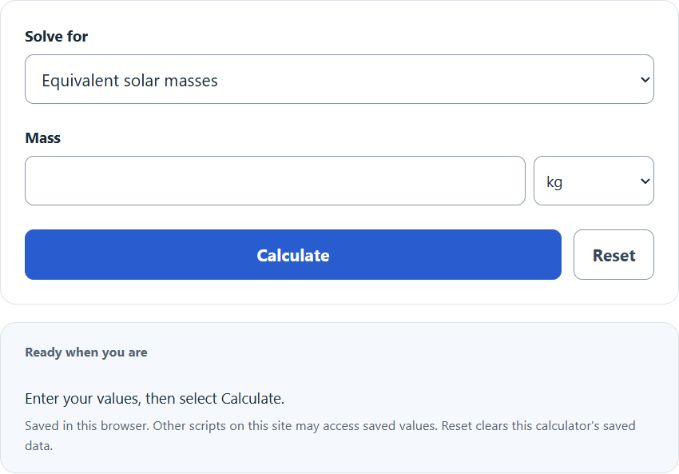
Calculate total mass or equivalent solar masses from kilograms, grams, pounds, short tons, or metric tons with unit conversion steps.
- All Mass Calculators
- Planet Mass Calculator
- Energy to Mass Calculator
- Theoretical Mass Calculator
- All Physics Calculators
Equivalent Solar Mass Formula
The solar mass is an astronomy unit used to compare an object’s mass with the Sun’s mass. This calculator retains the approximate convention 1 M☉ ≈ 1.98847 × 10³⁰ kg; the kilogram value is measured rather than exact. This makes very large masses easier to read and compare than using kilograms alone. The calculator converts a total mass into solar masses, or converts solar masses back into a standard mass unit.
- SM = equivalent solar mass
- M = total mass in kilograms
If you already know the value in solar masses and want the total mass, use the reverse form:
Because astronomical masses span many orders of magnitude, results are often shown in scientific notation.
Convert the Input to Kilograms First
The calculator can accept several mass units. When the input is not already in kilograms, convert it to kilograms before applying the solar mass formula.
| Input Unit | Conversion to Kilograms |
|---|---|
| Kilograms | Mkg = Mkg |
| Grams | Mkg = (Mg) / (1000) |
| Pounds | Mkg = Mlb × 0.45359237 |
| Short Tons | Mkg = Mₛₕₒᵣₜ × 907.18474 |
| Metric Tons | Mkg = Mmetric × 1000 |
One Solar Mass in Common Units
This reference is useful when you need to move between solar masses and the units supported by the calculator.
| Unit | Equivalent of 1 Solar Mass |
|---|---|
| Kilograms | 1 SM = 1.98847 × 10³⁰ kg |
| Grams | 1 SM = 1.98847 × 10³³ g |
| Pounds | 1 SM ≈ 4.38383 × 10³⁰ lb |
| Short Tons | 1 SM ≈ 2.19191 × 10²⁷ short tons |
| Metric Tons | 1 SM = 1.98847 × 10²⁷ metric tons |
How to Use the Solar Mass Calculator
- Enter a value for Total Mass or for Equivalent Solar Mass.
- Select the mass unit if you are entering a total mass.
- If the value is in grams, pounds, short tons, or metric tons, the calculator converts it to kilograms internally.
- The calculator then divides by the Sun’s mass to find solar masses, or multiplies by the same constant to recover the total mass.
- Choose the quantity to solve, then read the result in the separate results area.
Examples
Example 1: If the total mass is 1.50 × 1034 kilograms, the equivalent solar mass is:
The object has a mass of about 7,543.49 solar masses.
Example 2: If an object is estimated at 10 solar masses, the total mass is:
That is 1.98847 × 1031 kilograms.
What the Result Means
- Less than 1 solar mass: the object is less massive than the Sun.
- Equal to 1 solar mass: the object has the same mass as the Sun.
- Greater than 1 solar mass: the object is more massive than the Sun.
- Very small values: planets and smaller bodies are often shown in scientific notation because their mass is tiny compared to the Sun.
- Important: solar mass is a unit of mass, not weight, so the value does not depend on local gravity.
Why Solar Mass Is Useful
In astronomy, kilogram values become extremely large very quickly. Expressing mass in solar masses makes it easier to compare stars, stellar remnants, gas clouds, and galaxies on a common scale. A value such as 15 solar masses is usually more intuitive than writing the same quantity as a long number in kilograms.