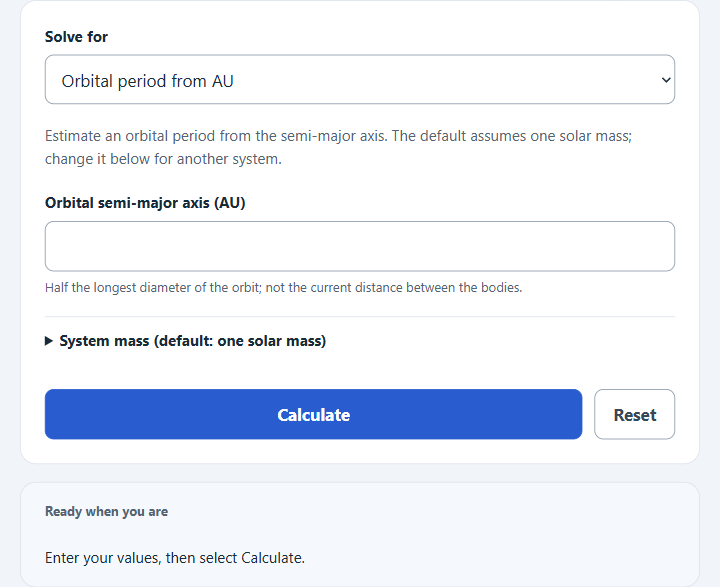
Estimate orbital period from the semi-major axis in AU, or estimate the semi-major axis from Julian years, using Kepler's third law. The default system mass is one solar mass; change it for another system.
AU to Years Formula
The following approximate solar-unit form of Kepler’s third law relates orbital period, semi-major axis and total system mass.
Variables:
- P is the orbital period in Julian years (365.25 days)
- a is the orbital semi-major axis in astronomical units (AU)
- M is the total mass of both bodies in solar masses
To estimate orbital period, cube the semi-major axis in AU, divide by total mass in solar masses, and take the square root. To estimate the semi-major axis instead, use a ≈ (P²M)^(1/3). The conventional solar-unit formula assumes an isolated Newtonian two-body orbit; it is not a constant-speed travel-time conversion.
| Semi-major axis (AU) | Years at 0.5 solar masses | Years at 1 solar mass | Years at 2 solar masses | Years at 3 solar masses | Years at 5 solar masses |
|---|---|---|---|---|---|
| 0.100 | 0.045 | 0.032 | 0.022 | 0.018 | 0.014 |
| 0.250 | 0.177 | 0.125 | 0.088 | 0.072 | 0.056 |
| 0.500 | 0.500 | 0.354 | 0.250 | 0.204 | 0.158 |
| 1.000 | 1.414 | 1.000 | 0.707 | 0.577 | 0.447 |
| 2.000 | 4.000 | 2.828 | 2.000 | 1.633 | 1.265 |
| 3.000 | 7.348 | 5.196 | 3.674 | 3.000 | 2.324 |
| 4.000 | 11.314 | 8.000 | 5.657 | 4.619 | 3.578 |
| 5.000 | 15.811 | 11.180 | 7.906 | 6.455 | 5.000 |
| 6.283 | 22.272 | 15.749 | 11.136 | 9.093 | 7.043 |
| 9.579 | 41.927 | 29.647 | 20.964 | 17.117 | 13.259 |
| 10.000 | 44.721 | 31.623 | 22.361 | 18.257 | 14.142 |
| 15.000 | 82.158 | 58.095 | 41.079 | 33.541 | 25.981 |
| 20.000 | 126.491 | 89.443 | 63.246 | 51.640 | 40.000 |
| 25.000 | 176.777 | 125.000 | 88.388 | 72.169 | 55.902 |
| 30.000 | 232.379 | 164.317 | 116.190 | 94.868 | 73.485 |
| 32.696 | 264.397 | 186.957 | 132.199 | 107.940 | 83.610 |
| 40.000 | 357.771 | 252.982 | 178.885 | 146.059 | 113.137 |
| 50.000 | 500.000 | 353.553 | 250.000 | 204.124 | 158.114 |
| 60.000 | 657.267 | 464.758 | 328.634 | 268.328 | 207.846 |
| 75.000 | 918.559 | 649.519 | 459.279 | 375.000 | 290.474 |
| P ≈ √(a³/M), with a in AU and total mass M in solar masses. Results rounded to three decimals. Assumes an isolated two-body orbit; one Julian year is 365.25 days. | |||||
What is an Astronomical Unit?
An astronomical unit (AU) is a unit of length used in astronomy. It is defined as exactly 149,597,870,700 meters (149,597,870.7 kilometers), which is close to the Earth’s average distance from the Sun. The AU is commonly used to express distances within our solar system and to compare the relative distances of planets and other celestial objects from the Sun.
How to Calculate Orbital Period?
The following steps outline how to estimate orbital period from a semi-major axis and system mass.
- First, determine the orbital semi-major axis a in astronomical units (AU). It equals the radius only for a circular orbit.
- Next, determine the total mass of the two bodies in solar masses. Blank system mass in the calculator means one solar mass.
- Choose Orbital period from AU, enter the semi-major axis, and change the optional system mass if needed.
- Select Calculate. The estimated period is P ≈ √(a³/M) Julian years.
Example Problem :
For a semi-major axis of 1 AU and total mass of 1 solar mass, P ≈ √(1³/1) = 1 Julian year.
Semi-major axis (a) = 1 AU
Total system mass = 1 solar mass; estimated orbital period = 1 Julian year