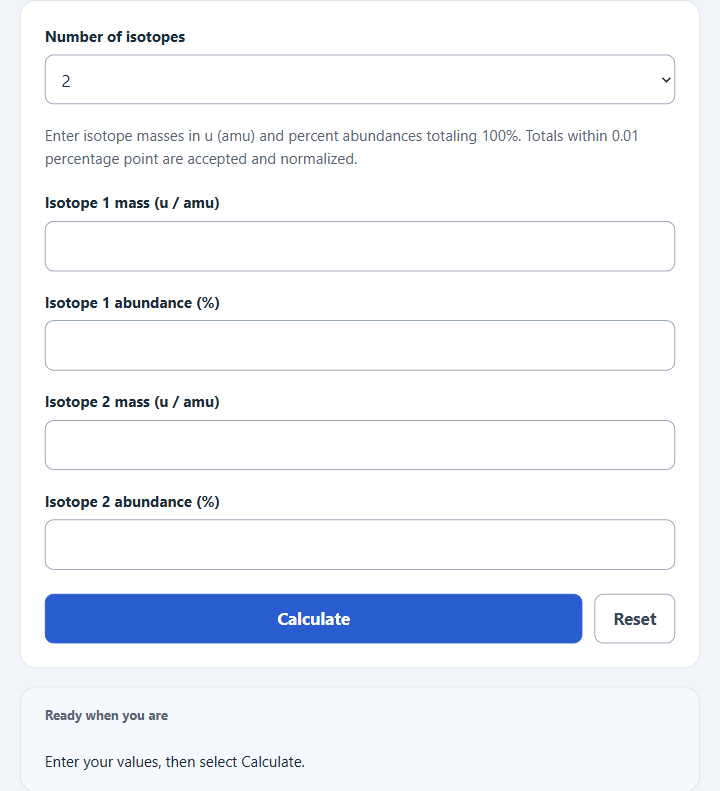
Calculate average atomic mass in amu from the masses and percent abundances of up to five isotopes, with weighted mass steps shown.
Average Atomic Mass Formula
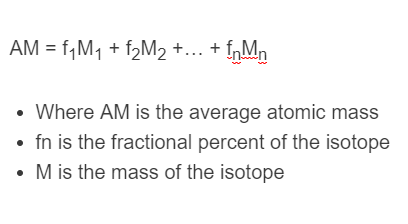
The following formula is used to calculate the average atomic mass of a substance.
- Where AM is the average atomic mass
- fn is the fractional abundance of isotope n (percentage divided by 100)
- M is the mass of the isotope
To calculate the average atomic mass, multiply the fractional abundance of each isotope by the mass of the isotope, then sum these values together.
Average Atomic Mass Definition
Average atomic mass is the abundance-weighted mean isotope mass for an element in a specified sample.
How to calculate average atomic mass?
How to calculate average atomic mass?
- First, determine each isotope percentage in the sample
For example, NIST lists representative chlorine abundances of 75.76% chlorine-35 and 24.24% chlorine-37. Their fractional abundances are 0.7576 and 0.2424.
- Next, determine the masses of each isotope
Using the same example, the isotope masses are approximately 34.968852682 u and 36.965902602 u. The integers 35 and 37 are mass numbers, not precise isotope masses.
- Finally, calculate the average atomic mass
The weighted average is 0.7576 × 34.968852682 + 0.2424 × 36.965902602 ≈ 35.452938 u. Natural sample compositions can vary.
FAQ
Average atomic mass is the abundance-weighted mean isotope mass for an element in a specified sample.
Fractional abundance is the isotope percentage divided by 100. For example, 75.76% corresponds to 0.7576.