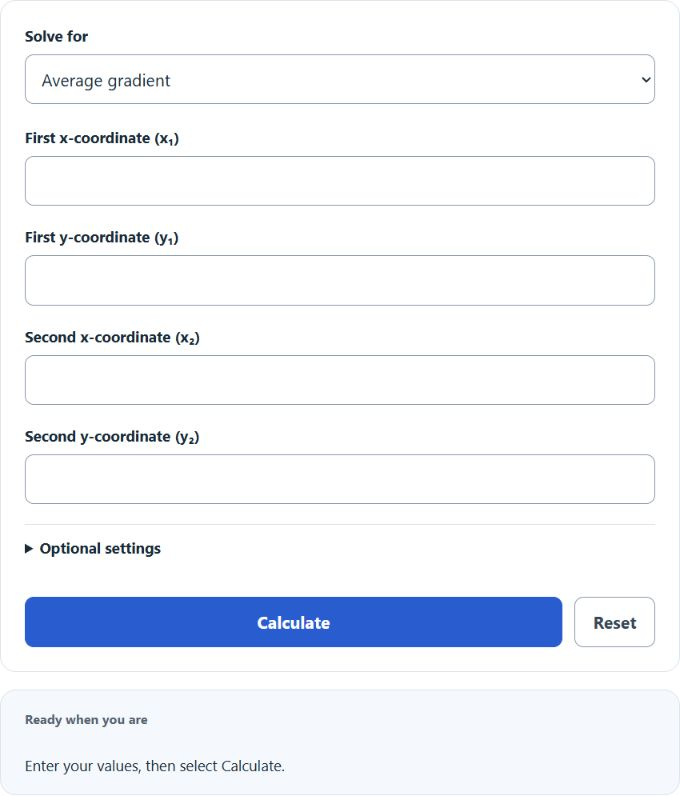
Calculate the average gradient between two points on a line or curve using the change in y divided by the change in x.
Average Gradient Formula
The average gradient between two points is the gradient of the straight line that joins them. It is the change in the y-value divided by the change in the x-value:
m = (y2 - y1) / (x2 - x1)
When you know the gradient and want a missing coordinate, the same relationship rearranges:
y2 = y1 + m * (x2 - x1)
x2 = x1 + (y2 - y1) / m
- m is the average gradient (also called the slope) between the two points.
- x1, y1 are the coordinates of the first point.
- x2, y2 are the coordinates of the second point.
- y2 - y1 is the rise, the vertical change between the points.
- x2 - x1 is the run, the horizontal change between the points.
The calculator subtracts the first y from the second y to get the rise, subtracts the first x from the second x to get the run, then divides the rise by the run. A positive result means the line goes up from left to right, a negative result means it goes down, and a result of zero means it is flat. If the x-values are equal but the y-values differ, the line is vertical and its gradient is undefined. Identical points do not determine a unique gradient. The percent and angle outputs convert the same gradient into a grade (m times 100) and an angle (the inverse tangent of m), and the secant line equation uses y = mx + b with b found from b = y1 - m times x1.
Typical Gradient Values and What They Mean
The table below shows how a gradient value relates to its percent grade and its angle, which helps you check whether a result looks reasonable.
| Gradient (m) | Percent grade | Angle | Direction |
|---|---|---|---|
| 0 | 0% | 0° | Flat |
| 0.5 | 50% | 26.57° | Rising |
| 1 | 100% | 45° | Rising |
| 2 | 200% | 63.43° | Steep rise |
| -1 | -100% | -45° | Falling |
Notice that gradient and angle are not proportional. Doubling the gradient does not double the angle, because the angle comes from the inverse tangent of the gradient.
Example Problems
Example 1. Find the average gradient between the points (1, 3) and (5, 11). The rise is 11 - 3 = 8 and the run is 5 - 1 = 4. The average gradient is 8 / 4 = 2. The line rises 2 units of y for every 1 unit of x.
Example 2. A curve passes through (2, 9) and (6, 1). The rise is 1 - 9 = -8 and the run is 6 - 2 = 4. The average gradient is -8 / 4 = -2, so the curve falls on average between these two points.
Frequently Asked Questions
What is the difference between average gradient and gradient? On a straight line the gradient is the same everywhere, so the average gradient equals that single value. On a curve the steepness changes from point to point, so the average gradient between two chosen points is the gradient of the straight line connecting them, not the steepness at any one point.
Can the average gradient be negative or zero? Yes. A negative average gradient means the second point is lower than the first, so the line falls from left to right. A gradient of zero means both points have the same y-value, so the line is horizontal between them.
Why is the gradient undefined when the x-values are equal? If x2 equals x1 the run is zero, and dividing by zero has no value. Two distinct points with the same x-value sit on a vertical line with no defined gradient. Identical points do not define a unique line.