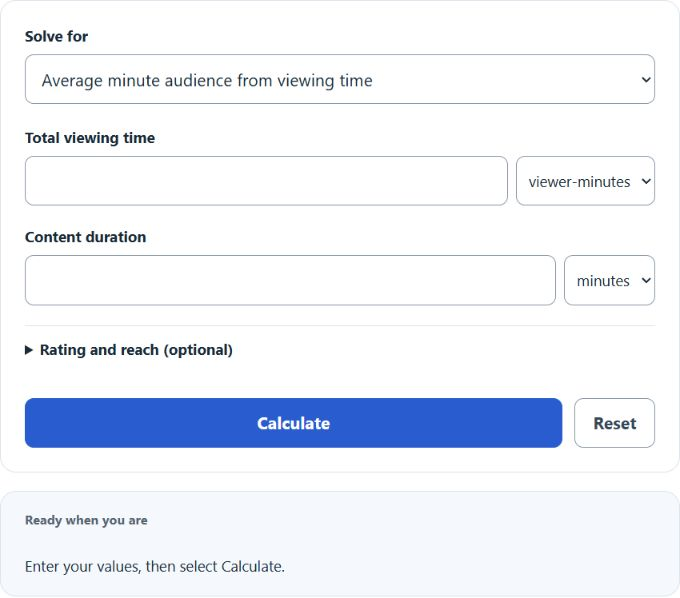
Calculate the average minute audience (AMA) of a broadcast or stream from total viewing minutes and content duration, solve for viewing minutes or duration, and convert AMA into a Nielsen-style rating.
Average Minute Audience Formula
- AMA is the average minute audience (viewers in an average minute)
- TVM is the total viewing minutes (the combined time watched by all viewers)
- TMC is the total minutes of content (the program duration)
The calculator also supports two rearranged forms of the same equation. To find total viewing minutes when you already know the audience figure, it uses:
To find how long the content was, it uses:
If you do not have total viewing minutes as a single number, the viewers x average watch time input method builds it for you: TVM = number of viewers x average minutes watched per viewer. The advanced options apply two further formulas. A universe estimate converts AMA into a Nielsen-style rating, Rating = AMA / UE x 100, where UE is the total people or homes in the measured market. A unique reach figure expresses AMA as a share of everyone who tuned in at any point, AMA % of reach = AMA / Reach x 100, which is a quick engagement check because AMA can never legitimately exceed reach.
Real-World AMA Benchmarks and Related Metrics
The table below shows reported average minute audience figures for well-known broadcasts, so you can sanity-check your own results against the scale of the industry.
| Broadcast | Year | Reported AMA |
|---|---|---|
| Super Bowl LVIII (CBS, Nielsen) | 2024 | About 123.7 million |
| Jake Paul vs. Mike Tyson (Netflix, global) | 2024 | About 108 million |
| NFL regular season game average | 2023 | About 17.9 million |
| Typical prime-time broadcast network show | Recent seasons | Roughly 2 to 6 million |
| Overwatch League Grand Finals (esports) | 2019 | About 1.12 million |
AMA is one of several audience metrics, and they are easy to confuse. This comparison shows what each one actually measures and how it relates to the numbers this calculator works with.
| Metric | What it measures | Relationship to AMA |
|---|---|---|
| Average minute audience (AMA) | Average viewers during any single minute | TVM / TMC |
| Unique reach | Everyone who watched at least briefly | Always greater than or equal to AMA |
| Rating | AMA as a percent of the universe estimate | AMA / UE x 100 |
| Average quarter-hour (AQH) | Average audience in 15-minute blocks (radio) | Coarser version of the same idea |
| Total views (online video) | Counted plays, often after a few seconds | Not comparable; inflates vs. AMA |
Example Problems
Example 1: A 90-minute live stream generates 4,500,000 total viewing minutes. Using AMA = TVM / TMC, divide 4,500,000 by 90 to get an average minute audience of 50,000 viewers. The audience averaged 50,000 viewers across the stream.
Example 2: A 2-hour broadcast reaches 250,000 unique viewers who watch an average of 18 minutes each. First find total viewing minutes: 250,000 x 18 = 4,500,000 minutes. The duration is 120 minutes, so AMA = 4,500,000 / 120 = 37,500 viewers in an average minute. As a share of reach, 37,500 / 250,000 x 100 = 15%, meaning the average minute held 15% of everyone who tuned in at some point.
FAQ
Why is the average minute audience so much lower than total viewers or views?
Reach and view counts credit anyone who watched even briefly, while AMA spreads all viewing time evenly across every minute of the content. If most people only watch a short portion, the per-minute average drops well below the headline reach number. That is why a video with 10 million views can have an AMA under 1 million, and why AMA is considered the stricter, more advertiser-friendly measure.
Can the average minute audience ever be higher than unique reach?
No. AMA is capped at reach, and it only equals reach if every single viewer watched the entire program from start to finish. If your calculated AMA exceeds your reach figure, one of the inputs is wrong, most often because total viewing minutes includes rewatches counted for the same viewers or the duration entered is shorter than the actual program.
How do I turn an AMA figure into a Nielsen-style rating?
Divide the AMA by the universe estimate for the market and multiply by 100. For example, an AMA of 6 million against a U.S. TV universe of roughly 125 million homes works out to a household rating of about 4.8. Enter the universe estimate in the advanced options and the calculator performs this conversion automatically.