Evaluate a two-leg tie under the legacy away-goals tiebreaker only when the competition’s current rules expressly use it.
Away Goal Rule Formula
The calculator totals both legs first and applies away goals only as a conditional tiebreaker.
How the Calculation Works
The calculator applies the displayed rule directly to the required inputs and reports its one defined output with supporting values and calculation steps.
How to Use This Calculator
- Confirm that the current competition regulations use away goals.
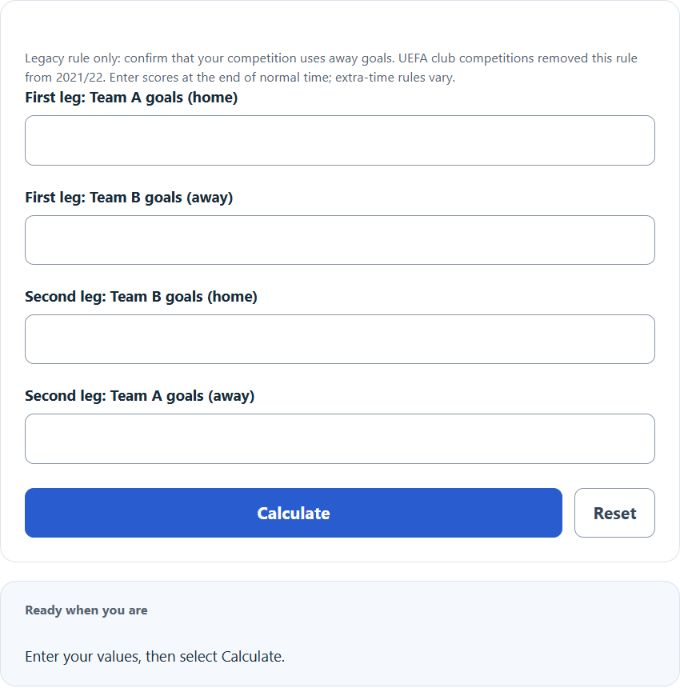
- Enter Team A and Team B’s scores from both legs in the stated home-and-away order.
- Select Calculate to compare aggregate score first and away goals only if aggregate is tied.
- If the tie remains level, follow the competition’s next stated tiebreaker.
Worked Example
If Team A loses 1–2 at home and wins 1–0 away, the aggregate is 2–2 and Team B has two away goals to Team A’s one.
Input and Result Guide
| Item | How to use it |
|---|---|
| First leg | Team A is home and Team B is away |
| Second leg | Team B is home and Team A is away |
| Still tied | Follow that competition’s next tiebreaker |
Interpreting the Result
Apply the result only to the stated inputs, rule, and sample. Confirm any competition-specific requirement before using the output for an official decision.
Assumptions and Limitations
This is a legacy, competition-specific method. UEFA removed the away-goals rule from its club competitions beginning in 2021/22, and the IFAB Laws do not require every competition to use it. Confirm the current competition regulations before relying on the result.
Common Questions
Why is there only one result option?
This calculator has one defined outcome. Enter all four normal-time scores; a mode menu is unnecessary.
Will my last successful calculation be restored?
Yes. The calculator saves structured inputs in this browser and recomputes the result on restoration. Reset clears its saved state.
Sources
International Football Association Board, Laws of the Game 2026/27. UEFA, Removal of the away goals rule in all UEFA club competitions, 2021.