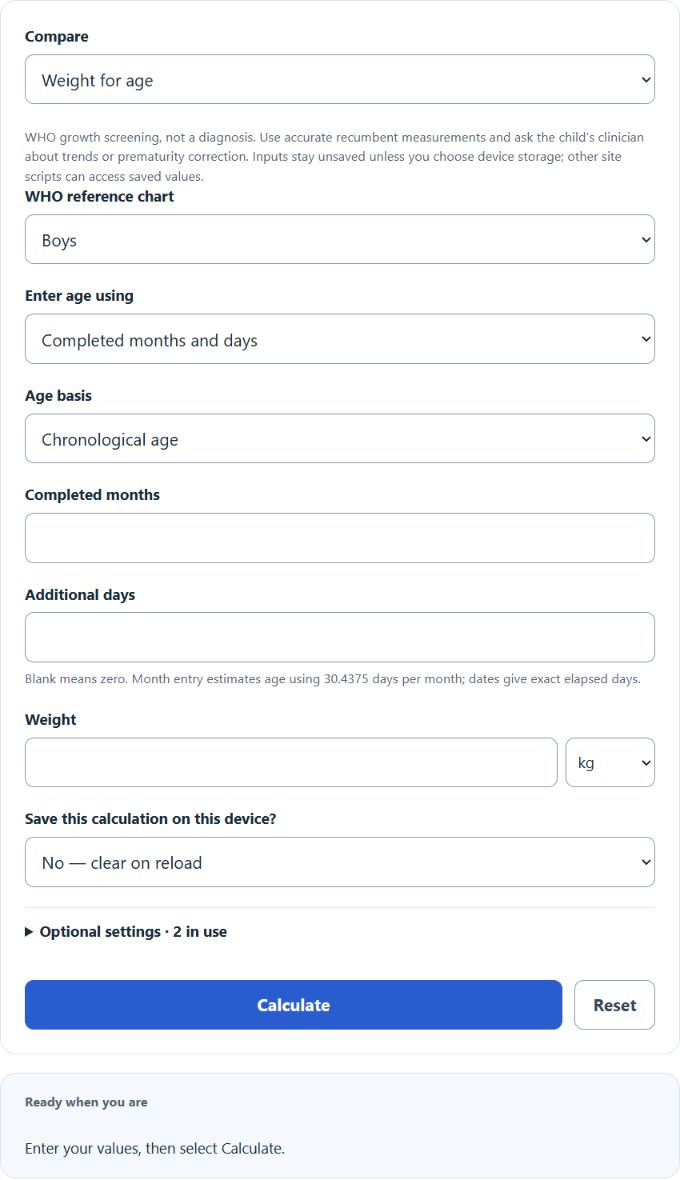
Calculate baby percentiles from your baby’s weight, length, and head circumference for their age and sex.
Baby Percentile Formula
The calculator uses the WHO LMS method. It uses complete daily age references and interpolates between adjacent 0.1 cm length references for the selected sex, then converts the z-score into a standard normal percentile. Dates provide exact elapsed days; month entry estimates days using 30.4375 days per month, rounded to a whole day. Weight indicators use WHO restricted LMS beyond ±3 z. At 731 days, recumbent length is reduced by 0.7 cm for height-based comparisons.
Z = ((X / M)^L - 1) / (L * S)
Percentile = 50 * (1 + erf(Z / sqrt(2)))
When L is effectively zero, the z-score reduces to Z = ln(X / M) / S.
- X = the measured value (weight, length, head circumference)
- M = WHO median value for that age and sex
- L = power that corrects the skew in the distribution
- S = coefficient of variation
- Z = number of standard deviations from the median
- erf = error function, used to turn the z-score into a percentile
The compare selector chooses which chart is used: weight for age, length for age, head circumference for age, or weight for length. The WHO chart selector sets whether boys or girls reference values are loaded, since the L, M, and S values differ by sex. The age basis option lets you use chronological age or a corrected age for babies born premature, which shifts the lookup to an earlier reference age. A percentile near 50 means the measurement sits at the median, a low percentile means the value is below most same-age babies, and a high percentile means it is above most.
Reading the Percentile Result
A single percentile is a snapshot. Pediatricians watch the trend across visits more than any one number.
| Percentile range | General interpretation |
|---|---|
| Below 3rd | Smaller than most same-age babies; worth discussing with your pediatrician |
| 3rd to 15th | On the lower side of the typical range |
| 15th to 85th | Middle of the typical range |
| 85th to 97th | On the higher side of the typical range |
| Above 97th | Larger than most same-age babies; worth discussing with your pediatrician |
The table below shows approximate WHO median values to give a sense of scale. Your calculator result uses the exact age in days, so these rounded figures are only a reference.
| Age | Median weight, boys | Median weight, girls |
|---|---|---|
| Birth | 3.3 kg (7.3 lb) | 3.2 kg (7.0 lb) |
| 3 months | 6.4 kg (14.1 lb) | 5.8 kg (12.8 lb) |
| 6 months | 7.9 kg (17.4 lb) | 7.3 kg (16.1 lb) |
| 12 months | 9.6 kg (21.2 lb) | 8.9 kg (19.6 lb) |
| 24 months | 12.2 kg (26.9 lb) | 11.5 kg (25.4 lb) |
Example Calculations
Example 1: A boy aged exactly 1 day weighs 3.3174 kg. The WHO daily weight-for-age median is 3.3174 kg. Because X equals M, z = 0 and the percentile is 50.0%.
Example 2: At exactly 7 days, the WHO weight-for-age median for boys is 3.4879 kg. A measurement of 3.4879 kg therefore gives z = 0 and the 50.0th percentile. Age in days matters during early infancy; a rounded monthly reference can give a materially different result.
FAQ
What does my baby’s percentile actually mean?
A percentile compares your baby to a reference group of healthy babies of the same age and sex. A 40th percentile weight means about 40 out of 100 same-age babies weigh less than yours and about 60 weigh more. It is a position, not a grade, so a lower or higher number is not automatically good or bad.
Should I use chronological or corrected age for a premature baby?
Ask the baby’s clinician whether corrected age and this reference chart are appropriate. This option subtracts (40 − completed gestational weeks) × 7 from chronological age. It shifts the age comparison and can change the percentile. A corrected age before term is outside this tool; a specialist may recommend a different chart. The calculator does not determine clinical eligibility or diagnose a growth condition.
Why did my baby’s percentile change between visits?
Small shifts are normal because babies grow in spurts rather than at a steady rate. Pediatricians look for a consistent curve over time rather than one fixed number. A large or sudden drop or jump across several percentile bands is the kind of change worth raising with your pediatrician.