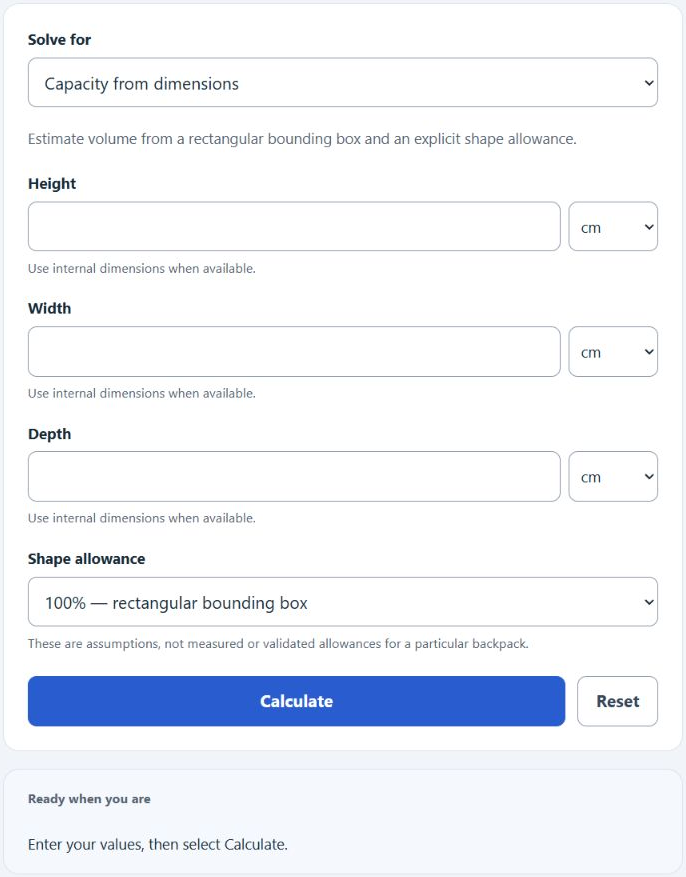
Calculate approximate backpack capacity from three independently labeled dimensions, or solve required depth from a target volume and known dimensions.
Backpack Capacity Formula
The calculator first converts every dimension to centimeters. It multiplies height, width, and depth, applies the user-selected shape allowance, and converts cubic centimeters to liters.
- V = estimated capacity in liters
- H, W, D = measured dimensions in centimeters
- s = user-selected assumed usable fraction (1, 0.85 or 0.75), not a validated backpack-specific correction
Volume Conversion Table
| Liters | Cubic inches | Cubic feet | US gallons |
|---|---|---|---|
| 20 L | 1,220.47 in³ | 0.706 ft³ | 5.283 gal |
| 40 L | 2,440.95 in³ | 1.413 ft³ | 10.567 gal |
| 60 L | 3,661.42 in³ | 2.119 ft³ | 15.850 gal |
| 80 L | 4,881.90 in³ | 2.825 ft³ | 21.134 gal |
Worked Example
A pack measuring 55 centimeters high, 30 centimeters wide, and 25 centimeters deep has a 41.25-liter rectangular bounding-box volume. With an assumed 85% shape allowance, the estimate is 35.0625 liters. Select Capacity from dimensions, enter each dimension with its unit, and choose the 85% assumption.
Measurement Scope
Tape-measure dimensions describe a bounding box and may not match a manufacturer’s standardized fill measurement. Curves, frames, padding, pockets, and tapered panels affect usable capacity. The 85% and 75% allowances are illustrative assumptions, not standardized measurements. Compare with manufacturer data when available. Unit changes convert the entered quantities.
Sources
- ASTM International — ASTM F2153, Standard Test Method for Measurement of Backpack Capacity
- National Institute of Standards and Technology — Guide for the Use of the International System of Units