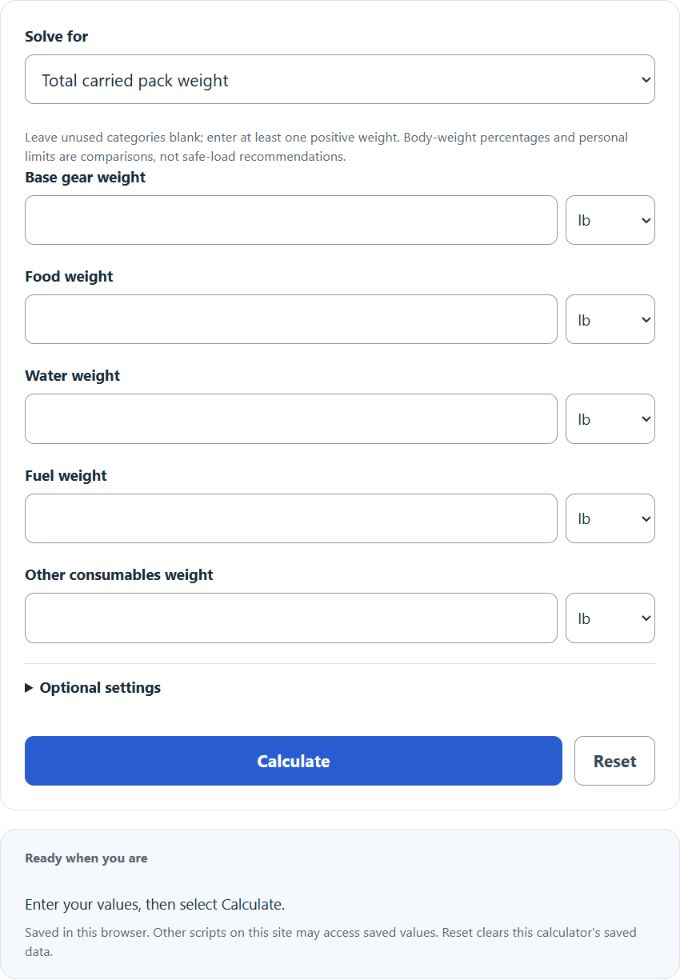
Add the weight of base gear, food, water, fuel, and other consumables, then compare the total with an optional body weight or a personal pack-weight limit.
What the Pack Total Includes
This calculator separates base gear from consumables so the result is useful for both a pre-trip inventory and a trailhead check. Base gear normally means the pack and equipment that should still be present at the end of the trip. Food, water, stove fuel, and other consumables can change during the route. Enter every item in exactly one category, using the unit beside that input, and the calculator normalizes the entries before adding them.
The arithmetic is total carried weight = base gear + food + water + fuel + other consumables. If body weight is entered, the tool also divides carried weight by body weight and reports the result as a percentage. If limit mode is selected, it subtracts the carried total from the limit supplied by the user. Neither optional comparison creates a recommended load.
| Category | Example weight | Included items | Changes during trip? |
|---|---|---|---|
| Base gear | 12.0 pounds | Pack, shelter, sleep system, clothing, and durable equipment | Usually little change |
| Food | 5.0 pounds | Meals and snacks | Decreases as consumed |
| Water | 4.4 pounds | Water carried at the measurement point | Changes at sources |
| Fuel and other | 1.6 pounds | Stove fuel and other consumables | May decrease |
Worked Example
A load with 12 pounds of base gear, 5 pounds of food, 4.4 pounds of water, 0.6 pound of fuel, and 1 pound of other consumables totals 23 pounds. Consumables account for 11 pounds of that amount. With an optional body weight of 170 pounds, the carried total is 13.53 percent of body weight. That percentage describes the entered inventory; it does not decide whether the load suits a particular person, route, season, or required water carry.
Using a Personal Limit
Limit mode is useful when a hiker has already established a project constraint, such as an airline allowance, equipment target, event rule, or personal planning ceiling. A positive remaining value is unused capacity. A negative value means the current inventory exceeds the entered limit. Review the category rows to see where the measured weight sits instead of treating the total as an instruction to remove a safety-critical item.
Why the Calculator Avoids Universal Bands
Official backpacking guidance uses different contextual rules of thumb. Terrain, experience, trip duration, season, shelter requirements, and water availability can materially change what must be carried. For that reason, the calculator reports transparent inventory arithmetic and leaves the choice of any limit to the user and current route guidance.
Sources
National Park Service: Packing Guide, Isle Royale National Park
USDA Forest Service: Backpacking
National Institute of Standards and Technology: Handbook 44, Appendix C, General Tables of Units of Measurement, 2026.