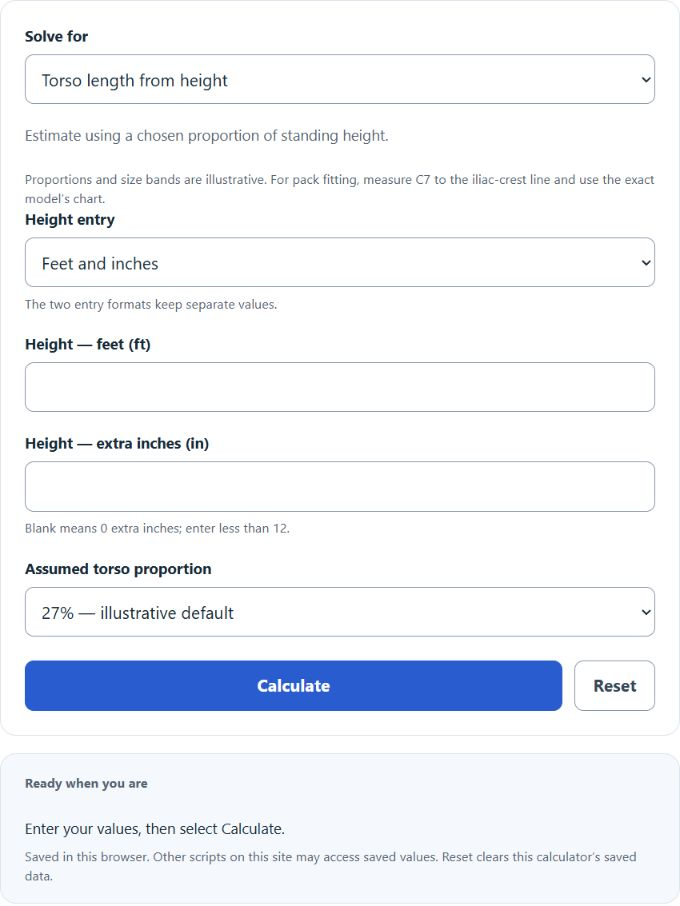
Estimate torso length from standing height, reverse-estimate height, or classify a directly measured backpack torso length, with explicit inches and centimeters.
Height-to-Torso Estimate
The height modes multiply standing height by a selected proportion, or reverse that arithmetic. The 24%, 27% and 30% presets are illustrative assumptions, not validated population averages. Human proportions vary; use a direct measurement for backpack fitting.
Illustrative Calculator Torso Bands
| Measured torso length | General band |
|---|---|
| Under 15 in / 38.1 cm | Extra Small |
| 15 to under 17 in / 38.1 to 43.18 cm | Small |
| 17 to under 19 in / 43.18 to 48.26 cm | Medium / Regular |
| 19 to under 21 in / 48.26 to 53.34 cm | Large / Tall |
| 21 in / 53.34 cm or more | Extra Large |
How to Measure for a Backpack
Find the C7 vertebra at the base of the neck and the iliac-crest line across the top of the hip bones. Measure along the spine between those points. Then compare that direct measurement with the size chart for the exact pack brand and model, because size bands are not standardized.
Example
At 70 inches tall and a selected 27% proportion, the estimate is 18.9 inches, or 48.01 centimeters. That falls in the calculator's illustrative Medium / Regular band, but a direct C7-to-iliac-crest measurement remains the fitting input to use.
Sources
- REI Co-op — How to Size and Fit a Backpack (measurement guidance)
- Osprey — Pack Sizing and Fitting (model-specific fit guidance)