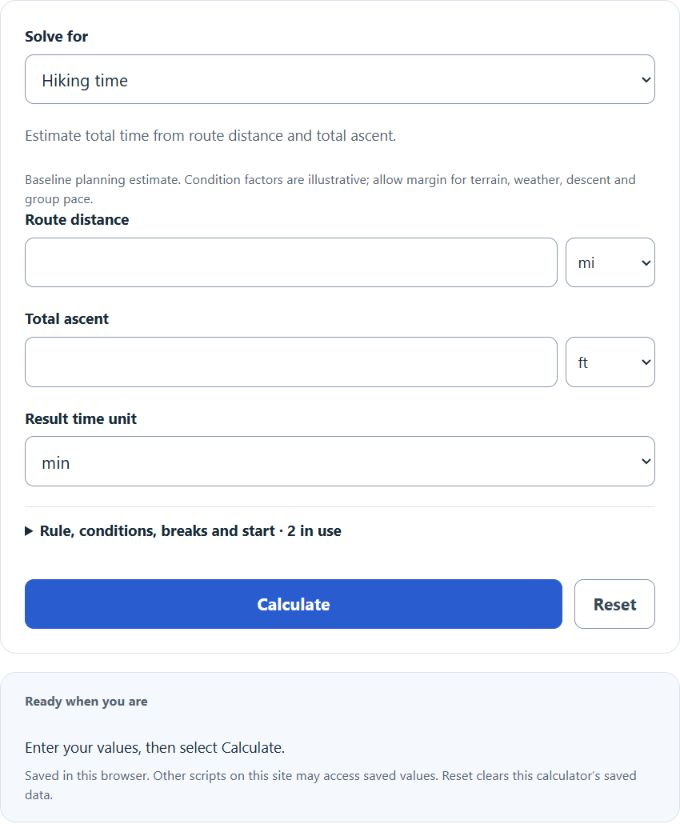
Estimate hiking time with classic Naismith arithmetic, reverse-solve distance or ascent, and compare two explicitly named equivalent-distance methods.
Classic Naismith Hiking-Time Formula
Classic Naismith planning time adds a distance allowance to an ascent allowance. The imperial form allows one hour per 3 miles plus one hour per 2,000 feet of ascent. The metric form allows one hour per 5 kilometers plus one hour per 600 meters of ascent.
- T = baseline time in hours
- D = route distance in miles
- G = total ascent in feet
Equivalent Distance Outputs
The calculator reports two secondary route-comparison values. An effort-distance comparison, adds one mile per 1,000 feet of ascent. Imperial Naismith time-equivalent distance converts the ascent allowance into the flat distance covered at 3 miles per hour. These are planning equivalences, not direct measures of energy expenditure.
| Method | Equivalent-distance formula | 10 mi + 3,000 ft |
|---|---|---|
| Effort-distance comparison | D + G / 1,000 | 13.0 mi |
| Classic Naismith time equivalent | D + 3G / 2,000 | 14.5 mi |
Example
For 6 miles and 2,000 feet of ascent, classic Naismith time is 6 / 3 + 2,000 / 2,000 = 3 hours before any optional condition factor or breaks. The effort-distance comparison is 8 effort miles, while the Naismith time-equivalent distance is 9 miles.
How to Interpret the Estimate
Treat the result as a baseline plan. Actual time changes with descent, terrain, weather, navigation, load, group pace, fitness, stops, and access conditions. The optional condition factors are illustrative assumptions. Condition adjustment and breaks are shown separately so the classic rule remains visible. Tranter correction is not applied.
Sources
- Scottish Mountaineering Club Journal — W. W. Naismith’s original 1892 rule
- Ordnance Survey — Why We’re Adjusting Naismith’s Rule
- Ordnance Survey — Map Reading booklet
- Appalachian Mountain Club — White Mountain Guide book-time guideline