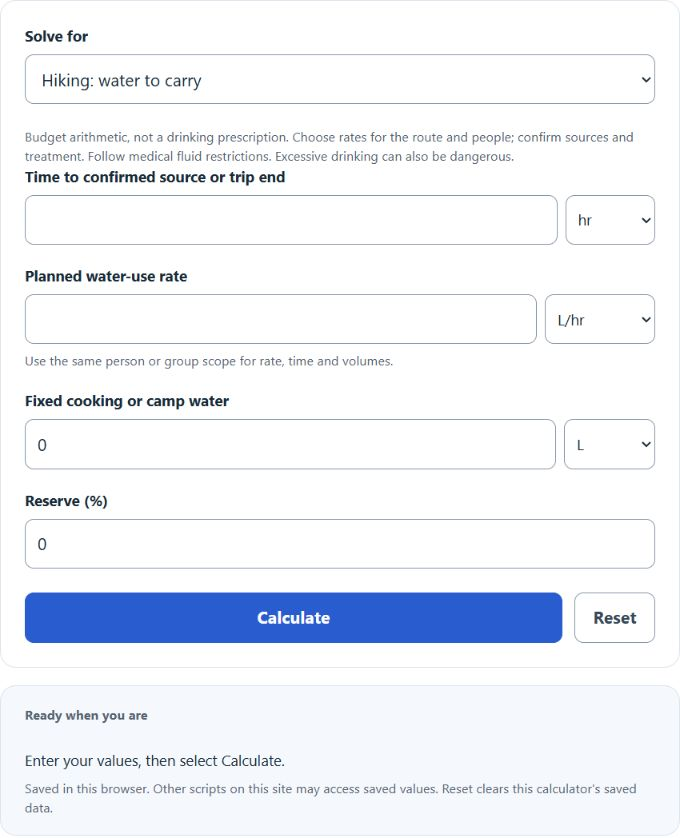
Plan hiking water carry or a time budget using your chosen rate. Camping modes calculate group water, people, days or containers from a daily budget you enter. These are carrying budgets, not drinking prescriptions.
Plan From a Locally Selected Rate
This planner begins with a water-use rate selected by the user from current guidance for the actual route and conditions. It has no preset rate and does not derive one from mileage, temperature, altitude, exertion, or body weight. In carry mode, the calculator multiplies time to the next confirmed source or trip end by the selected rate, adds a separately entered fixed volume for cooking or camp, and then applies an explicit reserve percentage.
The equation is total carry = (time x selected rate + fixed volume) x (1 + reserve percentage / 100). Duration mode instead uses a fixed set-aside, which must separately account for any desired percentage reserve. Its equation is supported time = (available water – fixed reserved water) / selected rate. Units are converted to liters and hours before the arithmetic, and the result is reported in both metric and U.S. volume units.
| Planning component | Illustrative entry | Calculated contribution | Purpose |
|---|---|---|---|
| Time to confirmed source | 4 hours | Used with the selected rate | Defines the planned interval |
| Selected use rate | 0.75 liters per hour | 3.00 liters over 4 hours | Comes from current local guidance and the user’s plan |
| Fixed water | 0.50 liter | 0.50 liter | Separates cooking or camp use |
| Explicit reserve | 20 percent | 0.70 liter | Adds a user-selected planning margin |
The illustration totals 4.20 liters. It demonstrates the equation only; the numbers are not a recommendation for another person or route.
Group Camping and Container Budgets
Camping modes retain total water, inverse people, inverse days and container planning. Enter a chosen daily use per person and any extra cooking/cleaning allowance. No activity or climate preset chooses a rate. Group water = people × days × (chosen daily use + extra allowance) × (1 + group reserve%/100). Inverse modes divide available water by the other entered factors. A people budget can be fractional; the maximum whole-person count rounds down. People entered in forward calculations must be whole.
Initial fixed, extra and reserve values are zero and can be edited; they are not recommended margins. Container count rounds up total water divided by usable container capacity. Preset capacities and approximate empty masses are editable. Water mass uses approximately 1 L =1 kg, and adds empty-container mass separately. All customary volumes use U.S. units.
Why the Rate Is Not Automatic
Water guidance is contextual. Work-rest schedules, acclimatization, humidity, sun exposure, route remoteness, altitude, illness, available treatment, and current source reliability can all matter. Guidance from different land managers also reflects local hazards. A universal rate hidden inside a calculator would create false precision, so this planner requires the user to enter a rate and labels it as a planning choice.
Worked Duration Example
Suppose 3 liters are available and 0.5 liter is reserved for camp. At a selected use rate of 0.75 liter per hour, 2.5 liters remain for the timed interval. Dividing 2.5 by 0.75 gives 3.33 hours, or approximately 3 hours 20 minutes. This duration does not promise that a source will be present, flowing, safe, or reachable.
Check the Plan Before Departure
Confirm sources and closures with current trail organizations and land managers. Account for treatment time and carry capacity, and review guidance about dehydration and excessive water intake. If the selected interval, rate, or reserve changes, rerun the calculation rather than relying on an earlier saved result.
Follow medical fluid restrictions and current guidance for the actual people and conditions. Excessive drinking can also be dangerous. The result is a carry budget, not an instruction to consume the full volume. Confirm treatment and access time; untreated natural water is not assumed potable.
Sources
CDC/NIOSH: Workplace Recommendations for Heat Stress
CDC/NIOSH: Heat Stress – Hydration
National Park Service: Hike Smart
National Park Service: Hike Smart, Big Bend National Park
National Park Service: Hiking Safety Information, Saguaro National Park
National Institute of Standards and Technology: Handbook 44, Appendix C, General Tables of Units of Measurement, 2026.