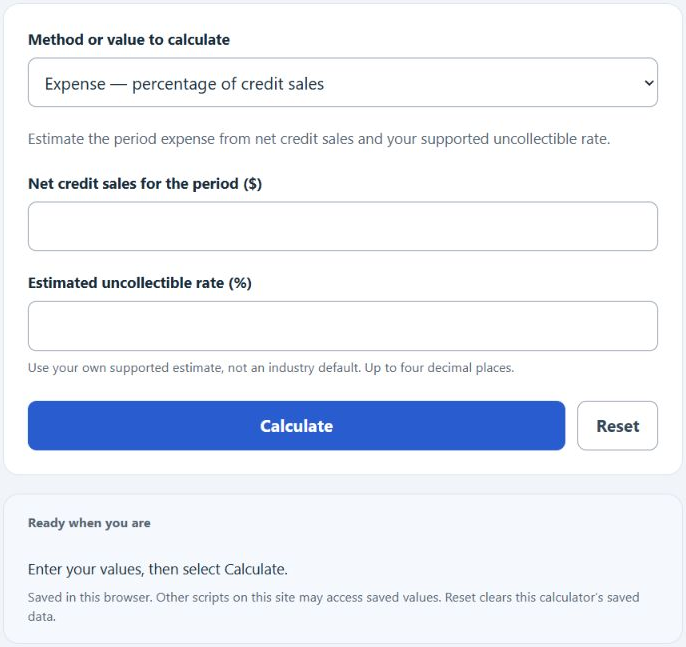
Calculate bad debt expense from credit sales, aging of accounts receivable, or percent of A/R, and see the adjusting journal entry.
Bad Debt Expense Formula
The following formula is used to calculate a bad debt expense using the % of credit sales method.
- Where BDE is the bad debt expense ($)
- S is the total (net) credit sales for the accounting period ($)
- BD is the estimated uncollectible rate as a percent of credit sales (%)
Select Expense — percentage of credit sales and multiply net credit sales by your supported uncollectible percentage. Receivables methods instead estimate the desired ending allowance and subtract the current allowance balance (credit positive, debit negative; blank means zero). In aging, an unused pair may be blank, but a positive balance requires a rate. Reverse modes explicitly solve credit sales or the rate; no industry presets are assumed.
Bad Debt Expense Definition
Bad debt expense is the expense recognized to reflect the estimated amount of accounts receivable (credit sales) that will not be collected during an accounting period (typically recorded with an Allowance for Doubtful Accounts).
Bad Debt Expense Example
How to calculate bad debt expense?
- First, determine the total credit sales.
Calculate the total credit sales for the time period being analyzed. For this example we will say this is $1,000.00.
- Next, determine the estimated percentage of credit sales that will be uncollectible.
Estimate what percentage of credit sales will not be collected. For this example we will say this is 10%.
- Finally calculate the bad debt expense.
Using the formula above, we find the bad debt expense to be $1,000.00 × 10% = $100.00.
FAQ