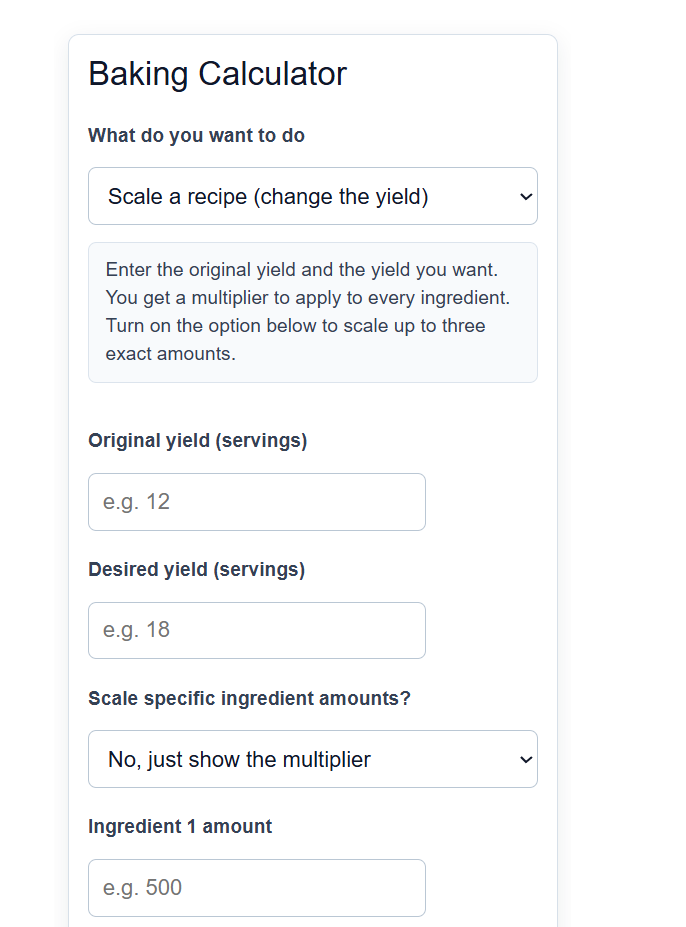
Calculate scaled recipe amounts, baker’s percentages, and pan size conversions to adjust any baking recipe to the exact yield you need.
Baking Calculator Formulas
This calculator runs three jobs. Each one uses its own formula.
Recipe scaling. To change how much a recipe makes, find a single multiplier and apply it to every ingredient.
Scale Factor = Desired Yield / Original Yield
New Amount = Original Amount * Scale Factor
Baker's percentage. Flour is fixed at 100 percent and every other ingredient is measured against it.
Ingredient % = (Ingredient Weight / Flour Weight) * 100
Ingredient Weight = Flour Weight * (Ingredient % / 100)
Hydration % = (Water Weight / Flour Weight) * 100
Pan conversion. Match the batter to a new pan by comparing the surface area of the two pans.
Scale Factor = New Pan Area / Original Pan Area
Round Area = pi * (D / 2)^2 Square Area = S^2 Rectangle Area = L * W
- Original Yield: how many servings or units the recipe makes as written.
- Desired Yield: how many servings or units you want.
- Scale Factor: the number you multiply each ingredient by.
- Flour Weight: total flour weight, used as the 100 percent base for baker's percentages.
- Ingredient Weight: the weight of water, salt, yeast, sugar, or fat.
- Hydration: water weight as a percentage of flour weight.
- D, S, L, W: the diameter of a round pan, the side of a square pan, and the length and width of a rectangular pan.
In scaling mode you enter two yields and the calculator returns the multiplier, then scales any amounts you type in. In baker's percentage mode you switch between entering weights to get percentages or entering percentages to get weights. In pan mode you pick the shape and size of each pan and the calculator returns the factor that keeps the batter at about the same depth.
Reference Values for Scaling and Bread Dough
Use these as a starting point when you set up a recipe or check a result.
| Ingredient | Typical baker's % | Notes |
|---|---|---|
| Flour | 100% | Always the base. |
| Water | 60 to 75% | Higher water gives an open, airy crumb. |
| Salt | 1.8 to 2.2% | About 2% is standard for most bread. |
| Instant yeast | 0.5 to 1% | Use less for a slow, cold rise. |
| Sugar | 0 to 12% | Higher in enriched doughs like brioche. |
Round cake pans scale by area, so a small change in diameter is a large change in volume.
| Round pan diameter | Approx. area (sq in) | Area vs 8 inch |
|---|---|---|
| 6 in | 28.3 | 0.56x |
| 8 in | 50.3 | 1.00x |
| 9 in | 63.6 | 1.27x |
| 10 in | 78.5 | 1.56x |
Example Problems
Example 1: Scaling a recipe. A cookie recipe makes 12 cookies and uses 250 g of flour. You want 18 cookies. The scale factor is 18 / 12 = 1.5. The new flour amount is 250 * 1.5 = 375 g. Multiply every other ingredient by 1.5 as well.
Example 2: Baker's percentage. A dough uses 1000 g flour, 650 g water, 20 g salt, and 7 g yeast. Water is 650 / 1000 * 100 = 65 percent, so hydration is 65 percent. Salt is 20 / 1000 * 100 = 2 percent and yeast is 0.7 percent. The total dough weight is 1677 g.
Frequently Asked Questions
Do I scale the bake time when I change the yield? Not by the same factor. The scale factor applies to ingredient amounts only. If you keep the same pan size and depth, the bake time stays close to the original. If the batter is deeper or you use a bigger pan, add a few minutes and check for doneness rather than trusting the clock.
Why is flour always 100 percent in baker's percentage? Flour is the main structure of bread, so bakers measure everything against it. Setting flour to 100 percent lets you compare and scale any recipe regardless of batch size, because the ratios stay the same whether you mix 500 g or 50 kg of flour.
Can I switch a recipe between a round and a square pan? Yes. The pan mode compares the surface area of both pans, so you can move between round, square, and rectangular pans. Multiply the batter by the factor it returns and keep the oven temperature the same, since a deeper or shallower layer mainly changes the time.