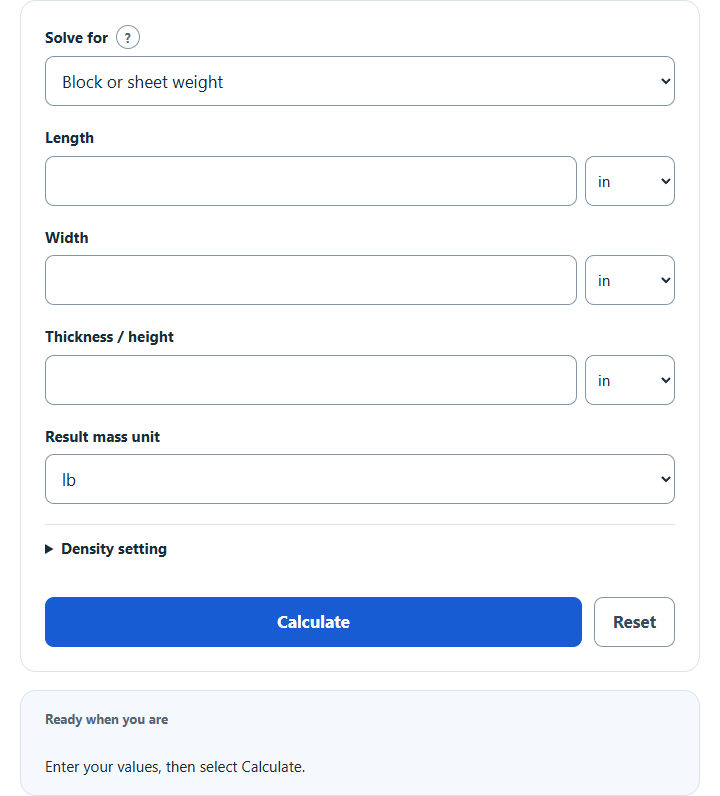
Calculate balsa wood weight in lb, kg or grams from the size of a sheet, block or rod, using a typical balsa density of 7.5 lb/ft³ or your own value.
- All Construction Calculators
- All Weight Calculators
- Plywood Weight Calculator
- Green Log Weight Calculator
- Hay Bale Weight Calculator
Calculator Functions
| Function | What it does | What it requires |
|---|---|---|
| Block or sheet weight | Finds the weight of a rectangular balsa block or sheet | Requires length, width and thickness |
| Round rod weight | Finds the weight of a round balsa rod or dowel | Requires diameter and length |
| Block length | Finds the length of a block of known weight | Requires balsa weight, width and thickness |
| Block width | Finds the width of a block of known weight | Requires balsa weight, length and thickness |
| Block thickness | Finds the thickness of a block of known weight | Requires balsa weight, length and width |
Dimensions can be entered in in, ft, cm or m, and weight in lb or kg. Every function has an optional Density setting in lb/ft³ or kg/m³. Left blank, it uses 7.5 lb/ft³, about 120 kg/m³. Results show the weight in lb or kg along with the volume and the mass in grams and ounces.
Balsa Wood Weight Formulas
| BWW | Balsa wood weight (lb) |
| L | Length (ft) |
| W | Width (ft) |
| H | Thickness or height (ft) |
| ρ | Balsa density (lb/ft³) |
Balsa is the lightest wood sold commercially, and its density varies a great deal from piece to piece. The lumber selected for use in the United States averages about 11 lb/ft³ (180 kg/m³) when dry and is often as light as 6 lb/ft³ (100 kg/m³) [1]. The 7.5 lb/ft³ default sits toward the light end of that range, so a measured or supplier density gives a closer answer.
Block or sheet weight
A 36 × 4 × 1/4 in sheet has a volume of 36 in³, or 0.02083 ft³, and weighs 0.02083 × 7.5 = 0.156 lb, which is 2.5 oz or 70.9 g. At 10 lb/ft³, a 36 × 3 × 1/8 in sheet weighs 1.25 oz, or 35.4 g.
Wood Weight in kg
In metric units the same formula is mass (kg) = length × width × thickness (m) × density (kg/m³). A 100 × 10 × 1 cm board at 160 kg/m³ has a volume of 0.001 m³ and a mass of 0.16 kg. Setting the result unit to kg and the density unit to kg/m³ gives this directly. The formula works for any wood once that wood’s density is entered in the Density setting.
Round rod weight
d is the diameter. A 1/2 in rod that is 36 in long has a volume of 7.069 in³ and weighs 0.0307 lb, or 13.9 g.
Block length
A 0.02 lb block has a volume of 0.02 ÷ 7.5 = 0.002667 ft³, or 4.608 in³. At 4 in wide and 1/4 in thick, it is 4.608 in long.
Block width
The volume is divided by length and thickness. A 0.02 lb block that is 36 in long and 1/4 in thick is 4.608 ÷ (36 × 0.25) = 0.512 in wide.
Block thickness
The volume is divided by length and width. A 0.02 lb sheet that measures 36 × 4 in is 4.608 ÷ (36 × 4) = 0.032 in thick.
Limits of This Estimate
- Balsa density depends on the piece and its moisture content. These estimates are based on the best available data and estimations.
- The piece is treated as solid and uniform. Cutouts, glue, finishes and coverings are not included.
- The suggested densities from 6 to 18 lb/ft³ are choices, not standard grades.
Sources
- USDA Forest Products Laboratory, Wood Handbook (FPL-GTR-282), Chapter 2: typical weight of balsa lumber