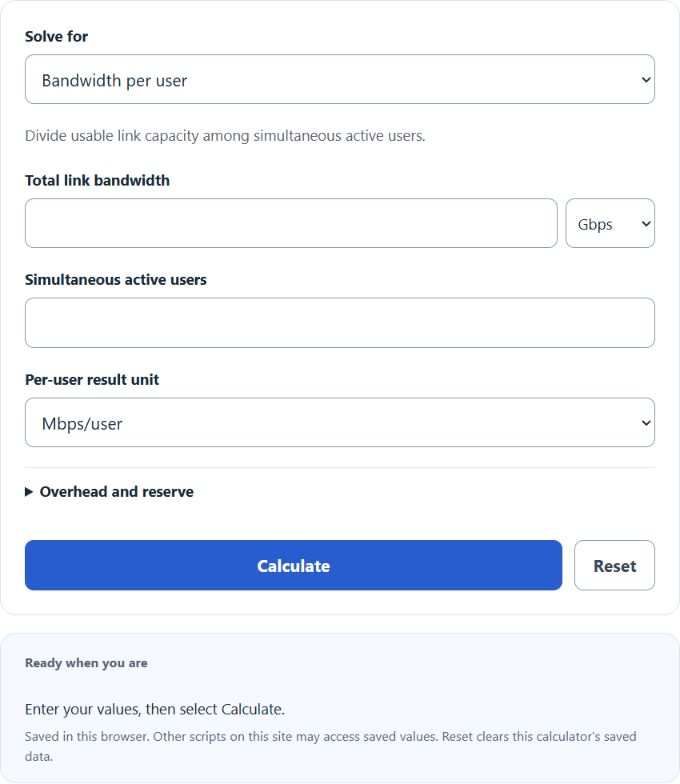
Bandwidth Per User Calculator for per-user speed, total capacity, supported users, and concurrency planning with overhead and real network units.
Bandwidth Per User Formula
Choose a solve mode and complete its visible inputs. Let f = 1 − reserve/100. Blank reserve means 0%. Rates use decimal bits per second, not bytes per second.
Per-user bandwidth = raw link capacity × f / active users. Required raw capacity = active users × target per-user rate / f. Supported whole users = floor(raw capacity × f / target rate).
Concurrency planning uses active-user equivalents = registered users × concurrency/100, then sizes raw capacity from that demand. This expected demand can be fractional. Reserve is a planning input, not a measured loss.
Bandwidth Unit Conversions
Use these conversions to check that your inputs are in the right scale.
| Unit | Equivalent | In Gbps |
|---|---|---|
| 1 kbps | 0.001 Mbps | 0.000001 Gbps |
| 1 Mbps | 1,000 kbps | 0.001 Gbps |
| 1 Gbps | 1,000 Mbps | 1 Gbps |
| 1 Tbps | 1,000 Gbps | 1,000 Gbps |
Illustrative Bandwidth Planning Ranges
These broad examples are not application requirements or service guarantees. Check actual traffic and current vendor guidance; for example, Microsoft Teams call-quality guidance describes video bandwidth that can be below this illustrative range. Budget upload and download separately.
| Use case | Typical bandwidth per active user | Notes |
|---|---|---|
| Email and basic browsing | 1 to 5 Mbps/user | Light usage with short bursts of traffic. |
| Video meetings | 3 to 10 Mbps/user | Depends on video quality and screen sharing. |
| HD streaming | 5 to 15 Mbps/user | Higher quality streams need more bandwidth. |
| Large file transfers or cloud backups | 10 Mbps/user or more | Can require much more bandwidth during peak activity. |
Example Problems
Example 1: Calculate bandwidth per user
You have 2 Gbps of total bandwidth and 100 users.
Since 0.02 Gbps equals 20 Mbps, the bandwidth per user is 20 Mbps/user.
Example 2: Calculate total bandwidth
You need 8 Mbps per user for 250 users.
Since 2,000 Mbps equals 2 Gbps, the total bandwidth needed is 2 Gbps.
FAQ
What does bandwidth per user mean?
Bandwidth per user is the average amount of network capacity available for each user. For example, if 50 users share a 500 Mbps connection equally, the bandwidth per user is 10 Mbps/user.
Should total users mean all users or active users?
Use active users if you are estimating real bandwidth demand. Not every registered or connected user is usually using the network at the same time. If you use total users instead of active users, the result is more conservative.
How do I choose what to calculate?
Select the named solve mode. Complete its required fields, optionally enter a reserve percentage, and select Calculate. The two examples above assume zero reserve and simultaneous active users.