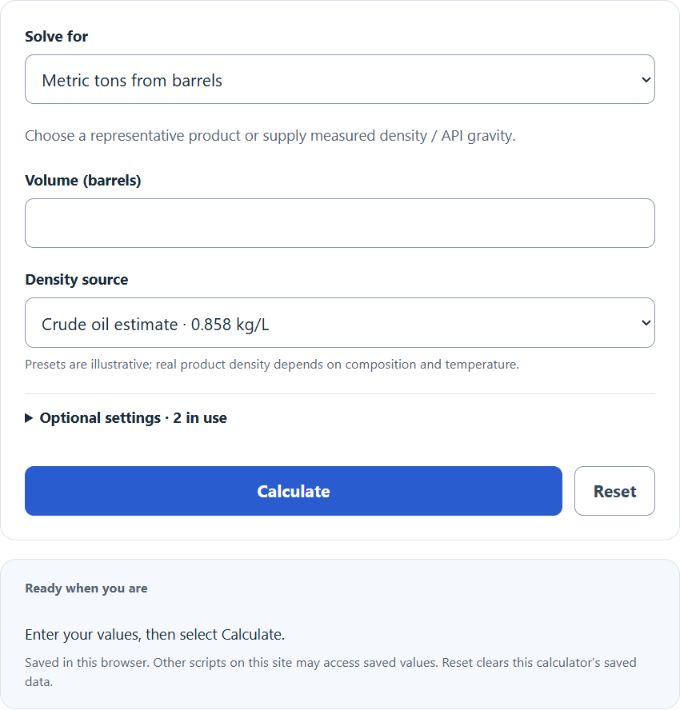
Convert barrels to metric tons (bbl to MT) or metric tons to barrels for crude oil, diesel, gasoline and other fuels using typical densities or your own.
- All Unit Converters
- Tons To Barrels Calculator
- Barrels Per Stroke Calculator
- Pounds To Barrels Calculator
Calculator Functions
| Function | What it does | What it requires |
|---|---|---|
| Metric tons from barrels | Converts a volume in barrels into metric tons | Requires the number of barrels and a product, a custom density or an API gravity |
| Barrels from metric tons | Converts a mass in metric tons into barrels | Requires the mass in metric tons and a product, a custom density or an API gravity |
| MMTPA from bbl/day | Converts a daily rate in barrels into million metric tonnes per year | Requires barrels per day, the operating days per year and a product, a custom density or an API gravity |
| bbl/day from MMTPA | Converts million metric tonnes per year into barrels per operating day | Requires the MMTPA figure, the operating days per year and a product, a custom density or an API gravity |
The Product list sets the density: crude oil 0.858 kg/L, gasoline 0.740, diesel 0.845, jet fuel 0.800, heavy fuel 0.960, LPG 0.540 or water 1. Custom density accepts kg/L, kg/m³ or specific gravity at 60 °F, and API gravity accepts degrees API at 60 °F. Optional settings change the barrel volume from the standard 158.987294928 L and the number of decimal places.
Barrels to Metric Tons Formulas
| t | Mass (metric tons) |
| bbl | Volume (barrels) |
| L | Liters in one barrel: 158.987 for the 42-gallon petroleum barrel [1] |
| ρ | Density of the liquid (kg/L) |
A barrel measures volume and a metric ton measures mass, so the density of the liquid sets the answer.
Metric tons from barrels
The formula above applies directly. One barrel of crude oil at 0.858 kg/L is 158.987 × 0.858 ÷ 1000 = 0.1364 metric tons, so 1,000,000 barrels is 136,411 metric tons.
Barrels from metric tons
For 1,000 metric tons of gasoline at 0.740 kg/L, bbl = 1,000 × 1000 ÷ (158.987 × 0.740) = 8,499.7 barrels, or about 8.5 barrels per metric ton.
MMTPA from bbl/day
ρ ÷ 109
MMTPA is million metric tonnes per year, and 109 is the 1,000,000,000 kilograms in one million metric tonnes. A rate of 550 bbl/day of crude oil over 365 days is 550 × 365 × 158.987 × 0.858 ÷ 1,000,000,000 = 0.0274 MMTPA. The days are the days on which the daily rate applies, so a plant that runs 330 days uses 330.
bbl/day from MMTPA
(days × L × ρ)
One MMTPA of crude oil over 365 days is 20,084 bbl/day, which is 2,739.7 metric tons per day.
Density From API Gravity
0.999016
Degrees API equal 141.5 divided by the specific gravity at 60 °F, minus 131.5 [2]. The calculator turns that around to get the specific gravity and multiplies by 0.999016 kg/L, the density it uses for water at 60 °F. A 35° API crude has a density of 0.8490 kg/L, so 1,000 barrels is 134.98 metric tons.
Barrels to Metric Tons Conversion Table
These values are for crude oil at 0.858 kg/L and the standard 42-gallon barrel.
| Barrels | Metric tons |
|---|---|
| 1 | 0.136 |
| 100 | 13.64 |
| 1,000 | 136.41 |
| 10,000 | 1,364.1 |
| 50,000 | 6,820.6 |
| 100,000 | 13,641 |
| 200,000 | 27,282 |
| 500,000 | 68,206 |
| 1,000,000 | 136,411 |
| 2,000,000 | 272,822 |
The product changes the answer. The last column is the average published by the United Nations Statistics Division [3] for comparison.
| Product | Density used | Metric tons per barrel | Barrels per metric ton | UN average, barrels per metric ton |
|---|---|---|---|---|
| Crude oil | 0.858 kg/L | 0.1364 | 7.33 | 7.32 |
| Gasoline | 0.740 kg/L | 0.1177 | 8.50 | 8.50 |
| Diesel | 0.845 kg/L | 0.1343 | 7.44 | 7.23 |
| Jet fuel | 0.800 kg/L | 0.1272 | 7.86 | 7.77 |
| Heavy fuel | 0.960 kg/L | 0.1526 | 6.55 | 6.62 |
| LPG | 0.540 kg/L | 0.0859 | 11.65 | 11.65 |
| Water | 1 kg/L | 0.1590 | 6.29 | Not listed |
Limits of This Estimate
- The product densities are typical values, not properties of a particular cargo. The crude oil, gasoline and LPG figures match the UN averages, while diesel, jet fuel and heavy fuel differ from them by 1% to 3% [3]. These estimates are based on the best available data and estimations.
- Crude oils range widely in density, and the density of any petroleum liquid changes with temperature. The calculator applies no temperature or pressure correction, so the density and the barrel count must refer to the same conditions.
- A product that is not listed, such as methanol, naphtha or vacuum gas oil, needs its own density entered under Custom density. For custody transfer or billing, the measured density on the quality certificate takes the place of any typical value.
Sources
- NIST Special Publication 811, Guide to the SI, Appendix B.8: cubic meters and liters in a 42-gallon petroleum barrel
- U.S. Energy Information Administration, Glossary, API gravity: the relation between degrees API and specific gravity at 60 °F
- United Nations Statistics Division, 2014 Energy Statistics Yearbook, Table II, Selected conversion factors for crude oil and oil products: average barrels per metric ton for crude oil and oil products