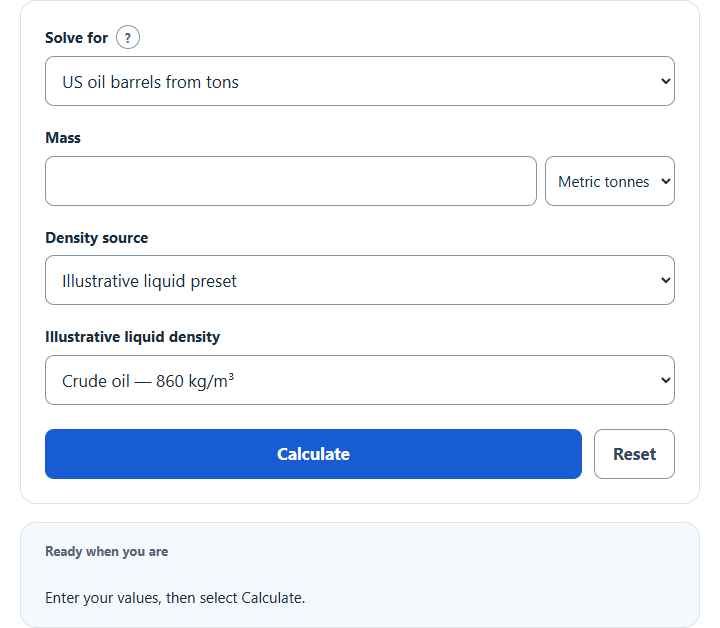
Convert metric, short, or long tons to 42-gallon oil barrels, or barrels back to tons, using liquid density, commodity presets, or API gravity.
- All Unit Converters
- Cubic Feet To Tons Calculator
- Gallons To Tons Calculator
- Pounds To Barrels Calculator
- API Gravity Calculator
- kg To Liters Oil Calculator
Calculator Functions
| Function | What it does | What it requires |
|---|---|---|
| US oil barrels from tons | Converts a mass of liquid in tons to US oil barrels | Requires the mass in metric tonnes, US short tons or long tons, and the density of the liquid |
| Tons from US oil barrels | Converts a volume in US oil barrels to a mass in tons | Requires the number of barrels, the ton unit for the result and the density of the liquid |
The density comes from one of three places: a preset liquid, a measured density in kg/m³, kg/L or lb per US gallon, or an API gravity at 60 °F. Results also show the mass in all three kinds of ton and the volume in liters, US gallons and cubic meters.
Tons to Barrels Formulas
| bbl | Volume in US oil barrels of 42 US gallons [2] |
| m | Mass (kg). One metric tonne is 1,000 kg, one US short ton is 907.18474 kg and one long ton is 1,016.0469 kg [1] |
| ρ | Density of the liquid (kg/m³) |
| k | 0.158987, the cubic meters in one barrel [1] |
A ton is a mass and a barrel is a volume, so there is no fixed number of barrels in a ton. Dividing the mass by the density gives the volume in cubic meters, and dividing by 0.158987 turns it into barrels. A light liquid fills more barrels per ton than a heavy one: a metric tonne of crude oil at 860 kg/m³ is 1,000 ÷ (860 × 0.158987) = 7.31 barrels, and a tonne of water is 6.30.
US oil barrels from tons
The main formula applies directly. The table lists the preset densities and the barrels they give per ton. The last column is the factor the United Nations publishes for the same product [4], and the presets land within 0.01 of each one.
| Liquid | Preset density | Barrels per metric tonne | Barrels per US short ton | UN factor, barrels per tonne |
|---|---|---|---|---|
| Crude oil | 860 kg/m³ | 7.31 | 6.63 | 7.32 |
| LPG | 540 kg/m³ | 11.65 | 10.57 | 11.65 |
| Gasoline | 740 kg/m³ | 8.50 | 7.71 | 8.50 |
| Jet fuel or kerosene | 810 kg/m³ | 7.77 | 7.04 | 7.77 |
| Diesel or gas oil | 870 kg/m³ | 7.23 | 6.56 | 7.23 |
| Residual fuel oil | 950 kg/m³ | 6.62 | 6.01 | 6.62 |
| Lubricating oil | 900 kg/m³ | 6.99 | 6.34 | 6.99 |
| Bitumen or asphalt | 1040 kg/m³ | 6.05 | 5.49 | 6.05 |
| Ethanol | 789 kg/m³ | 7.97 | 7.23 | not listed |
| Water at 20 °C | 998.2 kg/m³ | 6.30 | 5.72 | not listed |
300,000 Tons of Diesel in Barrels
At the diesel preset of 870 kg/m³, 300,000 metric tonnes is 300,000 × 7.2297 = 2,168,900 barrels, or about 2.17 million. The same number of US short tons is 1,967,593 barrels, and of long tons 2,203,704 barrels. For crude oil at 860 kg/m³, 300,000 metric tonnes is 2,194,120 barrels.
Tons from US oil barrels
The volume in cubic meters times the density gives kilograms, which are then divided by the size of the chosen ton. At 860 kg/m³, 1,000 barrels of crude oil is 1,000 × 0.158987 × 860 = 136,729 kg, or 136.73 metric tonnes, so one barrel is 0.1367 tonnes.
Density from API Gravity
API gravity is defined from specific gravity at 60 °F as API = 141.5 ÷ SG − 131.5 [3], and the line above is that definition solved for SG. The calculator multiplies SG by 999.016 kg/m³, its figure for water at 60 °F, to get the density. At 35 °API, SG is 141.5 ÷ 166.5 = 0.8498, the density is 849.0 kg/m³, and a metric tonne is 7.41 barrels. API gravity from −20 to 120 is accepted.
Limits of This Estimate
- The preset densities are typical values for each product, and real cargoes vary. The United Nations table gives one average factor per product [4], and crude oils alone range widely around it. These estimates are based on the best available data and estimations.
- Density changes with temperature. A measured density has to be for the temperature at which the barrels are counted, and an API gravity gives a volume at 60 °F. No temperature or pressure correction is applied.
- The barrel is the 42 US gallon oil barrel [2]. Other barrels, such as the US beer barrel or the dry barrel, are different sizes.
- The result is a conversion and not a custody-transfer measurement.
Sources
- NIST Special Publication 811, Appendix B.8: size of the petroleum barrel and of the metric, short and long ton
- U.S. Energy Information Administration, Glossary: Barrel: the barrel as 42 US gallons
- U.S. Energy Information Administration, Glossary: API gravity: definition of API gravity from specific gravity at 60 °F
- United Nations Statistics Division, 2023 Energy Statistics Yearbook, conversion factors: barrels per tonne for crude oil and petroleum products