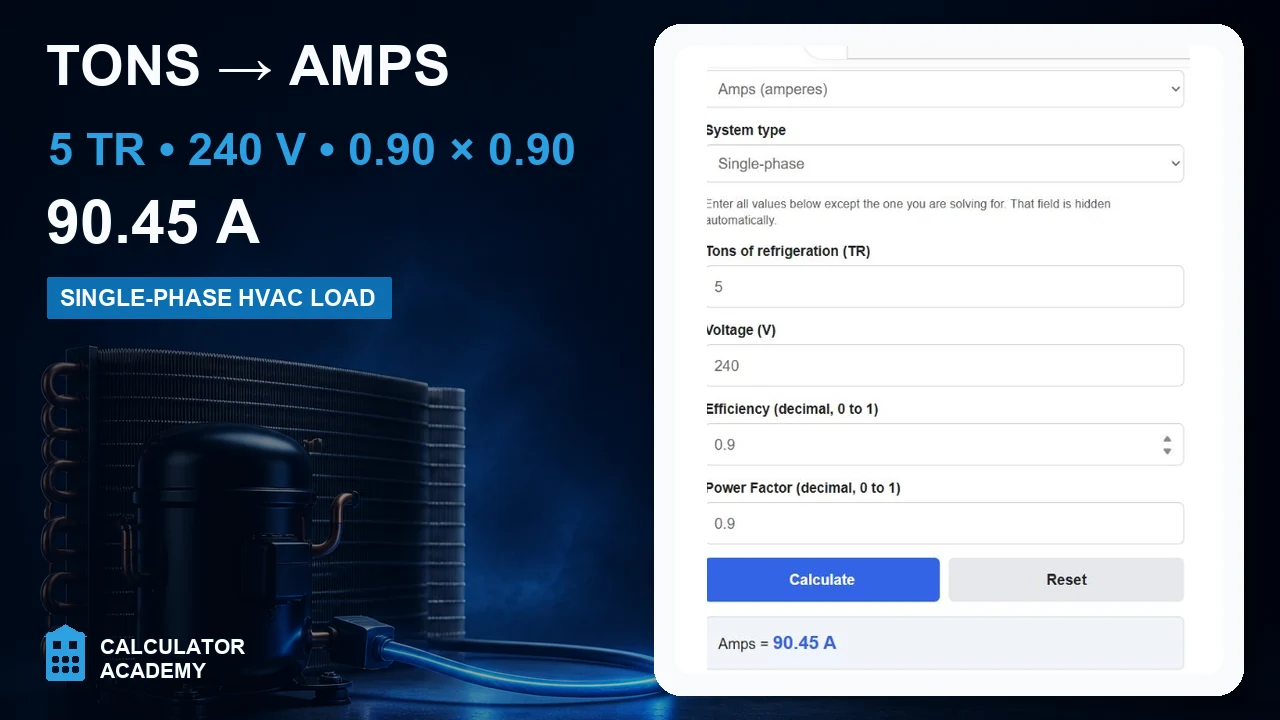
Calculate amps from refrigeration tons, voltage, efficiency, and power factor, or solve any missing value in the tons-to-amps formula.
- All Unit Converters
- BTU to Tonnage Calculator
- CFM to Tons Calculator
- CFM Per Ton Calculator
- kW Per Ton Calculator
- Tons to kW Calculator
- Amps to Watts Calculator
Tons to Amps Formula
The following formula is used to calculate the electrical current in amps from tons of refrigeration for a single-phase system.
Variables:
- I is the electrical current (amps)
- TR is the tons of refrigeration
- V is the voltage (volts)
- E is the efficiency (as a decimal)
- PF is the power factor (as a decimal)
To calculate the electrical current in amps, multiply the tons of refrigeration by 3516.85 (the wattage equivalent of one ton of refrigeration), then divide by the product of voltage, efficiency, and power factor. The constant 3516.85 watts comes from the definition that 1 ton of refrigeration equals 12,000 BTU/hr, and 1 BTU/hr equals 0.29307 watts (12,000 x 0.29307 = 3,516.85).
Three-Phase Tons to Amps Formula
For three-phase electrical systems, the formula requires an additional factor of the square root of 3 (approximately 1.732) in the denominator to account for the way power is distributed across three conductors:
Because three-phase power splits the load across three wires instead of two, the per-conductor current is lower for the same total cooling capacity. A 10-ton unit on a 460V three-phase circuit draws significantly less current per wire than a 10-ton unit on a 230V single-phase circuit, which is why commercial and industrial HVAC systems almost always use three-phase power for units above 5 tons.
| Tons (TR) | Amps (1-Phase, 240V) | Amps (3-Phase, 460V) |
|---|---|---|
| 1 | 18.1 | 5.5 |
| 1.5 | 27.1 | 8.2 |
| 2 | 36.2 | 10.9 |
| 2.5 | 45.2 | 13.7 |
| 3 | 54.3 | 16.4 |
| 3.5 | 63.3 | 19.1 |
| 4 | 72.4 | 21.9 |
| 5 | 90.5 | 27.3 |
| 7.5 | 135.7 | 41.0 |
| 10 | 180.9 | 54.7 |
| 12.5 | 226.1 | 68.4 |
| 15 | 271.4 | 82.0 |
| 20 | 361.8 | 109.4 |
| 25 | 452.3 | 136.7 |
| Single-phase calculated at 240V. Three-phase calculated at 460V with a 1.732 factor. Both assume efficiency of 0.90 and power factor of 0.90. Actual amp draw varies by equipment. Always reference the unit nameplate. | ||
What is a Ton of Refrigeration?
A ton of refrigeration (TR) is a unit of cooling capacity rooted in the ice harvesting era. It represents the amount of heat absorption needed to melt one short ton (2,000 lb) of ice at 32 degrees F over a 24-hour period. Because the latent heat of fusion of water is 144 BTU per pound, one ton of refrigeration equals 2,000 x 144 / 24 = 12,000 BTU per hour, or 3,516.85 watts.
This unit remains the standard in the United States, Japan, and parts of the Middle East for rating air conditioning and refrigeration equipment. Most of the rest of the world uses kilowatts of cooling (kW_c) instead. A quick conversion: 1 TR = 3.517 kW of cooling capacity.
Efficiency, SEER, and EER in the Formula
The “efficiency” variable in the tons-to-amps formula represents the ratio of cooling output to electrical input. In practice, HVAC professionals express this as EER (Energy Efficiency Ratio) or SEER (Seasonal Energy Efficiency Ratio). Understanding how these ratings map to the formula is essential for accurate calculations.
EER is defined as BTU/hr per watt of electrical input at a single test condition (typically 95 degrees F outdoor temperature). To convert EER to the decimal efficiency used in this calculator, divide the EER by the theoretical maximum EER at the given conditions. As a practical shorthand, for a system with an EER of 12, the COP (Coefficient of Performance) is approximately 12 / 3.412 = 3.52, corresponding to roughly 0.85 to 0.95 decimal efficiency in the context of this formula when paired with a typical power factor.
SEER is a seasonal average, not an instantaneous value. It accounts for varying outdoor temperatures across an entire cooling season. The 2023 SEER2 standard updated testing procedures to use higher external static pressure, resulting in slightly lower published numbers. A unit rated SEER2 15 performs similarly to one rated SEER 16 under the previous methodology. For this calculator, EER provides a more direct input since it reflects a single operating point.
| Tons (TR) | 10 SEER | 14 SEER | 16 SEER | 20 SEER |
|---|---|---|---|---|
| 1.5 | 8.8 | 6.3 | 5.5 | 4.4 |
| 2 | 11.8 | 8.4 | 7.4 | 5.9 |
| 2.5 | 14.7 | 10.5 | 9.2 | 7.4 |
| 3 | 17.6 | 12.6 | 11.0 | 8.8 |
| 3.5 | 20.6 | 14.7 | 12.9 | 10.3 |
| 4 | 23.5 | 16.8 | 14.7 | 11.8 |
| 5 | 29.4 | 21.0 | 18.4 | 14.7 |
| Values derived from SEER-based wattage: Watts = (TR x 12,000) / SEER, then Amps = Watts / (V x PF). These are approximations for comparison. Actual draw depends on operating conditions, refrigerant charge, and ambient temperature. SEER is a seasonal average, so peak-condition draw will be higher than these figures. | ||||
Power Factor in HVAC Systems
Power factor (PF) reflects the phase difference between voltage and current in an AC circuit. HVAC compressors use induction motors, which create a lagging power factor because the motor’s magnetic field draws reactive current that does no useful work. A power factor of 1.0 means all current is performing real work. Most residential air conditioning compressors operate at a power factor between 0.80 and 0.95, depending on load, age, and whether a power factor correction capacitor is installed.
Low power factor directly increases the amp draw for a given cooling output. An air conditioning unit with a power factor of 0.80 will draw roughly 19% more current than an identical unit with a power factor of 0.95 at the same voltage and tonnage. This is why the power factor variable has a significant impact on the calculation and should not be guessed at casually. The equipment nameplate or manufacturer specification sheet provides the rated power factor at design conditions.
Why Tonnage Does Not Convert Linearly to Amps
A frequent misconception is that doubling the tonnage doubles the amp draw. Tonnage measures cooling output (heat removal from the conditioned space), while amperage measures electrical input to the compressor and fan motors. The relationship between input and output depends on the thermodynamic efficiency of the refrigeration cycle, which shifts with outdoor ambient temperature, indoor load, refrigerant type and charge level, condenser cleanliness, and compressor wear.
A 3-ton unit running on a mild 80-degree day might draw 8 to 10 amps at 240V, while the same unit on a 110-degree day could draw 14 to 16 amps because the compressor must work harder against a higher condensing pressure. Variable-speed and inverter-driven compressors further complicate the relationship, as they modulate their speed (and therefore amp draw) continuously rather than cycling on and off at a fixed current. For these units, nameplate data typically lists a range of operating amps rather than a single value.
NEC Electrical Sizing for Air Conditioning Circuits
When converting tons to amps for the purpose of sizing branch circuits, the National Electrical Code (NEC) Article 440 governs air conditioning and refrigeration equipment. Two nameplate values matter more than any formula: Minimum Circuit Ampacity (MCA) and Maximum Overcurrent Protection Device (MOCP).
MCA already includes the NEC-required 125% multiplier on the largest motor load plus the sum of all other loads. Wire size must be selected to carry at least the MCA. MOCP sets the largest breaker or fuse permitted on that circuit. Under NEC 440.22, air conditioning circuits are allowed to use breakers larger than what the wire ampacity would normally permit because the running overload protection is built into the compressor motor (typically a thermal protector inside the hermetic housing). This is why it is common and code-compliant to see a 30A or even 40A breaker on 10 AWG wire for an air conditioning condensing unit.
| AC Size (Tons) | Typical MCA Range (A) | Typical MOCP (A) | Common Wire Size (AWG) |
|---|---|---|---|
| 1.5 | 10 – 13 | 15 – 20 | 14 or 12 |
| 2 | 13 – 17 | 20 – 25 | 12 or 10 |
| 2.5 | 15 – 19 | 20 – 30 | 12 or 10 |
| 3 | 17 – 23 | 25 – 35 | 10 |
| 3.5 | 19 – 26 | 30 – 40 | 10 or 8 |
| 4 | 22 – 30 | 35 – 45 | 10 or 8 |
| 5 | 27 – 37 | 40 – 60 | 8 or 6 |
| Ranges reflect variation across manufacturers and efficiency levels. Always use the specific MCA and MOCP printed on the equipment nameplate per NEC Article 440. Values shown are for typical residential split-system condensing units on 230/240V single-phase circuits. | |||
Industry Rules of Thumb
Experienced HVAC technicians and electricians often use quick estimates when precise nameplate data is not yet available, such as during early project planning or load calculations for new construction. The most common rule of thumb is approximately 1 horsepower per ton for air-cooled condensing units (including condenser fan motors). Since 1 HP equals about 746 watts, this translates to roughly 3.1 amps per ton at 240V or about 7 amps per ton at 120V for the compressor alone.
Another common approximation is 1.5 kVA per ton for packaged air conditioning units in the 2- to 5-ton range. This figure includes the compressor, condenser fan, and indoor blower motor. At 240V, 1.5 kVA per ton equates to about 6.25 amps per ton. These rules of thumb are useful for ballpark estimates but can be off by 20% to 30% depending on the specific equipment, so they should never replace actual nameplate data for final circuit sizing.
Refrigerant Type and Amp Draw
The refrigerant used in the system influences compressor amp draw because different refrigerants have different thermodynamic properties, operating pressures, and latent heats of vaporization. R-410A, the dominant residential refrigerant since the early 2000s, operates at about 50% higher pressure than the older R-22 it replaced. This higher pressure means compressors designed for R-410A must do more mechanical work per cycle, which generally results in slightly higher amp draw at equivalent tonnage compared to R-22 systems.
The newer R-32 (used in some mini-split and international markets) operates at pressures similar to R-410A but has a higher volumetric cooling capacity, meaning compressors can be physically smaller for the same tonnage. R-454B, the leading low-GWP replacement for R-410A in the U.S. market, has a slightly lower capacity than R-410A, so systems may require marginally larger compressors (and correspondingly higher amp draw) to achieve the same cooling tonnage. These differences are typically small (5% to 10%) but worth noting when comparing older and newer equipment.