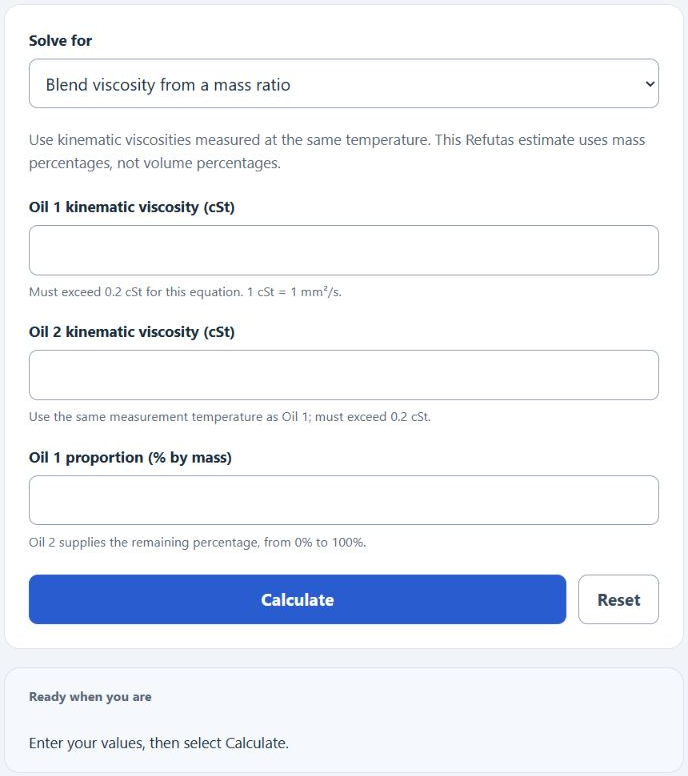
Calculate the viscosity of a blend of two oils, or the mix ratio needed to reach a target viscosity, using the Refutas equation.
Base Oil Viscosity Formula
The Refutas method estimates kinematic viscosity at a common reference temperature. All viscosities must exceed 0.2 cSt for the double logarithm. Let x be the Oil 1 mass fraction (percentage divided by 100).
- Where BV is the blended viscosity (cSt)
- O1 is the viscosity of Oil 1 (cSt)
- O2 is the viscosity of Oil 2 (cSt)
Calculate each oil’s blending number, average those numbers using mass fractions, then invert the transform. For a target viscosity, x = (Btarget − B2)/(B1 − B2). Equal oil viscosities give any ratio only when the target is the same; a target outside the two oil viscosities is unattainable in this model.
What is Base Oil Viscosity?
Definition:
Base oil viscosity typically refers to the measurement of an oil’s resistance to flow, expressed in centistokes (cSt). It is a key factor in formulating lubricants and ensuring optimal performance under varying temperature conditions.
How to Calculate Base Oil Viscosity?
Example Problem:
The following example outlines the steps and information needed to calculate the blended viscosity.
First, determine the viscosity of Oil 1. In this example, Oil 1 has a viscosity of 100 cSt.
Next, determine the viscosity of Oil 2. In this example, Oil 2 has a viscosity of 400 cSt.
Choose Blend viscosity from a mass ratio and use 50% Oil 1 by mass. Both viscosities must refer to the same temperature. Then calculate using the formula above:
Bblend = 0.5 × B(100) + 0.5 × B(400)
BV = exp(exp((Bblend − 10.975)/14.534)) − 0.8
BV ≈ 191.335 cSt
FAQ
What factors can affect the viscosity of base oils?
The viscosity of base oils can be influenced by temperature, chemical composition, and the presence of additives. Production processes and environmental conditions also play a significant role.
Can the Refutas estimate be used for all oil blends?
No. This empirical model is an estimate, not a guarantee of compatibility or lubricant performance. Chemistry, additives and non-Newtonian behavior can change the outcome. Confirm suitability and measure the finished blend before use.
Why is measuring base oil viscosity important?
Accurate viscosity measurements are essential for ensuring optimal lubricant performance and protecting machinery. They help in selecting the right oil for specific operating conditions.