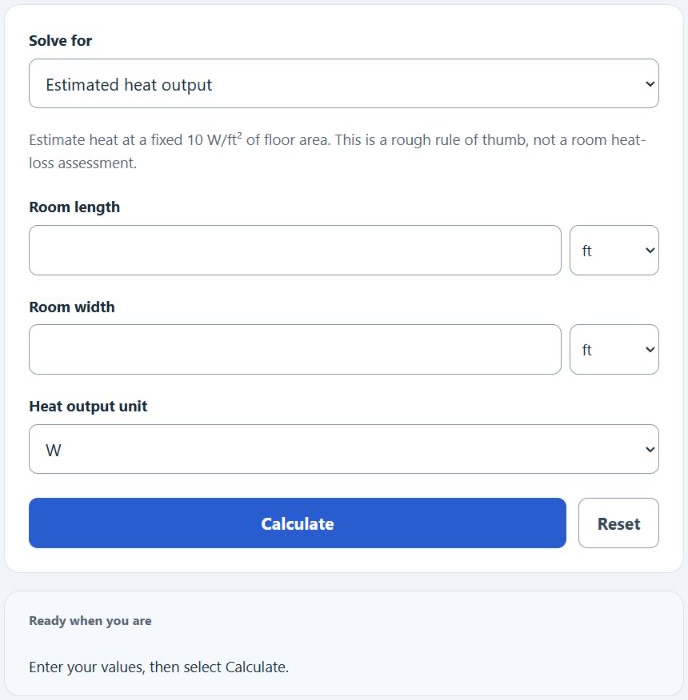
Choose estimated heat output, room length or room width. Enter the two requested values to calculate using a fixed 10 W/ft² rule of thumb. This is not a full room heat-loss assessment.
Baseboard Heat Formula
The baseboard heat calculator uses a rough heat load assumption of 10 watts per square foot. Choose the value to solve for, then enter the two requested values.
- H = estimated baseboard heat output in watts
- L = room length in feet
- W = room width in feet
- 10 = assumed heat load in watts per square foot
If you enter length and width, the calculator estimates heat output under the stated assumption. If you enter heat size and width, it solves for room length. If you enter heat size and length, it solves for room width.
The calculator converts length and width units to feet before calculating. Heat size is calculated in watts, then converted to BTU/h if that unit is selected.
Common Baseboard Heat Values
| Room Size | Area | Estimated Watts at 10 W/ft² | Approx. BTU/h |
|---|---|---|---|
| 10 ft × 10 ft | 100 ft² | 1,000 W | 3,412 BTU/h |
| 12 ft × 12 ft | 144 ft² | 1,440 W | 4,914 BTU/h |
| 12 ft × 15 ft | 180 ft² | 1,800 W | 6,142 BTU/h |
| 15 ft × 20 ft | 300 ft² | 3,000 W | 10,236 BTU/h |
| Conversion | Value |
|---|---|
| 1 watt | 3.412 BTU/h |
| 1 BTU/h | 0.293 watts |
| 1 meter | 3.2808 feet |
| 1 inch | 0.0833 feet |
Examples
Example 1: Estimate heat size for a room
You have a room that is 12 ft long and 15 ft wide.
Area = 12 × 15 = 180 ft²
Heat size = 180 × 10 = 1,800 W
In BTU/h, that is about 1,800 × 3.412 = 6,142 BTU/h.
Example 2: Find the room length
You have 1,500 W of baseboard heat available and the room is 10 ft wide.
Length = 1,500 ÷ (10 × 10)
Length = 1,500 ÷ 100 = 15 ft
FAQ
Is 10 watts per square foot always enough for baseboard heat?
No. The 10 W/ft² rule is a rough estimate. A poorly insulated room, very cold climate, high ceilings, large windows, or exterior walls may need more heat. A well-insulated room in a mild climate may need less.
How do you convert baseboard heat from watts to BTU/h?
Multiply watts by 3.412. For example, 1,500 W × 3.412 = 5,118 BTU/h. To convert BTU/h back to watts, multiply BTU/h by 0.293.
Should you size baseboard heat by floor area only?
Floor area is a quick starting point, but it is not a full heat-loss calculation. For final equipment sizing, also consider insulation, ceiling height, window area, air leakage, local outdoor design temperature, and whether the room has exterior walls.