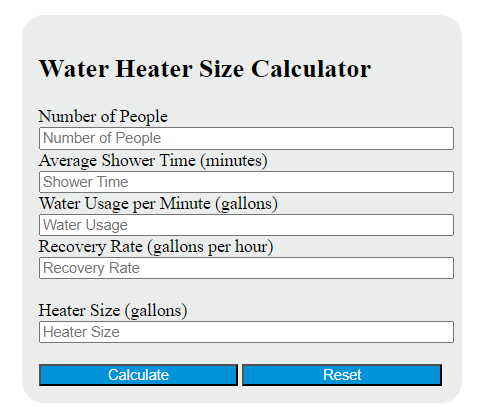
Size a storage water heater by validated peak-hour demand and recovery, or calculate tankless GPM and heat input with 1%-to-100% efficiency.
Related Calculators
- Boiler Efficiency Calculator
- Hot Water Recovery Calculator
- Water Flow Rate Calculator
- GPM Calculator
- BTU to Heat Water Calculator
- All Construction Calculators
Water Heater Size Formula
This calculator estimates the minimum storage tank capacity needed to cover a peak shower period. It compares total shower demand against the amount of hot water the heater can recover during that same time window.
- HS = required water heater storage size
- N = number of people expected to shower during the same peak period
- T = average shower time per person
- G = showerhead flow rate
- R = water heater recovery rate per hour
The formula is useful because water heaters do not rely only on stored hot water. As hot water is used, the unit is also reheating incoming cold water. That recovery lowers the amount of storage you need in the tank.
How the Formula Works
First calculate the total shower demand during the peak-use window:
Then calculate how much hot water the heater can recover during that same period:
The required storage is the difference between demand and recovery:
Since recovery is often listed per hour, dividing by 60 converts it to a per-minute value so it can be compared directly to shower flow rate.
How to Use the Calculator
- Enter the number of people likely to use showers during the same peak period.
- Enter the average shower length in minutes.
- Enter the showerhead flow rate in gallons per minute or liters per minute.
- Enter the recovery rate of the water heater in gallons per hour or liters per hour.
- Calculate the result to estimate the minimum storage size needed.
For the most realistic result, base the inputs on your busiest hot-water period, not your total daily water use.
Input Guide
| Input | What It Represents | Effect on Heater Size |
|---|---|---|
| Number of People | How many people are drawing shower hot water during the same peak period | More people increase required storage |
| Average Shower Time | The typical duration of each shower | Longer showers increase required storage |
| Water Usage | The showerhead flow rate | Higher flow rates increase demand quickly |
| Recovery Rate | How fast the heater can reheat water | Higher recovery reduces required storage |
Example Calculation
Suppose:
- N = 4 people
- T = 10 minutes
- G = 2 gallons per minute
- R = 40 gallons per hour
The estimated minimum tank size is 53.33 gallons. In practical selection, rounding up is usually safer than rounding down because real households do not use hot water in perfectly smooth, evenly spaced patterns.
What This Result Means
The result is best understood as a minimum storage estimate for a shower-driven peak period. If your home also runs other hot-water loads at the same time, your actual required size may be higher.
- Near-zero result: The heater recovery rate is close to or greater than the shower demand rate.
- Larger result: The household is relying more heavily on stored hot water than on ongoing recovery.
- Higher safety margin: Choose a larger unit if comfort, overlap, or future demand matters more than minimizing tank size.
When to Size Up
Consider selecting a larger heater than the calculator minimum if any of the following are true:
- Multiple showers commonly run at the same time
- A bathtub is filled during the same morning or evening peak
- Dishwashers or clothes washers are used during peak hot-water demand
- Your household prefers long showers
- You want extra capacity for guests or future occupancy changes
Common Mistakes
- Using total household size instead of peak overlap: only count people likely to use hot water in the same demand window.
- Ignoring showerhead flow rate: a low-flow showerhead can materially reduce required storage.
- Mixing units: keep gallons with gpm and gph, or liters with L/min and L/h.
- Confusing recovery with storage: a heater can have a modest tank but a strong recovery rate, or a large tank with slower recovery.
- Assuming the formula covers all fixtures: this model is most accurate when showers are the main peak load.
Practical Sizing Notes
This calculator is most helpful for storage-type water heaters. If you are comparing equipment, remember that the household experience depends on more than raw tank volume alone. Recovery performance, incoming water temperature, fixture overlap, and desired temperature stability all influence how the system feels in everyday use.
If your calculated requirement is very small or negative, that does not mean a heater is unnecessary. It simply means the unit’s recovery rate is meeting or exceeding the shower demand rate in this simplified model. In real use, some storage buffer is still typically desirable.
FAQ
Is this calculator only for shower demand?
Yes, the formula is centered on overlapping shower use. If sinks, tubs, laundry, or dishwashing occur during the same peak period, include extra margin when choosing a final tank size.
What if my result is between two heater sizes?
In most cases, choose the next larger available size. Small shortfalls in storage are usually more noticeable to users than modest excess capacity.
Can this be used for tankless heaters?
Not directly. Tankless units are generally sized by required flow rate and temperature rise rather than stored gallons.
Why does recovery rate matter so much?
A faster recovery rate means the heater replaces hot water more quickly while water is being used. That reduces the amount of hot water the tank must have stored in advance.