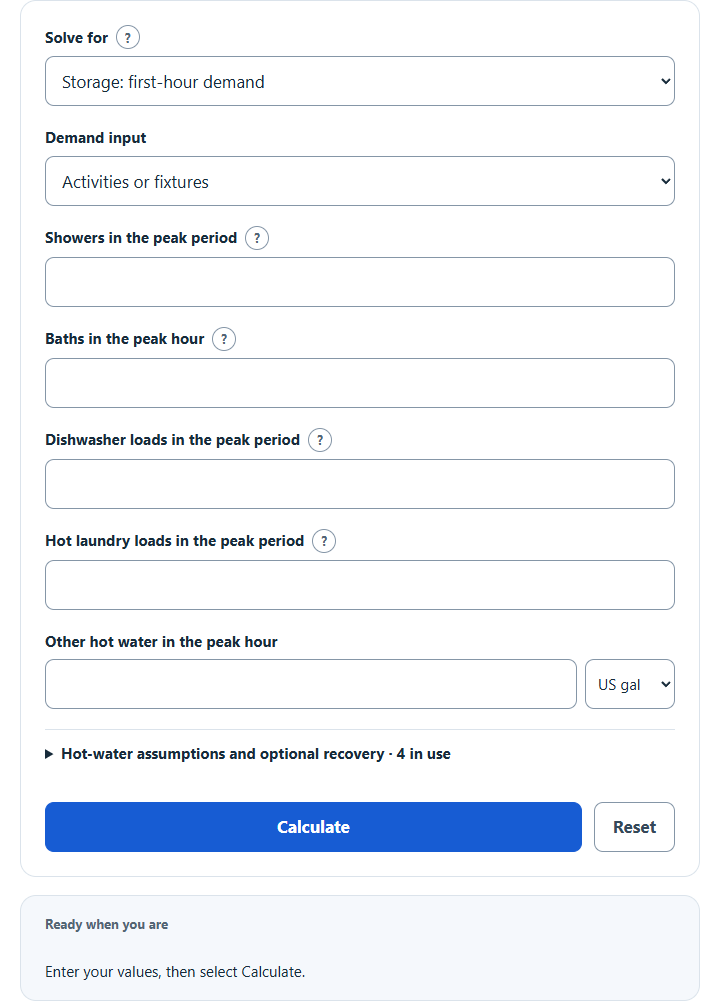
Estimate what size water heater you need: the first-hour rating for a tank, or flow rate and heat input for a tankless unit, from peak hot-water use.
Related Calculators
- Boiler Efficiency Calculator
- Hot Water Recovery Calculator
- Water Flow Rate Calculator
- GPM Calculator
- BTU to Heat Water Calculator
- All Construction Calculators
Water Heater Size Formula
Storage heaters are compared by first-hour rating: hot-water delivery in an hour that starts with the tank fully heated. Estimate the volume needed in your busiest hour and compare it with a manufacturer’s listed rating. This calculator does not infer nominal tank capacity.
- D = hot-water volume used during the busiest hour
- FHR = manufacturer first-hour rating, not tank gallons or indefinite hourly output
- Q = simultaneous hot-side flow through a tankless heater
- ΔT = heater outlet temperature minus inlet temperature
- η = thermal efficiency as a fraction, used only for approximate input power
Recovery contributes to first-hour performance, but nominal storage and usable hot-water delivery are different. The manufacturer’s rating, temperature conditions and actual draw pattern govern equipment selection.
How the Formula Works
For storage, enter activities in the busiest hour or a known total volume. Activity demand is count multiplied by the editable hot-water volume per event. Starting values are illustrative planning assumptions; replace them with measured appliance quantities.
Optional recovery gives only an ideal one-hour balance: max(0, D − R × 1 hour). It assumes fully usable stored volume and recovery available throughout the hour at the same temperature basis. Burst timing, mixing and stratification can invalidate it; it is not a tank recommendation.
For tankless operation, sum simultaneous hot-side fixture flows and calculate the temperature rise. Compare that pair with the manufacturer’s flow curve.
The factor 500 approximates water density, specific heat and minutes per hour. Divide BTU/h by 3,412.141633 for kW. Thermal efficiency is not UEF or heat-pump COP.
How to Use the Calculator
- Choose storage first-hour demand or tankless flow and heat input.
- Choose activity/fixture counts or enter a known total demand. Blank counts mean zero; total demand must be positive.
- For storage, count all hot-water events in one hour. For tankless, count only fixtures expected to run simultaneously.
- Open the optional assumptions and replace illustrative event volumes or hot-side flow rates with measured values. Storage recovery can be left blank.
- For tankless, enter inlet and outlet calculation temperatures and review thermal efficiency. These inputs are not thermostat recommendations.
- Calculate and compare the first-hour or flow-at-temperature-rise target with manufacturer ratings.
For the most realistic result, base the inputs on your busiest hot-water period, not your total daily water use.
Input Guide
| Input | What It Represents | Effect on Sizing Target |
|---|---|---|
| Peak-hour events or total volume | All hot-water use in the busiest hour | Sets the storage first-hour delivery target |
| Simultaneous hot-side flow | Water flowing through the heater at its outlet temperature | Sets the tankless flow target |
| Inlet and outlet temperatures | The required temperature rise, including seasonal inlet conditions | Higher rise requires more heat per gallon |
| Optional recovery | Hot water replenished at the same temperature basis | Used only in an ideal one-hour balance, not nominal tank selection |
Example Calculation
In the busiest hour, suppose there are two showers, one bath, one dishwasher load and one hot laundry load. With the illustrative defaults:
- Showers: 2 × 10 = 20 US gal
- Bath: 1 × 15 = 15 US gal
- Dishwasher: 1 × 6 = 6 US gal
- Laundry: 1 × 7 = 7 US gal
Compare the 48-gallon demand with a manufacturer’s first-hour rating at relevant conditions. If recovery is entered as 20 gal/h, the optional ideal starting volume is 48 − 20 = 28 gallons; that is not a nominal tank recommendation.
A separate tankless example uses 3.5 US gpm, inlet 50°F and outlet 120°F: rise 70°F; approximate water load 122,500 BTU/h. At 90% thermal efficiency, input is about 136,111.1111 BTU/h or 39.8902 kW. Verify the manufacturer can deliver 3.5 gpm at that rise.
What This Result Means
The storage result is a first-hour delivery target. Tankless results specify concurrent hot-side flow at a temperature rise, plus an approximate steady-state heat balance.
- Zero optional balance: Recovery covers the total one-hour volume in the ideal model; bursts or unusable stored volume can still require a buffer.
- Larger demand: The selected equipment must supply more hot water at the stated conditions.
- Scenario margin: Recalculate realistic guest, overlap and seasonal scenarios rather than applying arbitrary tank rounding.
When to Size Up
Include the following conditions in the demand scenario and compare suitable manufacturer ratings:
- Multiple showers commonly run at the same time
- A bathtub is filled during the same morning or evening peak
- Dishwashers or clothes washers are used during peak hot-water demand
- Your household prefers long showers
- You want extra capacity for guests or future occupancy changes
Common Mistakes
- Using total household size instead of peak overlap: only count people likely to use hot water in the same demand window.
- Ignoring measured demand: replace illustrative assumptions with actual hot-water volumes or flows.
- Mixing units: keep gallons with gpm and gph, or liters with L/min and L/h.
- Confusing recovery with storage: a heater can have a modest tank but a strong recovery rate, or a large tank with slower recovery.
- Using mixed fixture flow as heater flow: tankless demand must use the hot-side flow at the entered heater outlet temperature.
Practical Sizing Notes
Use first-hour rating for storage and flow at the required temperature rise for tankless. Nominal tank volume and input power alone do not establish delivered performance. Check actual draw timing, mixing, inlet temperature and manufacturer test conditions. See DOE storage-heater guidance and DOE tankless sizing guidance.
The optional ideal starting-volume balance is clamped at zero. A zero balance does not establish that no heater or buffer is needed. Recovery may arrive after an early burst; stored volume may not be fully usable. Final equipment, fuel, venting and electrical suitability need separate professional assessment.
FAQ
Is this calculator only for shower demand?
No. Storage mode includes showers, baths, dishwasher, laundry and other hot-water volume, or a known total. Tankless mode includes simultaneous fixtures or a known hot-side flow.
What if my result is between two heater sizes?
Compare the required first-hour delivery with the model’s listed first-hour rating. Nominal tank gallons do not directly match this target; use actual ratings and draw conditions rather than rounding the ideal balance to a tank size.
Can this be used for tankless heaters?
Yes. Select tankless mode, enter simultaneous hot-side flow and inlet/outlet conditions, then compare required flow rate at that temperature rise with the manufacturer’s curve. Approximate input power alone is insufficient.
Why does recovery rate matter so much?
Recovery contributes to the rated first-hour delivery. The optional balance illustrates its one-hour volume contribution, but timing, mixing, controls and usable capacity prevent it from being a direct nominal-storage recommendation.