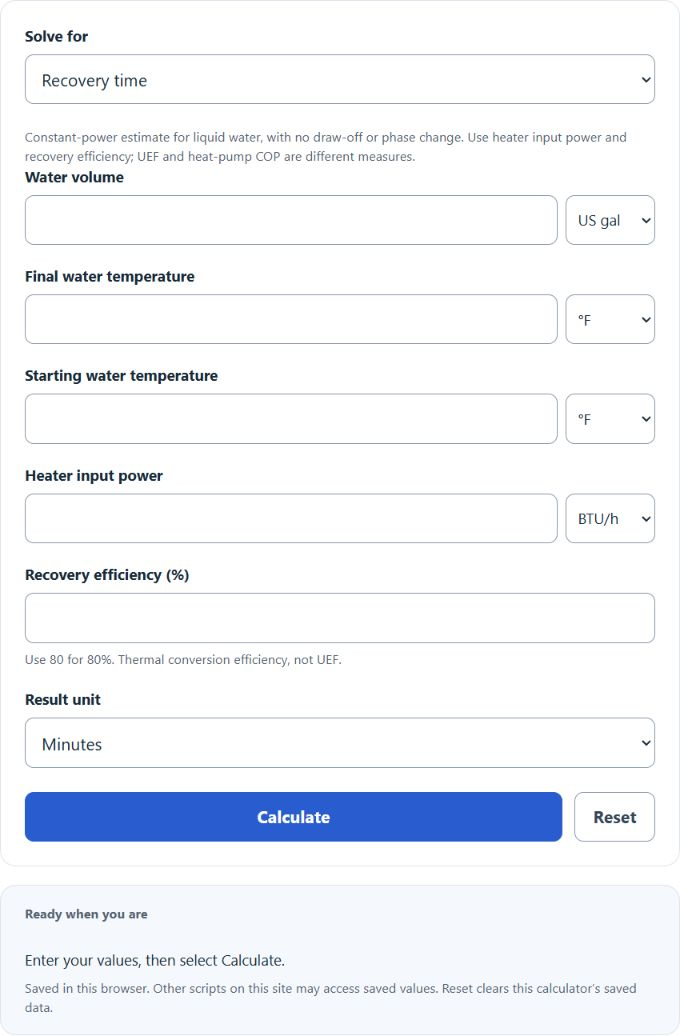
Calculate hot water recovery time, tank volume, water temperature, heater capacity or efficiency from five inputs in gallons, °F, BTU/hr or kW.
Related Calculators
- Hot Water Demand Calculator
- Insulation K Value Calculator
- Rockwool R-Value Calculator
- Loss Coefficient Calculator
- All Construction Calculators
Hot Water Recovery Formula
The calculator uses the heat required to raise a tank of water from the cold water temperature to the hot water temperature. Internally, it converts inputs to hours, US gallons, degrees Fahrenheit, and BTU/hr.
- t = hot water recovery time, in hours before final unit conversion
- V = volume of tank, in US gallons before final unit conversion
- T_h = temperature of hot water, in °F before final unit conversion
- T_c = temperature of cold water, in °F before final unit conversion
- H = heater input power in BTU/hr before final unit conversion
- E = recovery/thermal efficiency as a decimal; enter 80 for 80%, used as 0.80. UEF is not this input.
- 8.34 = approximate pounds per US gallon, with specific heat approximated as 1 BTU/(lb·°F); water properties vary with temperature
To calculate hot water recovery time, the calculator first finds the energy needed in BTU, then divides by the effective heater output, which is heating capacity multiplied by efficiency.
Select the quantity to solve for and enter the other five values. The same relationship is rearranged for time, volume, final or starting temperature, heater input power, or recovery efficiency.
Typical Inputs for Hot Water Recovery Calculations
These are illustrative engineering ranges, not setpoint recommendations or specifications for every heater. This constant-input model assumes liquid water at 0–100°C, positive volume/input/time, a positive temperature rise and recovery efficiency above 0% through 100%. It excludes heat-pump COP, phase changes and draw-off.
| Input | Common range | Notes |
|---|---|---|
| Residential tank volume | 30 to 80 gal | Larger tanks need more energy to recover from the same temperature rise. |
| Hot water setpoint | 120°F to 140°F | A larger temperature rise increases recovery time. Follow applicable temperature and scald-protection guidance; this table does not recommend a setpoint. |
| Incoming cold water | 40°F to 70°F | Colder inlet water increases the required temperature rise. |
| Gas heater input | 30,000 to 75,000 BTU/hr | Only the useful heat after efficiency is applied goes into the water. |
| Electric heater input | 3 to 5.5 kW | 1 kW equals about 3,412 BTU/hr. |
| Unit | Conversion used | Used for |
|---|---|---|
| 1 gallon | 8.34 lb of water | BTU heat calculation |
| 1 kW | 3,412.141633 BTU/hr | Heater capacity conversion |
| 1 liter | 0.264172 gal | Tank volume conversion |
| 1 cubic meter | 264.172052 gal | Tank volume conversion |
| °C to °F | °F = °C*9/5 + 32 | Temperature conversion |
Hot Water Recovery Examples
Example 1: Calculate recovery time
You have a 50 gal tank, 120°F hot water, 60°F cold water, a 40,000 BTU/hr heater, and 80% efficiency.
The recovery time is about 46.91 minutes.
Example 2: Calculate required heater capacity
You want an 80 gal tank to recover in 70 minutes. The hot water temperature is 120°F, the cold water temperature is 50°F, and the heater efficiency is 90%.
The required heater capacity is about 44,480 BTU/hr.
Hot Water Recovery FAQ
What does hot water recovery mean?
Hot water recovery is the time it takes a water heater to bring a tank of water back up to the target hot water temperature after hot water has been used. It depends on tank size, incoming water temperature, set temperature, heater capacity, and efficiency.
Why does colder inlet water increase recovery time?
Colder inlet water creates a larger temperature rise. For example, heating water from 50°F to 120°F requires more energy than heating it from 70°F to 120°F. With the same heater capacity and efficiency, more required energy means a longer recovery time.
Should efficiency be entered as a percent or decimal?
Enter recovery/thermal efficiency as a percent, for example 80 for 80%, used as 0.80. Do not substitute UEF, which includes a standardized usage pattern and standby effects. Heat-pump COP can exceed one and is outside this efficiency model.