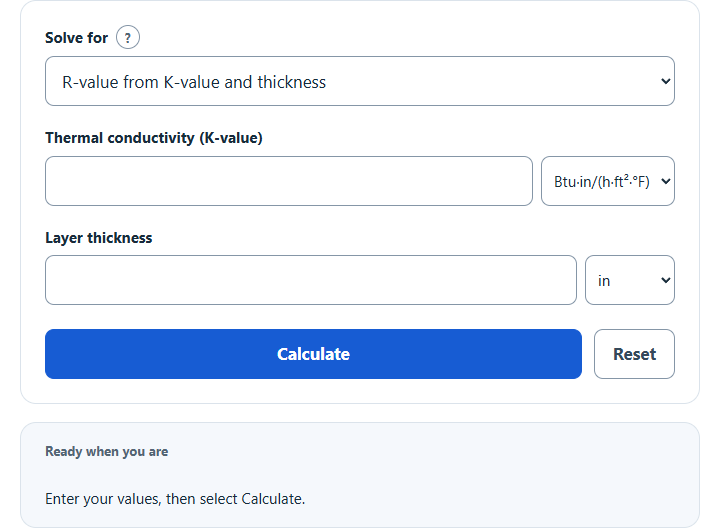
Convert insulation K-value to R-value using thickness, find K from R-value, or convert U-value to R-value and back, in US or SI units.
Insulation K Value Formula
Variables:
- K is the Insulation K Value (BTU-in/hr-ft^2-F)
- T is the thickness (in)
- R is the layer R-value (h·ft²·°F/Btu for inch-based K, or m²·K/W with thickness in meters for SI K)
For a homogeneous layer, divide thickness by its thermal resistance in consistent units: k = d/RSI in SI units. The calculator also uses k = Qd/(AΔT) for steady one-dimensional heat flow, d = k × RSI for thickness and RSI = d/k for resistance. Layer-only conductance is 1/RSI; it is not the whole-assembly U-value. See the Open University conduction model. US conversions use the International Table Btu.
How to Calculate Insulation K Value?
The following steps outline how to calculate the Insulation K Value.
- First, determine the thickness (in).
- Next, determine the R-value.
- Next, gather the formula from above: K = T / R.
- Finally, calculate the Insulation K Value.
- After inserting the variables and calculating the result, check your answer with the calculator above.
Example Problem :
Use the following variables as an example problem to test your knowledge.
thickness (in) = 30
R-value = 2.5 h·ft²·°F/Btu. With 30 inches thickness, K = 30/2.5 = 12 Btu·in/(h·ft²·°F), approximately 1.730735 W/(m·K). This is an arithmetic example, not a typical insulation recommendation.
FAQs about Insulation K Value
What is R-value in insulation?
R-value is a measure of thermal resistance used in the building and construction industry. It indicates how well a material can resist heat flow. The higher the R-value, the better the material is at insulating.
Why is the K value important in insulation?
The K value, or thermal conductivity, measures how easily heat passes through a material. It’s important in insulation because it helps determine the efficiency of the insulation material. Lower K values mean better insulation properties.
Can I calculate the K value for any type of insulation material?
For a homogeneous layer, use thickness and thermal resistance measured under matching conditions and in consistent units. Air gaps, reflective systems, surface films, thermal bridges, moisture and installation can require a more complete model; do not treat an assembly rating as intrinsic material conductivity.
How can improving insulation K value benefit a building?
Improving the K value of a building’s insulation can significantly reduce energy costs by minimizing heat loss or gain. It also enhances comfort levels within the building and contributes to a more environmentally friendly structure by reducing the need for heating and cooling.