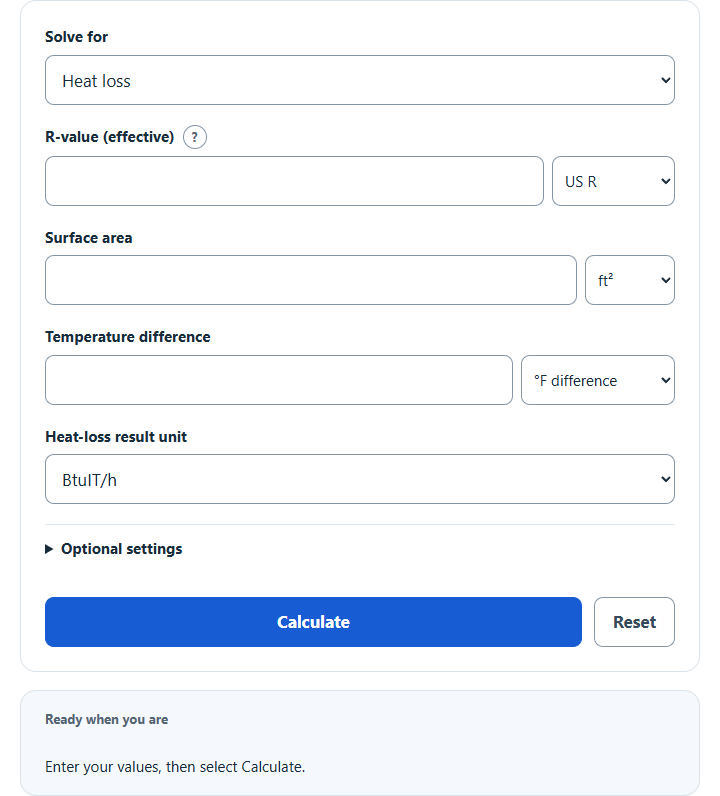
Calculate heat loss through a wall, roof or window from its R-value, area and temperature difference, or convert between R-value and U-factor.
- All Construction Calculators
- All Heat Calculators
- Electric Motor Heat Loss Calculator
- Ventilation Heat Loss Calculator
Heat Loss from R-Value Formula
This steady one-dimensional conduction model uses effective whole-assembly resistance. Use consistent US or SI units; it excludes air leakage and other heat paths.
Variables:
- HLR is the Heat Loss from R-Value (BTU/hr)
- SA is the surface area (ft2)
- dT is the temperature differential (°F)
- R is effective area-normalized thermal resistance (h·ft²·°F/Btu in US units; m²·K/W in SI), not resistance in K/W for the whole object.
To calculate the heat loss, multiply the surface area by the temperature differential, then divide by the R-value.
How to Calculate Heat Loss from R-Value?
The following steps outline how to calculate the Heat Loss from R-Value.
- First, determine the surface area (ft2).
- Next, determine the temperature differential (°F).
- Next, determine the R-value.
- Next, gather the formula from above = HLR = SA * dT / R.
- Finally, calculate the Heat Loss from R-Value.
- After inserting the variables and calculating the result, check your answer with the calculator above.
Example Problem:
Use the following variables as an example problem to test your knowledge.
surface area (ft2) = 5
temperature differential (°F) = 7
R-value = 8 h·ft²·°F/Btu; HLR = 5 × 7 / 8 = 4.375 Btu/h. U = 1/R. A 24-hour energy estimate assumes constant conditions for all 24 hours. Use effective assembly data rather than nominal insulation R alone; framing, films and other paths can alter performance.
R-value from Thickness and Thermal Conductivity
For one uniform flat layer, choose Layer R-value. Enter the layer thickness and its tested thermal conductivity. The result shows US R, RSI and reciprocal layer conductance. The reverse mode finds conductivity from thickness and layer R-value.
RSI = t / k, with thickness t in meters and conductivity k in W/(m·K). US R = RSI / 0.1761101838. For example, 100 mm at 0.04 W/(m·K) gives RSI 2.5, US R 14.1957 and layer conductance 0.4 W/(m²·K). Use product-specific conductivity; generic material names cannot account for temperature, moisture, density or aging. This layer result excludes air films, framing and other layers, so it is not automatically the effective whole-assembly resistance used for building heat loss. See the DOE conduction heat-transfer handbook.
Heat Loss through Pipe Insulation
Pipe insulation needs radial conduction rather than the flat-wall formula above. Use the Thermal Resistance Calculator, select heat flow and hollow-cylinder geometry, and enter inner and outer radii, length, conductivity and temperature difference. It uses Q = 2πkLΔT / ln(rₒ/rᵢ); the result is total heat rate for length L, not heat rate per unit length. Surface films and end losses are not automatically included.