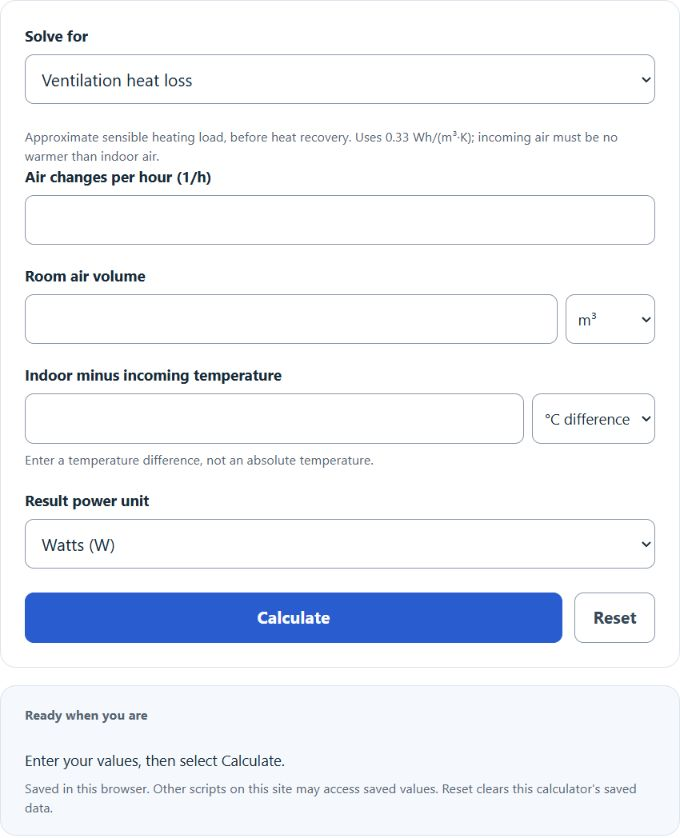
Select ventilation heat loss, air changes per hour, room volume, or temperature difference to solve for, then enter the three required values. Heat loss is the sensible heating load before heat recovery.
- All Construction Calculators
- Energy Loss Calculator
- Air Exchange Calculator (Air Change Per Hour & Minute)
- Air Enthalpy Calculator
- Heat Dissipation Calculator
How to Calculate Ventilation Heat Loss
Ventilation heat loss is the sensible heating load created when indoor air is replaced by cooler outdoor air. This calculation is useful for estimating heating demand from fresh-air ventilation, exhaust makeup air, or overall air exchange in a room or building. The relationship is linear, so increasing air changes per hour, space volume, or temperature difference increases the heat loss in direct proportion.
For rectangular spaces, room volume is found by multiplying length, width, and height.
Inputs and Output
| Item | Meaning | Common Units | Practical Note |
|---|---|---|---|
| Air Exchanges Per Hour (n) | How many times the full air volume is replaced each hour | 1/hr | Higher values mean more outdoor air to heat |
| Volume (V) | Total conditioned air volume of the room or building | m³ or ft³ | Use volume, not floor area |
| Temperature Change (ΔT) | Indoor target temperature minus incoming air temperature | °C or °F | Use the temperature difference only |
| Ventilation Heat Loss (Q) | Heating power required to warm the incoming air | W or BTU/hr | This is a sensible load estimate |
Back-Solving for a Missing Value
Select the missing variable and enter the other three. Inverse calculations require nonzero multiplying inputs; zero heat loss with a zero multiplying input does not determine a unique answer. Room volume must be positive. Use a nonnegative indoor-minus-incoming temperature difference for this heating model.
Examples
A 300 m³ room with 2 air changes per hour and a 15°C indoor-to-outdoor temperature difference has the following ventilation heat loss:
A 12,000 ft³ space with 1.5 air changes per hour and a 25°F temperature difference has:
How to Interpret the Result
- Higher ACH: More fresh or leaked air enters the space, so the heating load rises.
- Larger volume: Bigger spaces contain more air and therefore require more heat when that air is replaced.
- Larger temperature difference: Cold outdoor conditions increase the amount of heat needed to bring incoming air up to room temperature.
- Linear scaling: Reducing any one input by 20% reduces ventilation heat loss by 20%, assuming the others stay constant.
| Change | Effect on Ventilation Heat Loss |
|---|---|
| ACH doubles | Heat loss doubles |
| Room volume doubles | Heat loss doubles |
| Temperature difference doubles | Heat loss doubles |
| Any one input is cut in half | Heat loss is cut in half |
Heat Recovery Adjustment
If the ventilation system includes an HRV or ERV, the actual heating load on the building can be lower than the raw ventilation loss. A quick adjustment is to apply the sensible recovery efficiency.
If the original ventilation heat loss is 2970 W and the system recovers 75% of the sensible heat, the remaining load is:
Quick Reference
| Conversion or Term | Value |
|---|---|
| 1 kW | 1000 W |
| 1 W | 3.412 BTU/hr |
| 1 m³ | 35.315 ft³ |
| 1 ACH | One full room air volume replaced each hour |
Important Notes
- This estimate covers ventilation-related sensible heat loss only. It does not include heat transfer through walls, roofs, floors, windows, or doors.
- For peak winter heating checks, use the indoor setpoint and the expected outdoor design temperature, not a mild daily average.
- If you are estimating total air-exchange load, make sure the ACH value reflects both mechanical ventilation and any uncontrolled leakage you want to include.
- Be careful not to mix unit systems when calculating manually. Use metric values with the metric constant and imperial values with the imperial constant.
- If a result seems too low, verify that you entered room volume rather than floor area and that ceiling height was included.