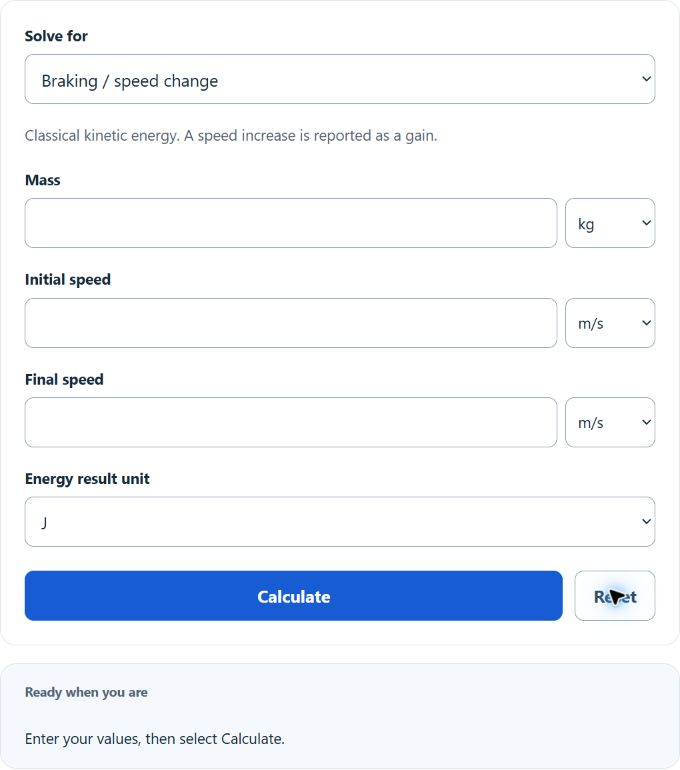
Calculate energy loss from braking, falling, friction, or ion penetration with mass, speed, height and thickness inputs; outputs in J, cal, Wh, or MeV.
- Mechanical Energy Calculator
- Average Kinetic Energy Calculator
- All Physics Calculators
- Energy Loss From Friction Calculator
Energy Loss Formula
The following formula is used to calculate the kinetic energy loss of a moving object.
- Where EL is the total energy loss (J)
- M is the mass of the object (kg)
- Vi is the initial velocity (m/s)
- Vf is the final velocity (m/s)
To calculate the energy loss of a moving object, subtract the final kinetic energy from the initial kinetic energy, where the initial and final kinetic energies are calculated using the formula 1/2*M*V^2.
What is energy loss?
Definition:
Energy loss describes energy leaving a chosen system or mechanical energy becoming heat, sound or other forms. Energy is transferred or transformed rather than destroyed.
The formula above measures kinetic energy loss; a negative loss indicates a gain. Falling-object mode reports gravitational potential energy released, friction mode estimates mechanical energy dissipated, and ion mode uses a constant stopping-power approximation rather than energy-dependent transport data.
How to calculate energy loss?
Example Problem:
The following example problem outlines how to calculate the energy loss of a moving object.
First, determine the mass of the object. In this example, the mass is weighed to be 10 kg.
Next, determine the initial velocity of the object. In this example, the initial velocity is measured to be 12 m/s.
Next, determine the final velocity after some event that causes energy loss. In this case, the final velocity is measured to be 8 m/s.
Finally, calculate the total energy loss (kinetic), using the formula above:
EL = 1/2*M*Vi^2 - 1/2*M*Vf^2
EL = 1/2*10*12^2 - 1/2*10*8^2
EL = 400 J