Calculate average kinetic energy from temperature, or find temperature, speed, or mass from kinetic energy for gases and moving objects.
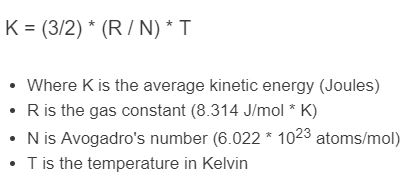
Average Kinetic Energy Formula
Choose Gas kinetic energy, Gas temperature, or the moving-object value to solve for. The calculator uses the following formulas.
Per-particle (Gas kinetic energy mode):
Per-mole (also used in Gas temperature mode):
RMS particle speed (optional in Gas kinetic energy mode):
Moving object (classical kinetic energy):
- KE_avg = average translational kinetic energy
- kB = Boltzmann constant, 1.380649 × 10⁻²³ J/K
- R = molar gas constant, 8.31446 J/(mol·K)
- T = absolute temperature in kelvin
- M = molar mass in kg/mol (input in g/mol is converted)
- m = object mass in kg
- v = object speed in m/s
- v_rms = root-mean-square molecular speed in m/s
The gas formulas assume an ideal gas in thermal equilibrium and count only translational motion, not rotation or vibration. Temperature must be at or above absolute zero. At zero kelvin, zero energy is the classical limiting value; quantum motion is not modeled. The moving-object formula is non-relativistic and breaks down once speed approaches a noticeable fraction of the speed of light; the calculator flags results above 1% of c.
The calculation choices do the following:
- Gas kinetic energy takes T and returns KE per particle and per mole. Enter an optional molar mass for RMS speed; choose a gas suggestion or enter a custom value.
- Gas temperature inverts the gas formula. Give it KE in J/particle, eV/particle, J/mol, or kJ/mol and it returns T in K, °C, and °F.
- The moving-object choices use KE = ½mv². Select energy, mass, or speed in Solve for and enter the two required values.
Reference Tables
Average kinetic energy of an ideal-gas molecule at common temperatures.
| Temperature | KE per molecule (J) | KE per molecule (eV) | KE per mole (kJ/mol) |
|---|---|---|---|
| 100 K | 2.07 × 10⁻²¹ | 0.0129 | 1.247 |
| 200 K | 4.14 × 10⁻²¹ | 0.0259 | 2.494 |
| 273.15 K (0 °C) | 5.66 × 10⁻²¹ | 0.0353 | 3.406 |
| 298.15 K (25 °C) | 6.17 × 10⁻²¹ | 0.0385 | 3.718 |
| 500 K | 1.04 × 10⁻²⁰ | 0.0646 | 6.236 |
| 1000 K | 2.07 × 10⁻²⁰ | 0.1293 | 12.472 |
RMS speed of common gases at 25 °C (298.15 K), using approximate molar masses. Air is treated as an effective single-species approximation; a mixture has species-specific speeds.
| Gas | Molar mass (g/mol) | v_rms (m/s) |
|---|---|---|
| Hydrogen (H₂) | 2.01588 | 1920 |
| Helium (He) | 4.003 | 1363 |
| Nitrogen (N₂) | 28.0134 | 515 |
| Air | 28.97 | 506 |
| Oxygen (O₂) | 31.9988 | 482 |
| Carbon dioxide (CO₂) | 44.0095 | 411 |
Worked Examples and FAQ
Example 1: Air at room temperature. At T = 298.15 K, KE_avg = (3/2)(1.380649 × 10⁻²³)(298.15) = 6.17 × 10⁻²¹ J per molecule. Per mole that is (3/2)(8.314)(298.15) = 3718 J/mol, or about 3.72 kJ/mol.
Example 2: Solving for temperature. If the average kinetic energy of gas molecules is 8.00 × 10⁻²¹ J, then T = KE / ((3/2) kB) = 8.00 × 10⁻²¹ / (2.071 × 10⁻²³) = 386 K, which is 113 °C.
Example 3: Moving object. A 1500 kg car at 20 m/s has KE = 0.5 × 1500 × 20² = 300,000 J, or 300 kJ.
Why the factor 3/2? A monatomic ideal gas has three translational degrees of freedom. Each contributes (1/2) kB T to the average energy, giving (3/2) kB T total. Diatomic and polyatomic gases store more energy in rotation and vibration, but the translational part is still (3/2) kB T.
Does average kinetic energy depend on the type of gas? No. At the same temperature, every ideal gas has the same average translational kinetic energy per molecule. Lighter molecules just move faster to compensate, which is why hydrogen has a much higher v_rms than carbon dioxide at the same T.
What is the difference between average kinetic energy and total kinetic energy? Average kinetic energy is per molecule (or per mole). Total kinetic energy of a sample is the average multiplied by the number of molecules (or moles) present.
When does KE = ½mv² stop working? Relativistic corrections grow continuously with speed. The calculator warns above 1% of light speed as a conservative notice, not a sharp boundary, and rejects object speeds at or above light speed. Use KE = (γ − 1)mc² when relativistic precision is needed.