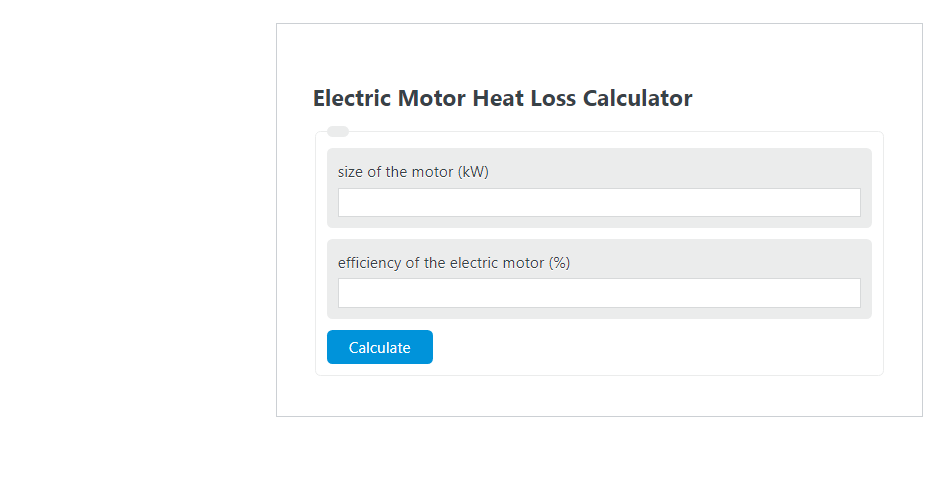
Calculate electric motor heat loss from power and efficiency or measured volts, amps, power factor, and phase, with W, kW, Btu/hr, and cooling-ton results.
- All Physics Calculators
- All Heat Calculators
- Electric Motor Torque Calculator
- Heat Dissipation Calculator
Electric Motor Heat Loss Formula
The calculator uses one of three formulas, depending on which tab you select.
Heat loss from rated power and efficiency:
Room heat gain (depends on what sits in the room):
Heat loss from measured amps:
- Q_loss = motor heat loss (kW)
- Q_room = heat dumped into the room (kW)
- P_input = electrical power drawn by the motor (kW)
- P_output = shaft or nameplate output power (kW)
- eta = motor efficiency (decimal, e.g. 0.85)
- V = line voltage (V)
- I = line current (A)
- PF = power factor (0 to 1)
The Heat loss tab takes nameplate or measured power plus an efficiency and returns the waste heat. The Room heat gain tab adds a location choice so the result reflects only what is physically inside the room. The From amps tab starts with voltage and current readings, computes the electrical input, and applies efficiency to get the heat loss. Results are shown in W, kW, Btu/hr, and tons of cooling.
Typical Values
Use these tables to pick a reasonable efficiency or to sanity check the output.
| Motor size | Typical efficiency | Typical power factor |
|---|---|---|
| Under 1 kW (under ~1.3 hp) | 70 to 80% | 0.70 to 0.80 |
| 1 to 3 kW | 75 to 85% | 0.78 to 0.85 |
| 3 to 15 kW | 85 to 90% | 0.82 to 0.88 |
| 15 to 150 kW | 90 to 94% | 0.85 to 0.90 |
| Over 150 kW | 93 to 96% | 0.87 to 0.92 |
| Output | Heat loss at 85% eff | Heat loss at 90% eff | Heat loss at 94% eff |
|---|---|---|---|
| 1 kW | 176 W (601 Btu/hr) | 111 W (379 Btu/hr) | 64 W (218 Btu/hr) |
| 5 kW | 882 W (3,010 Btu/hr) | 556 W (1,896 Btu/hr) | 319 W (1,089 Btu/hr) |
| 15 kW | 2,647 W (9,032 Btu/hr) | 1,667 W (5,687 Btu/hr) | 957 W (3,267 Btu/hr) |
| 50 kW | 8,824 W (30,107 Btu/hr) | 5,556 W (18,956 Btu/hr) | 3,191 W (10,889 Btu/hr) |
| 100 kW | 17,647 W (60,214 Btu/hr) | 11,111 W (37,913 Btu/hr) | 6,383 W (21,778 Btu/hr) |
Worked Examples
Example 1: 7.5 kW pump motor. Nameplate output is 7.5 kW. Efficiency is 88%. Input power is 7.5 / 0.88 = 8.523 kW. Heat loss is 8.523 − 7.5 = 1.023 kW, or about 3,490 Btu/hr. If the pump and motor both sit in a plant room, the room sees the full 8.523 kW of heat once the fluid energy dissipates back. If only the motor is inside, the room gain is 1.023 kW.
Example 2: From amps. A three-phase motor runs at 400 V, draws 18 A, with PF 0.85 and efficiency 90%. Input power is 1.732 × 400 × 18 × 0.85 / 1000 = 10.6 kW. Heat loss is 10.6 × (1 − 0.90) = 1.06 kW, or about 3,617 Btu/hr.
FAQ
Why does the room gain sometimes equal the full input power? If both the motor and the equipment it drives stay in the same room, all the electrical input eventually turns into heat. Friction, fluid turbulence, and belt losses all become heat in that space.
Should I use nameplate power or measured power? Nameplate is fine for sizing. For an installed motor that is not fully loaded, measured amps give a more accurate heat loss because part-loaded motors draw less than nameplate.
Does power factor change the heat loss? Power factor affects the apparent power and the current, but the real power (kW) is what becomes heat. The calculator already uses real power in the amps tab.
How do I convert the result to cooling tons? One ton of cooling equals 12,000 Btu/hr. The result panel shows tons directly so you can size an AC unit or fan that offsets the gain.