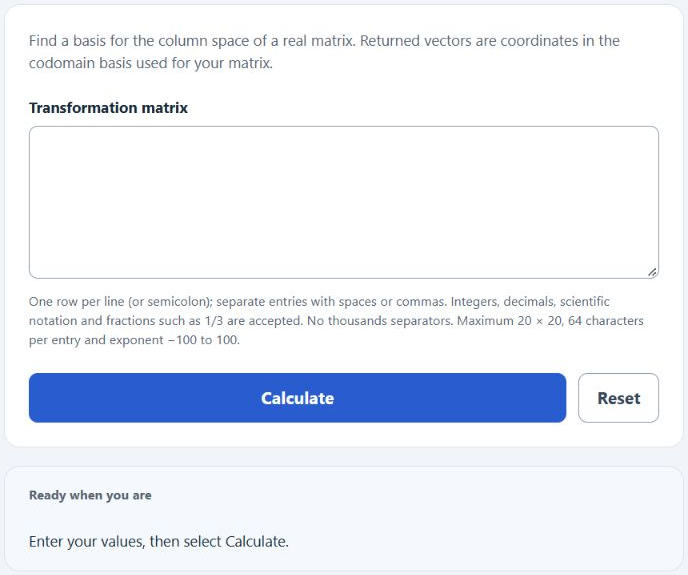
Calculate an image basis from a real transformation matrix using exact rational arithmetic. Enter rows on separate lines; decimals and fractions are treated as exact values. The calculator returns original pivot columns, rank and reduced row echelon form for matrices up to 20 × 20.
Basis Of Image Formula
The image (also called the range) of a linear transformation T is the set of all outputs T(v). A basis of the image is any linearly independent set of vectors that spans this image.
Variables:
- Im(T) is the image (range) of the transformation T
- V is the domain vector space
- T(v) is the output of the linear transformation applied to the input vector v
- A is a matrix representation of T; its column space represents the image in codomain coordinates. With nonstandard bases, the returned vectors are coordinate lists in the chosen codomain basis.
To find a basis of the image, apply T to a spanning set (typically a basis) of V to get vectors in the codomain, then keep a linearly independent subset that still spans the same set of outputs. If T is given by a matrix A, a standard method is to row-reduce A to find the pivot columns; the corresponding columns of the original matrix form a basis for the image (the column space).
What is the Basis of Image?
A basis of an image, in the context of linear algebra, refers to a set of vectors that spans the image of a linear transformation or a matrix. These vectors are linearly independent, meaning they cannot be expressed as a linear combination of each other. The basis of an image provides a way to describe every vector in the image space in terms of a linear combination of the basis vectors.
How to Calculate Basis Of Image?
The following steps outline a common way to calculate a basis of the image.
- Identify the linear transformation T:V\to W (or its matrix A with respect to chosen bases).
- Choose a basis {v1,…,vn} of the domain V.
- Compute the images T(v1),…,T(vn), which are vectors in the codomain W.
- Form a matrix whose columns are these vectors (equivalently, if you already have the matrix A, its columns are T(e1),…,T(en) in standard coordinates).
- Row-reduce to find which columns are pivot columns, then take the corresponding columns of the original matrix as a basis for Im(T). The number of basis vectors is the rank (dimension of the image).
Example Problem:
Use the following variables as an example problem to test your knowledge:
Let {v1, v2, v3, v4} be a basis of a vector space V.
Define the linear transformation T(v)=2v (over the real numbers, or any field where 2 ≠ 0).
Then Im(T)=V, and one basis of the image is {T(v1),T(v2),T(v3),T(v4)} = {2v1,2v2,2v3,2v4} (which is also a basis of V).