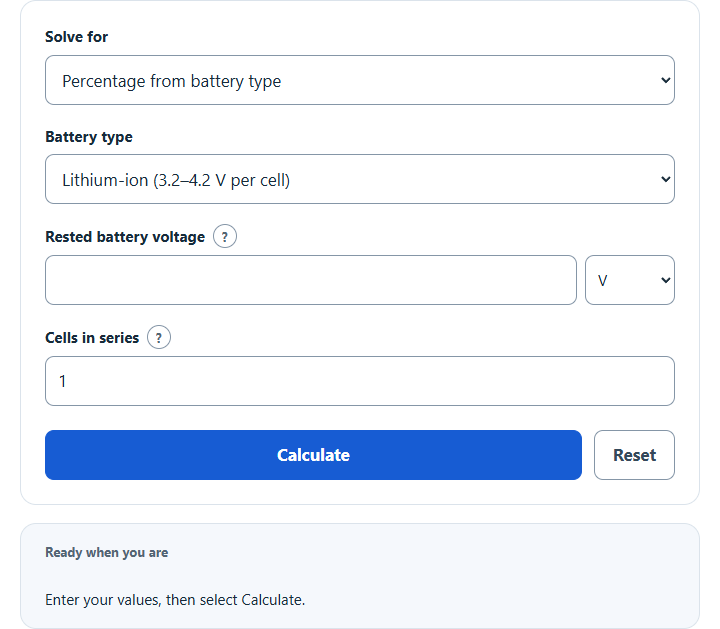
Convert battery voltage to percentage: pick Li-ion, LiFePO4 or lead-acid and enter the rested voltage and cell count, or use your own 0%/100% voltages.
- All Unit Converters
- Battery Efficiency Calculator
- Battery Cost Calculator
- Battery Pro Rata Calculator
Battery Voltage Percentage Formula
Variables:
- BVP is the Battery Voltage Percentage (%)
- Vc is the current voltage
- Vmin is the minimum voltage (0% reference)
- Vmax is the maximum voltage (100% reference)
How to Calculate Battery Voltage Percentage?
The following steps outline how to calculate the Battery Voltage Percentage.
- First, determine the current battery voltage (Vc) in volts.
- Next, determine the maximum (full) voltage (Vmax) in volts.
- Next, determine the minimum (empty) voltage (Vmin) in volts.
- Next, use the formula from above: BVP = (Vc − Vmin) / (Vmax − Vmin) × 100.
- Finally, calculate the Battery Voltage Percentage.
- After inserting the variables and calculating the result, check your answer with the calculator above.
Example Problem :
Use the following variables as an example problem to test your knowledge.
current battery voltage (volts) = 12.5
maximum battery voltage (volts) = 12.7
minimum battery voltage (volts) = 11.9
battery voltage percentage (%) = (12.5 − 11.9) / (12.7 − 11.9) × 100 = 75%
Frequently Asked Questions
What is the significance of knowing a battery's voltage percentage?
A voltage percentage (based on your chosen “empty” and “full” voltages) can be a quick way to gauge where the measured voltage sits within that range. It can help decide when to recharge, but voltage alone is not a precise measure of remaining capacity—especially under load or while charging.
How can environmental factors affect battery voltage readings?
Temperature and recent battery use have a major effect on voltage readings. Temperature changes the voltage/SOC relationship; a battery’s voltage can sag under load and rise while charging (surface charge). Use the manufacturer’s rest period and temperature-specific data. The included chemistry tables are illustrative examples, not calibrated remaining-capacity measurements.
Can the battery voltage percentage formula be used for all types of batteries?
The formula can be used for any battery as a linear percentage between a selected Vmin and Vmax. However, because battery voltage vs. state-of-charge is chemistry-dependent and often non-linear, the result may not match true state of charge unless the chosen voltage range and measurement conditions are appropriate.
Why is it important to use the maximum battery voltage in calculations?
Vmax (together with Vmin) defines the reference range for the percentage calculation. Using a correct Vmax for your battery and measurement conditions helps keep the calculated percentage meaningful and comparable.