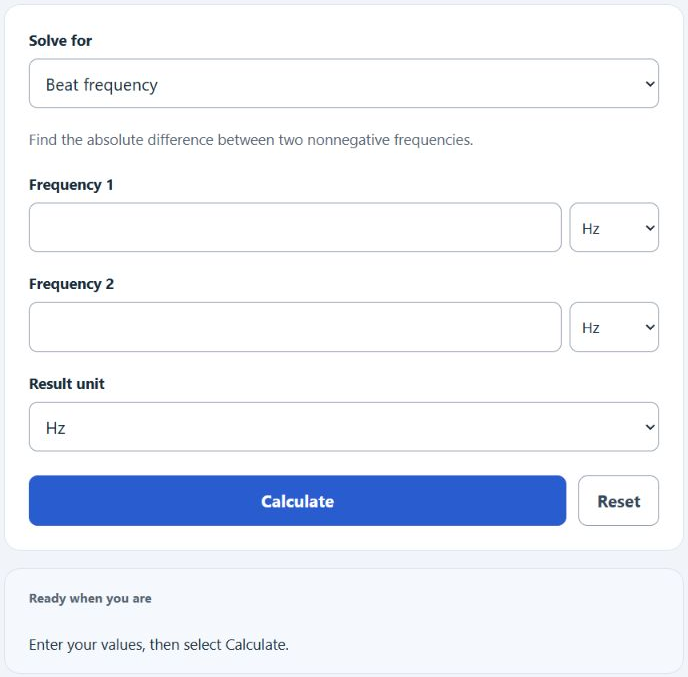
Calculate beat frequency, frequency 1, or frequency 2 from two known values in Hz, kHz, MHz, or GHz with step-by-step results and units.
- All Physics Calculators
- Natural Frequency Calculator
- Decibel Calculator
- Sound Pressure Level Calculator
- Bars Per Minute Calculator
Beat Frequency Formula
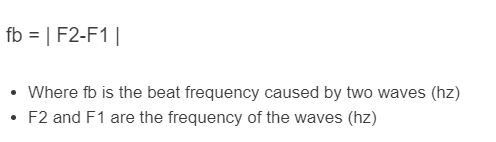
The beat frequency is the absolute difference between two frequencies. When two tones or signals are close in frequency, the beat frequency is the rate at which the combined sound or signal seems to pulse.
To solve for a missing frequency, the calculator uses the beat frequency relationship in reverse:
- f_b = beat frequency
- f_1 = frequency 1
- f_2 = frequency 2
The calculator converts all entered values to hertz before applying the formula. After the calculation, it converts the result back to the unit selected for the missing value.
- Calculate beat frequency: enter Frequency 1 and Frequency 2. The calculator finds the absolute difference between them.
- Calculate Frequency 1: enter Frequency 2 and the beat frequency. Select the higher or lower branch to solve for Frequency 1.
- Calculate Frequency 2: enter Frequency 1 and the beat frequency. Select the higher or lower branch to solve for Frequency 2.
Because beat frequency is based on an absolute difference, a missing original frequency can sometimes have two possible values: one above the known frequency and one below it. This calculator lets you select the higher or lower solution and rejects negative frequencies.
Frequency Unit Conversions
Use these conversions to check values when working with Hz, kHz, MHz, and GHz.
| Unit | Meaning | Equivalent in Hz |
|---|---|---|
| Hz | Hertz | 1 Hz |
| kHz | Kilohertz | 1,000 Hz |
| MHz | Megahertz | 1,000,000 Hz |
| GHz | Gigahertz | 1,000,000,000 Hz |
Typical Beat Frequency Interpretations
| Beat Frequency | What it means |
|---|---|
| 0 Hz | The two frequencies are the same, so no beating occurs. |
| 1 to 5 Hz | Slow, clearly noticeable pulsing for audible tones. |
| 5 to 20 Hz | Faster beating that can sound rough or wavy. |
| Above 20 Hz | The beat may be heard less as separate pulses and more as roughness or a separate effect, depending on the signals. |
Example
Example 1: Find the beat frequency
You have two tuning fork frequencies: 440 Hz and 444 Hz.
The beat frequency is 4 Hz.
Example 2: Find a missing higher frequency
You know one frequency is 1.2 kHz and the beat frequency is 50 Hz. Convert 1.2 kHz to hertz first.
The missing higher frequency is 1250 Hz, or 1.25 kHz.
FAQ
What is beat frequency?
Beat frequency is the difference between two frequencies. If one tone is 440 Hz and another is 444 Hz, the beat frequency is 4 Hz. That means the combined sound rises and falls in loudness 4 times per second.
Why is the beat frequency nonnegative?
The beat frequency uses the absolute value of the difference between the two frequencies. A difference of 444 Hz minus 440 Hz gives 4 Hz, and 440 Hz minus 444 Hz gives -4 Hz. Since beat frequency represents a rate, the result is written as positive 4 Hz.
Can two different frequencies produce the same beat frequency?
Yes. For example, if the known frequency is 440 Hz and the beat frequency is 5 Hz, the other frequency could be 445 Hz or 435 Hz. Both are 5 Hz away from 440 Hz. When solving for a missing frequency, make sure you know whether the missing frequency should be higher or lower than the known one.