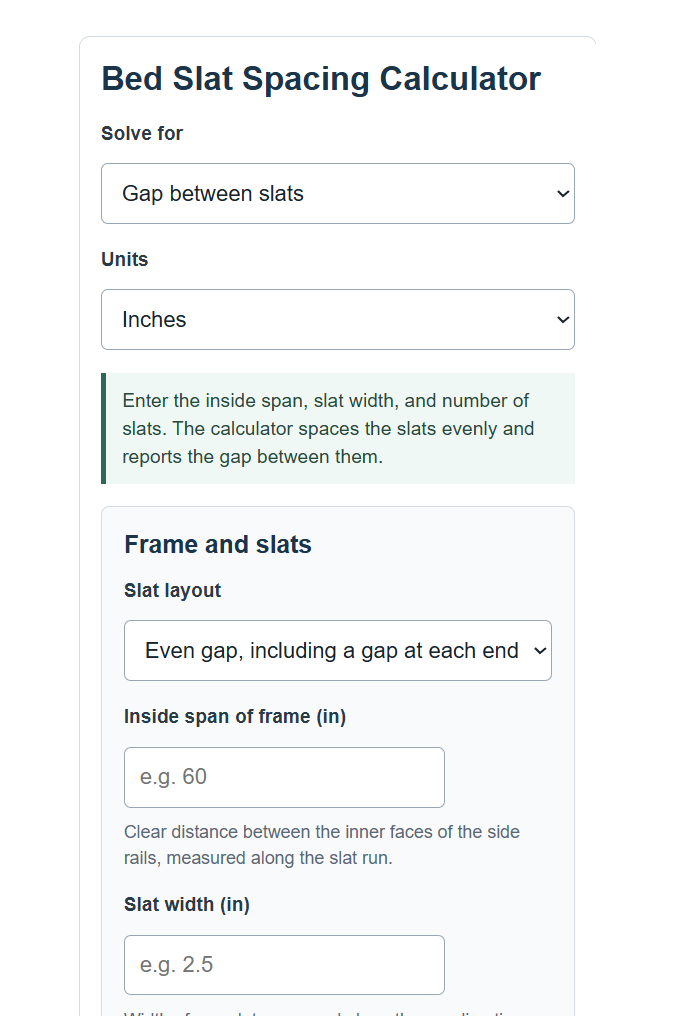
Calculate even bed slat spacing in seconds. Enter your frame width, slat width, and slat count to find the right gap for solid mattress support.
Bed Slat Spacing Formula
The calculator uses two layouts. A flush layout sets the first and last slat against the frame and only counts the gaps between slats. An even layout leaves a gap at each end as well, so there is one more gap than the number of slats.
To find the gap when you know how many slats you have:
Gap = (S - N*W) / (N + 1) (gap at each end)
Gap = (S - N*W) / (N - 1) (slats flush to frame)
To find the fewest slats that keep every gap at or below a target size G:
N = ceil( (S - G) / (W + G) ) (gap at each end)
N = ceil( (S + G) / (W + G) ) (slats flush to frame)
- S = inside span of the frame measured between the inner faces of the side rails, along the direction the slats run
- N = number of slats
- W = width of one slat measured along the same direction
- G = the largest gap you will allow between slats
- Gap = the even clear space between neighboring slats
The gap formula subtracts the space taken up by the slats (N times W) from the inside span, then divides the leftover space by the number of gaps. The slat count formula rearranges the same relationship to solve for N and rounds up, since you cannot use a fraction of a slat. After rounding up, the calculator recomputes the real gap, which will be a little smaller than your target.
On-center spacing reported with the result is one slat width plus one gap. It is the distance from the start of one slat to the start of the next, which is useful when you mark the rails for screws.
Recommended Gap by Mattress Type
Spacing affects both support and airflow. Wider gaps breathe better but let foam sag; tighter gaps support more but trap heat. These ranges are common starting points, but always follow your mattress maker’s instructions, since a too-wide gap can void the warranty.
| Mattress type | Recommended gap | Notes |
|---|---|---|
| Memory foam | 2 to 3 in | Needs close support to stop sagging |
| Latex | 2.5 to 3 in | Heavy, so keep gaps tight |
| Hybrid | 2.5 to 3 in | Foam comfort layer sets the limit |
| Innerspring | 3 to 4 in | Internal coils tolerate wider gaps |
Typical Slat Counts by Bed Size
These figures assume slats roughly 2.5 to 3 in wide with an even gap near 3 in. Use them as a sanity check against your own result.
| Bed size | Approx. slat run | Typical slats |
|---|---|---|
| Twin | 75 in | 12 to 14 |
| Full | 75 in | 12 to 14 |
| Queen | 80 in | 13 to 15 |
| King | 80 in | 13 to 15 |
Example Problems
Example 1. A frame has an inside span of 60 in along the slat run. You plan to use 12 slats, each 2.5 in wide, with an even gap including a gap at each end. The slats take up 12 times 2.5, or 30 in. The leftover space is 60 minus 30, or 30 in. There are 12 plus 1, or 13 gaps. The gap is 30 divided by 13, which is about 2.31 in. That is within range for any mattress type.
Example 2. The same 60 in frame, slats 2.5 in wide, and you want no gap larger than 3 in using the even layout. The slat count is the ceiling of (60 minus 3) divided by (2.5 plus 3), which is the ceiling of 57 divided by 5.5, or the ceiling of 10.36, which rounds up to 11 slats. Rechecking, 11 slats cover 27.5 in, leaving 32.5 in across 12 gaps, for a real gap of about 2.71 in. That meets the 3 in limit.
Frequently Asked Questions
Should I measure the frame or the mattress? Measure the inside span of the frame, between the inner faces of the side rails, along the direction the slats run. The mattress size does not enter the math. What matters is the clear space the slats have to bridge and the support they give the mattress above them.
What is the difference between the two layouts? The flush layout puts the first and last slat hard against the head and foot of the frame, so the only gaps are between slats. The even layout leaves a gap at each end too, which spreads support more evenly and is what most ready-made slat kits use. Pick the one that matches how your slats will actually sit.
Is a smaller gap always better? Not always. Tighter spacing gives foam and latex mattresses better support, but packing slats too close traps heat and moisture and uses more material. Aim for the recommended range for your mattress type rather than the smallest possible gap, and check your warranty for a stated maximum.