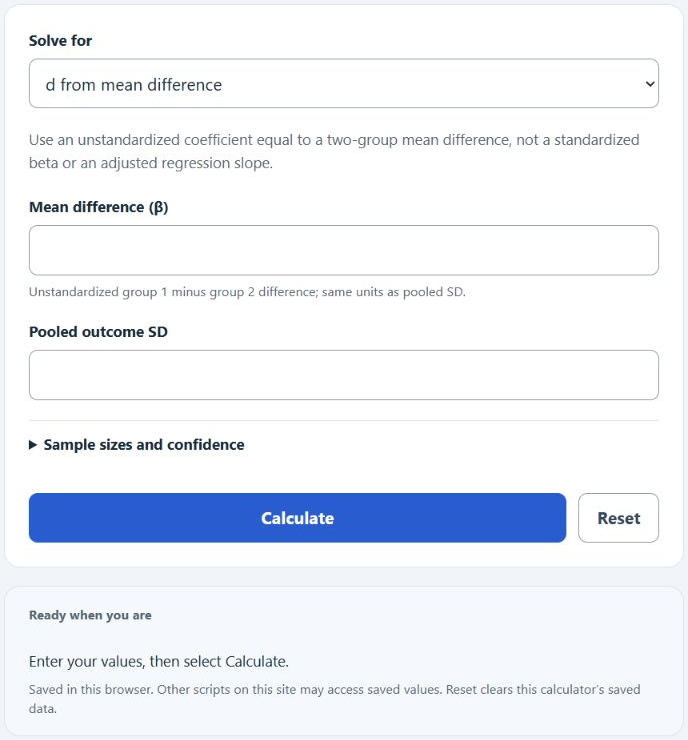
Calculate Cohen’s d from an unstandardized two-group mean difference, means and SDs, an independent t statistic, or raw group data. A separate paired method reports d_z. Hedges’ g, Glass’ Δ, r and approximate confidence intervals are shown when supported by the inputs.
Related Calculators
- Difference Of Means Calculator
- Partial Correlation Calculator
- B Value Calculator
- T Statistic Calculator (T-Value)
- All Statistics Calculators
Beta to Cohen’s d Formula
The following relationship can be used to calculate Cohen’s d from a regression coefficient β that represents a two-group mean difference (e.g., from an unadjusted linear regression with only an intercept and a binary predictor coded 0/1, where β equals the difference in group means) and the pooled standard deviation of the outcome.
Variables:
- d is Cohen’s d (unitless)
- β is the two-group mean difference (often the unstandardized regression coefficient for a 0/1 group indicator), in outcome units
- spooled is the pooled standard deviation of the outcome, in the same outcome units as β
To calculate Cohen’s d in this two-group setting, divide the mean difference (β) by the pooled standard deviation of the outcome.
| β (mean difference, outcome units) | Cohen’s d (unitless) |
|---|---|
| 0.10 | 0.10 |
| 0.20 | 0.20 |
| 0.30 | 0.30 |
| 0.40 | 0.40 |
| 0.50 | 0.50 |
| 0.60 | 0.60 |
| 0.70 | 0.70 |
| 0.80 | 0.80 |
| 0.90 | 0.90 |
| 1.00 | 1.00 |
| 1.10 | 1.10 |
| 1.20 | 1.20 |
| 1.30 | 1.30 |
| 1.40 | 1.40 |
| 1.50 | 1.50 |
| 1.60 | 1.60 |
| 1.70 | 1.70 |
| 1.80 | 1.80 |
| 1.90 | 1.90 |
| 2.00 | 2.00 |
| *Assumes pooled outcome SD (spooled) = 1.0. Formula: d = β ÷ spooled. | |
What is Cohen’s d?
Cohen’s d is a measure of effect size used in statistics to indicate the standardized difference between two means. In the common two-independent-groups case, it is calculated as the difference between the group means divided by the pooled standard deviation of the outcome. Cohen’s d is useful for comparing effect sizes across different studies and contexts because it is standardized (unitless).
How to Calculate Cohen’s d?
The following steps outline how to calculate Cohen’s d for two independent groups (and how it connects to β in a simple regression with a 0/1 group indicator).
- Define the two groups you are comparing.
- Find the mean difference between the groups (M1 − M0). In an unadjusted linear regression with only an intercept and a binary predictor coded 0/1, this mean difference is the unstandardized coefficient β for the group indicator. A standardized beta or a covariate-adjusted slope is not generally this mean difference.
- Compute the pooled standard deviation of the outcome (spooled).
- Calculate Cohen’s d: d = β ÷ spooled.
- Optionally, verify your result using the calculator above.
Example Problem :
Use the following variables as an example problem to test your knowledge.
Regression coefficient / mean difference (β) = 0.5
Pooled standard deviation of the outcome (spooled) = 2
Cohen’s d = β ÷ spooled = 0.5 ÷ 2 = 0.25