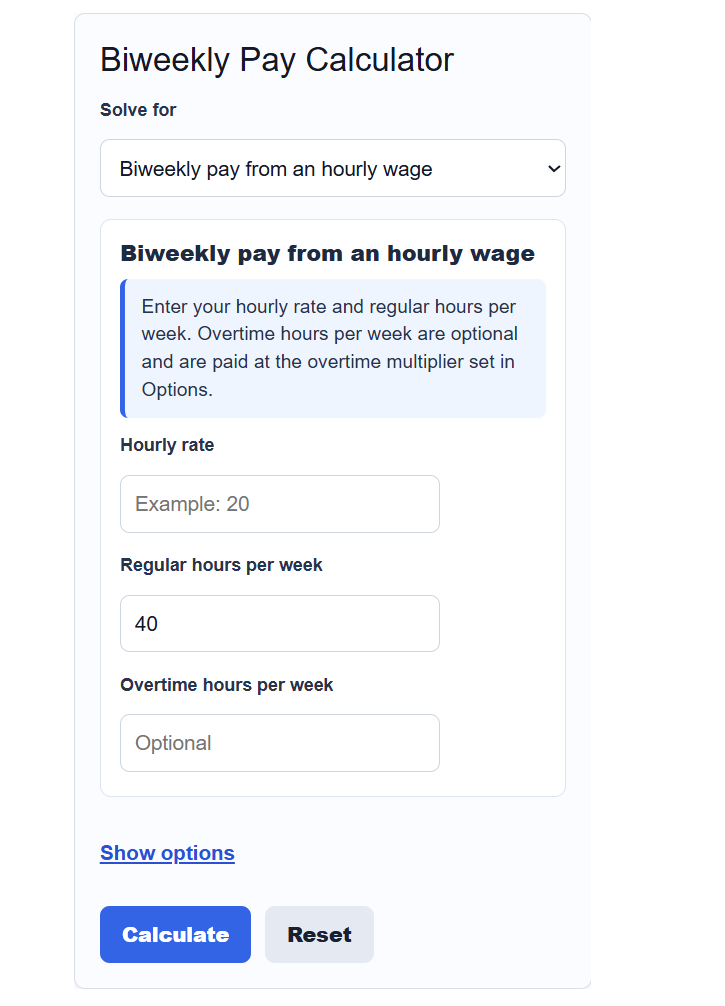
Calculate your biweekly pay from an hourly wage or annual salary, add overtime, and convert a biweekly paycheck to annual, monthly, weekly, and hourly pay.
Biweekly Pay Formula
The formula depends on what you start from. When you start from an hourly wage, biweekly pay is the hourly rate times the hours you work in a week times two, because a biweekly period covers two weeks:
Biweekly Pay = Hourly Rate * Hours per Week * 2
When you also work overtime, the overtime hours are paid at a higher multiplier and added on top:
Biweekly Pay = (Rate * Regular Hours * 2) + (Rate * OT Multiplier * OT Hours * 2)
When you start from an annual salary, biweekly pay is the salary divided by the number of pay periods in the year. Most biweekly schedules have 26 periods:
Biweekly Pay = Annual Salary / Pay Periods
To convert a biweekly paycheck back to other pay frequencies, multiply by the number of pay periods to get annual pay, then divide for the rest:
Annual = Biweekly Pay * 26 Hourly = Annual / (Weeks * Hours per Week)
The variables are:
- Hourly Rate: your pay for one hour of regular work.
- Hours per Week: the hours you are paid for in a normal week, usually 40.
- OT Multiplier: the overtime rate factor, normally 1.5 for time and a half.
- OT Hours: overtime hours worked in a week, paid at the multiplier.
- Annual Salary: your gross yearly pay before taxes and deductions.
- Pay Periods: the number of paychecks per year, 26 for a biweekly schedule.
- Weeks: paid weeks per year, usually 52, used to back out an hourly rate.
The hourly mode turns a wage into a paycheck and also reports the annual, monthly, and weekly equivalents. The salary mode splits a yearly figure into one biweekly check. The convert mode takes a biweekly amount you already receive and shows what it is worth per year, per month, per week, and per hour. The optional withholding percent applies a flat estimate so you can see an approximate take-home figure, and it is only an estimate because real taxes depend on your filing details.
Hourly Wage to Biweekly Pay
This table shows gross biweekly and annual pay for common hourly rates at a standard 40-hour week with no overtime. Biweekly pay is the rate times 80 hours, and annual pay is the rate times 2,080 hours.
| Hourly Rate | Biweekly Pay | Annual Pay |
|---|---|---|
| $15.00 | $1,200.00 | $31,200.00 |
| $20.00 | $1,600.00 | $41,600.00 |
| $25.00 | $2,000.00 | $52,000.00 |
| $30.00 | $2,400.00 | $62,400.00 |
| $40.00 | $3,200.00 | $83,200.00 |
| $50.00 | $4,000.00 | $104,000.00 |
To convert a biweekly paycheck to another pay frequency, use the factors below. These assume 26 biweekly periods and a 40-hour week.
| Convert Biweekly Pay To | Operation |
|---|---|
| Weekly | Divide by 2 |
| Annual | Multiply by 26 |
| Monthly | Multiply by 26, then divide by 12 |
| Hourly | Multiply by 26, then divide by 2,080 |
Example Problems
Example 1. You earn $22.00 per hour, work 40 regular hours per week, and put in 5 overtime hours per week paid at 1.5 times your rate. Regular biweekly pay is 22 times 40 times 2, which is $1,760.00. Overtime biweekly pay is 22 times 1.5 times 5 times 2, which is $330.00. Total biweekly gross pay is $2,090.00.
Example 2. Your gross annual salary is $60,000 and you are paid every two weeks on a 26-period schedule. Biweekly pay is 60,000 divided by 26, which is $2,307.69. Over a year those 26 checks add back up to $60,000.
Frequently Asked Questions
How many biweekly pay periods are in a year? A biweekly schedule pays every two weeks, which works out to 26 paychecks in most years. Because 52 weeks divided by 2 is 26, and because the calendar does not divide evenly, some years contain 27 biweekly paydays. If a 27-paycheck year applies to you, set the pay periods field to 27 in Options so the annual math matches your actual checks.
Is biweekly pay the same as semimonthly pay? No. Biweekly pay arrives every two weeks for 26 checks per year, while semimonthly pay arrives twice a month for 24 checks per year. A biweekly check is therefore smaller than a semimonthly check for the same salary, but you receive two more of them each year, so the annual total is the same.
How do I turn my biweekly pay into a yearly figure? Multiply your gross biweekly pay by 26. For example, $2,000 biweekly times 26 equals $52,000 per year. To estimate take-home pay instead, enter a withholding percent in Options and the calculator subtracts that share to show an approximate net amount.