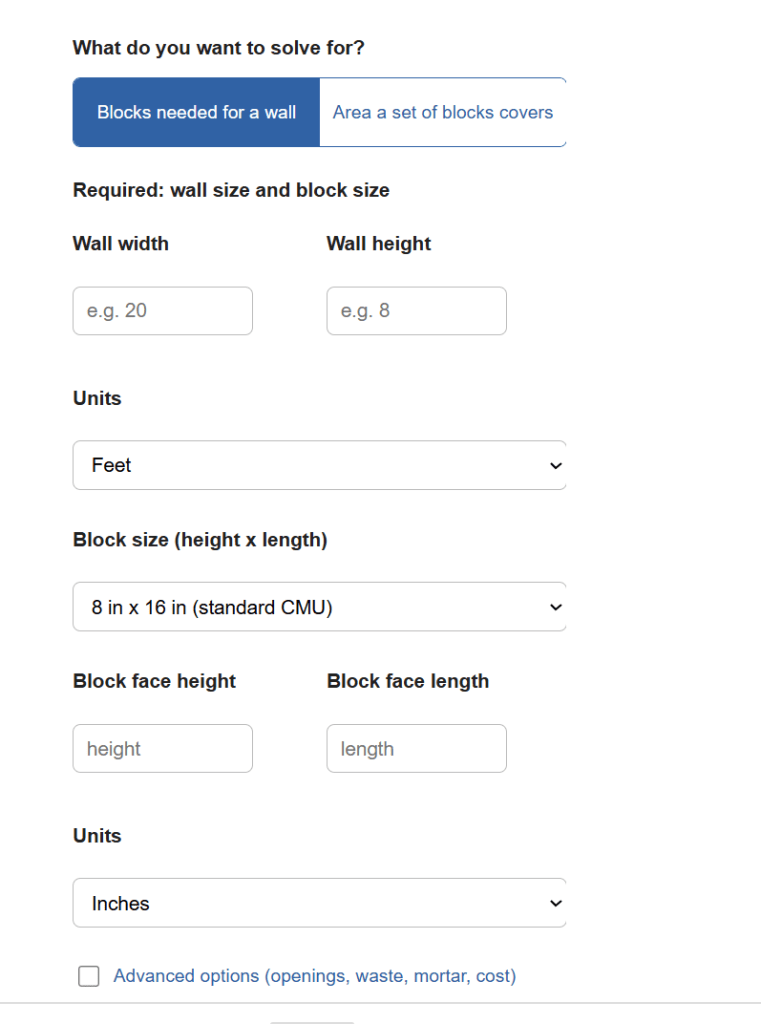
Calculate the number of concrete blocks and bags of mortar you need, plus the total cost for your wall, by entering the wall dimensions and block size.
Block Formula
The number of blocks you need is the area of the wall divided by the face area of one block, with a waste allowance added on top.
Blocks = (W * H) / a * (1 + waste / 100)
The face area of a single block is its face height times its face length, divided by 144 to convert square inches to square feet.
a = (Bh * Bl) / 144
To estimate mortar, divide the block count by 33.3, since about 3 bags of mortar bond 100 blocks. To work the other way and find how much wall a known number of blocks will cover, multiply the block count by the face area.
Mortar Bags = Blocks / 33.3
Area Covered = N * a
- Blocks = total blocks required for the wall.
- W = wall width.
- H = wall height (use the same unit as the width).
- a = face area of one block in square feet.
- Bh = block face height in inches.
- Bl = block face length in inches.
- waste = percent added for cuts and breakage, usually 5 to 10.
- N = a known number of blocks.
The wall area term (W times H) sets the surface you need to cover. Dividing by the face area converts that surface into a raw block count, and the waste factor pads the count so you do not run short on cut pieces at corners and openings. The mortar line turns the block count into bags, and the coverage formula reverses the process when you already have a block count and want the wall size.
Block Sizes and Coverage
Block size is set by the face you see once the wall is built, which is the height times the length. Depth changes the mortar and fill volume but not the number of blocks. The values below use nominal sizes that include a 3/8 inch mortar joint.
| Block face (H x L) | Face area (sq ft) | Blocks per 100 sq ft |
|---|---|---|
| 8 in x 16 in (standard) | 0.89 | 113 |
| 8 in x 8 in (half) | 0.44 | 226 |
| 4 in x 16 in | 0.44 | 226 |
| 4 in x 8 in | 0.22 | 452 |
| 12 in x 16 in | 1.33 | 75 |
Once you have a block count, use the rules of thumb below to round out the rest of the order.
| Material | Rule of thumb |
|---|---|
| Mortar | About 3 bags per 100 blocks |
| Sand | About 1 cubic yard per 7 bags of mortar |
| Waste | Add 5 to 10 percent for cuts and breakage |
Example Problems
Example 1. You are building a wall that is 20 feet wide and 8 feet high using standard 8 in x 16 in blocks, with a 10 percent waste allowance.
The wall area is 20 times 8, which is 160 square feet. The face area of the block is 0.89 square feet, so the raw count is 160 divided by 0.89, which is about 180 blocks. Adding 10 percent gives about 198 blocks. Dividing 198 by 33.3 gives 6 bags of mortar.
Example 2. You have 100 standard 8 in x 16 in blocks left over and want to know how much wall they cover.
Multiply 100 by the face area of 0.89 square feet. The blocks cover about 89 square feet of wall.
FAQ
How many blocks are in a square foot of wall?
For a standard 8 in x 16 in block, you need about 1.125 blocks per square foot, which is the same as 113 blocks per 100 square feet. Smaller blocks cover less area each, so the count per square foot goes up.
How much mortar do I need for a block wall?
Plan on about 3 bags of mortar for every 100 blocks, or roughly 1 bag for every 33 blocks. Thicker joints and rough block faces use more, so round up if you are unsure.
Should I order extra blocks?
Yes. Add 5 to 10 percent on top of the calculated count to cover blocks that get cut at corners and openings or that crack during handling. Returning a few extra blocks is easier than stopping work to buy more.