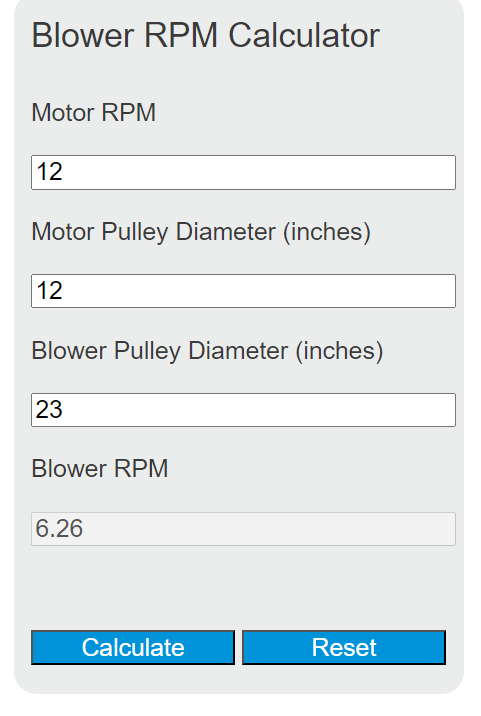
Calculate blower RPM, motor speed, or motor and blower pulley diameter for belt-driven systems, with optional internal step-up ratio and RPM limit checks.
Related Calculators
- Belt Speed Calculator
- Pulley Acceleration Calculator
- Venturi Effect Calculator
- Orifice Velocity Calculator
- All Physics Calculators
Blower RPM Formula
The calculator uses the belt drive speed ratio combined with any internal step-up gear inside the blower.
Rearranged to size a blower pulley for a target speed:
- Motor RPM — speed of the engine crank or electric motor shaft.
- Driver Diameter — diameter of the pulley on the motor or crank.
- Blower Diameter — diameter of the driven pulley on the blower snout.
- Step-Up Ratio — internal gear ratio inside the blower (use 1 if there is none).
- Blower RPM — rotational speed of the blower rotors.
The three modes use the same formula:
- Blower RPM mode solves for blower speed from the two pulleys, motor speed, and ratio. An optional max RPM field flags whether you are over the limit.
- Size Pulley mode rearranges the formula to give the blower pulley diameter needed to hit a target speed.
- Missing Value mode lets you leave any one of the four speed or pulley fields blank and solves for it.
Reference Tables
Use these to sanity check inputs before you commit to a pulley purchase.
| Blower Type | Typical Max RPM | Internal Step-Up |
|---|---|---|
| Roots 6-71 / 8-71 | 6,000 – 7,500 | 1.00 |
| Roots 14-71 | 6,500 | 1.00 |
| Eaton M62 / M90 | 14,000 | 1.00 |
| Whipple twin-screw | 14,000 – 16,000 | 1.00 |
| Vortech / ProCharger centrifugal | 52,000 – 65,000 (impeller) | 3.45 – 5.40 |
| Industrial PD blower | 3,600 – 5,000 | 1.00 |
| Pulley Ratio (Driver:Blower) | Drive Type | Effect |
|---|---|---|
| Less than 1:1 (underdriven) | Driver smaller than blower | Blower spins slower than motor. Lower boost. |
| 1:1 | Equal pulleys | Blower matches motor speed. |
| Greater than 1:1 (overdriven) | Driver larger than blower | Blower spins faster than motor. Higher boost. |
Worked Examples
Example 1 — Roots blower on a V8. Engine at 6,000 RPM, 8.0 in crank pulley, 7.0 in blower pulley, no internal gear.
Blower RPM = 6,000 × (8.0 / 7.0) × 1 = 6,857 RPM. That is right at the redline for an 8-71 style case, so a slightly larger blower pulley would pull it back into a safer range.
Example 2 — Sizing a centrifugal pulley. You want 50,000 impeller RPM at 6,500 engine RPM with a 3.45 internal step-up and a 6.0 in crank pulley.
Blower Pulley = 6,500 × 6.0 × 3.45 / 50,000 = 2.69 in.
FAQ
What happens if I leave the step-up ratio at 1? The math reduces to a plain belt drive calculation. Use 1 for Roots and twin-screw blowers without an internal gear, and the published ratio for centrifugal superchargers.
Should I use OD or pitch diameter? For accurate belt-driven speed, pitch diameter is technically correct. Outside diameter is close enough for most street setups and is what most pulley specs list.
How do I drop blower speed without changing the crank pulley? Install a larger blower (driven) pulley. Bigger driven pulley equals slower blower.
Why is my actual boost lower than expected? Belt slip, blower wear, leaks, and cam timing all reduce real output. The calculator gives shaft speed, not boost pressure.