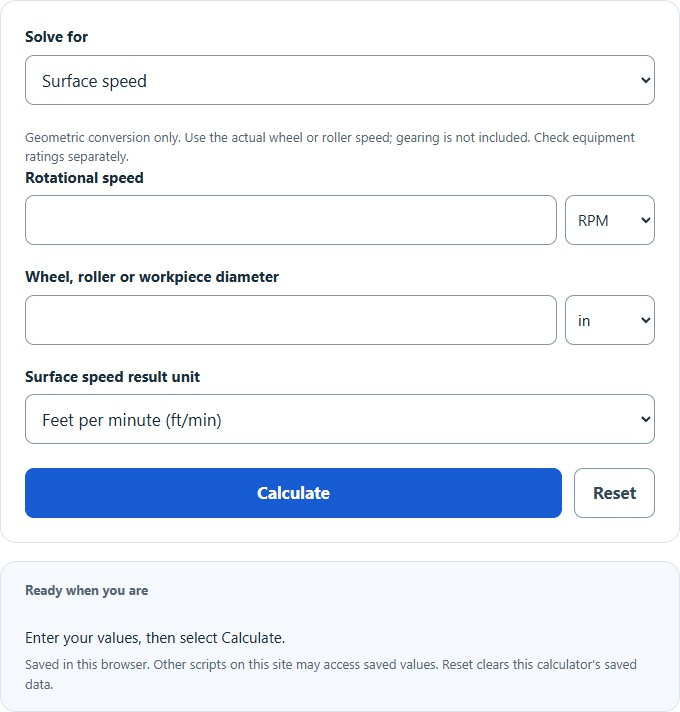
Calculate feet per minute from RPM and diameter, or solve for missing RPM or diameter using ft, m, in, rad/s, ft/min, m/min, or in/min.
| RPM to ft/min | ft/min to RPM |
|---|---|
| 60 RPM = 62.83 ft/min | 50 ft/min = 47.75 RPM |
| 100 RPM = 104.72 ft/min | 100 ft/min = 95.49 RPM |
| 200 RPM = 209.44 ft/min | 150 ft/min = 143.24 RPM |
| 300 RPM = 314.16 ft/min | 200 ft/min = 190.99 RPM |
| 500 RPM = 523.60 ft/min | 250 ft/min = 238.73 RPM |
| 600 RPM = 628.32 ft/min | 300 ft/min = 286.48 RPM |
| 750 RPM = 785.40 ft/min | 400 ft/min = 381.97 RPM |
| 1000 RPM = 1047.20 ft/min | 500 ft/min = 477.46 RPM |
| 1200 RPM = 1256.64 ft/min | 600 ft/min = 572.96 RPM |
| 1500 RPM = 1570.80 ft/min | 750 ft/min = 716.20 RPM |
| 1725 RPM = 1806.42 ft/min | 1000 ft/min = 954.93 RPM |
| 1800 RPM = 1884.96 ft/min | 1500 ft/min = 1432.39 RPM |
| 2000 RPM = 2094.40 ft/min | 1800 ft/min = 1718.87 RPM |
| 2400 RPM = 2513.27 ft/min | 2000 ft/min = 1909.86 RPM |
| 3000 RPM = 3141.59 ft/min | 2500 ft/min = 2387.32 RPM |
| 3450 RPM = 3612.83 ft/min | 3000 ft/min = 2864.79 RPM |
| 3600 RPM = 3769.91 ft/min | 3600 ft/min = 3437.75 RPM |
| 5000 RPM = 5235.99 ft/min | 4000 ft/min = 3819.72 RPM |
| 6000 RPM = 6283.19 ft/min | 5000 ft/min = 4774.65 RPM |
| 10000 RPM = 10471.98 ft/min | 10000 ft/min = 9549.30 RPM |
| ft/min = pi x RPM x D(ft) | RPM = ft/min / (pi x D). D = 4 in (0.3333 ft). | |
- All Unit Converters
- Linear Feet Calculator
- Feet Per Minute To RPM Calculator
- RPM to Horsepower Calculator
- RPM to Flow Rate Calculator
RPM to Feet Per Minute Formula
The core relationship between rotational speed and linear velocity is:
Where FPM is the linear velocity in feet per minute, RPM is revolutions per minute, D is the diameter of the rotating element in feet, and pi is approximately 3.14159. When the diameter is measured in inches (common in machining and conveyor work), the formula becomes FPM = RPM x d x pi / 12, or approximately FPM = RPM x d x 0.2618, where d is in inches. That constant, 0.2618, appears on shop-floor reference cards because it eliminates the unit conversion step.
Where This Conversion Is Used
The RPM-to-FPM conversion bridges rotational motion and linear motion in several industries. In CNC machining and manual lathe work, surface feet per minute (SFM) determines how fast a cutting tool moves across the workpiece surface. Getting SFM wrong causes premature tool wear, poor surface finish, or workpiece damage. Conveyor systems rely on this conversion to set belt speed based on drive-roller RPM and roller diameter. In HVAC and ventilation, fan tip speed is one factor in performance and noise; selection also requires the fan performance and sound data for the intended operating point. Grinding operations use peripheral wheel speed (FPM) to stay within safe operating limits set by abrasive manufacturers.
Illustrative SFM-to-RPM Conversions
The table below illustrates RPM = SFM x 12 / (pi x d) for hypothetical surface-speed inputs. These are conversion examples, not recommended cutting speeds. Select cutting data from the tool manufacturer for the workpiece material, tool grade, operation and cutting conditions; a fixed percentage reduction does not establish a suitable speed for HSS tooling.
| Example | SFM Range | RPM at 1″ Dia. | RPM at 0.5″ Dia. |
|---|---|---|---|
| Example 1 | 600 – 1,000 | 2,292 – 3,820 | 4,584 – 7,639 |
| Example 2 | 300 – 600 | 1,146 – 2,292 | 2,292 – 4,584 |
| Example 3 | 200 – 400 | 764 – 1,528 | 1,528 – 3,056 |
| Example 4 | 250 – 400 | 955 – 1,528 | 1,910 – 3,056 |
| Example 5 | 150 – 300 | 573 – 1,146 | 1,146 – 2,292 |
| Example 6 | 100 – 250 | 382 – 955 | 764 – 1,910 |
| Example 7 | 75 – 175 | 286 – 668 | 573 – 1,337 |
| Example 8 | 200 – 400 | 764 – 1,528 | 1,528 – 3,056 |
| Example 9 | 50 – 100 | 191 – 382 | 382 – 764 |
| Example 10 | 500 – 1,500 | 1,910 – 5,730 | 3,820 – 11,459 |
Common Motor Speeds and Resulting Belt/Surface Speeds
At 60 Hz, synchronous speed is 1,800 RPM for a four-pole motor or 3,600 RPM for a two-pole motor. Induction-motor shaft speed under load is lower because of slip; values such as 1,725, 1,750 or 3,450 RPM are loaded-speed examples, not synchronous speeds. The table uses the stated RPM as illustrative roller or pulley shaft speeds with direct drive. Use the actual driven-shaft speed after any gearing, and check equipment ratings separately.
| Roller/Pulley Dia. | 1,725 RPM | 1,750 RPM | 3,450 RPM | 3,600 RPM |
|---|---|---|---|---|
| 2 in | 903 ft/min | 916 ft/min | 1,806 ft/min | 1,885 ft/min |
| 4 in | 1,806 ft/min | 1,833 ft/min | 3,613 ft/min | 3,770 ft/min |
| 6 in | 2,710 ft/min | 2,749 ft/min | 5,419 ft/min | 5,655 ft/min |
| 8 in | 3,613 ft/min | 3,665 ft/min | 7,226 ft/min | 7,540 ft/min |
| 12 in | 5,419 ft/min | 5,498 ft/min | 10,838 ft/min | 11,310 ft/min |
| 18 in | 8,129 ft/min | 8,247 ft/min | 16,258 ft/min | 16,965 ft/min |
| 24 in | 10,838 ft/min | 10,996 ft/min | 21,677 ft/min | 22,619 ft/min |
Conveyor Belt Speed
For an ideal conveyor with no belt slip, belt speed equals the drive roller circumference multiplied by the roller’s RPM. Use the roller speed after any gear reduction, rather than motor RPM. For example, a 1,750 RPM motor with a 30:1 reducer gives 58.3 RPM at a 6-inch roller, or about 91.6 ft/min. This conversion does not select a suitable conveyor operating speed.
Grinding Wheel Safe Speed Limits
Check the maximum operating speed marked on the specific abrasive wheel and follow the wheel and machine manufacturers’ instructions. Ratings may be stated in RPM or surface speed; never infer a safe rating from the wheel category or this calculator. OSHA requires checking machine spindle speed against the maximum operating speed marked on the wheel before mounting. RPM = SFPM x 12 / (pi x diameter in inches) is a unit conversion, not a safety approval. See OSHA 1910.215 and the manufacturer’s guidance.
Fan Tip Speed and Noise
Fan tip speed is the blade-tip circumference multiplied by the fan shaft RPM. For example, a 48-inch fan at 1,750 RPM has a tip speed of about 21,991 ft/min. That value alone does not establish acceptable noise, airflow or mechanical safety. Fan design, operating point and installation affect performance and sound; use manufacturer speed limits and performance and sound data for the intended duty. See AMCA’s fan noise guidance.
How to Calculate Feet Per Minute from RPM
Measure the diameter of the rotating element. If the measurement is in inches, divide by 12 to convert to feet, or use the shortcut constant 0.2618 directly with inches. Multiply the diameter (in feet) by pi (3.14159), then multiply by the RPM. The result is feet per minute.
Example: A conveyor drive roller is 6 inches in diameter and spins at 80 RPM. Using the inch-based shortcut: FPM = 0.2618 x 6 x 80 = 125.7 ft/min. Alternatively: diameter in feet = 6/12 = 0.5 ft, FPM = 0.5 x 3.14159 x 80 = 125.7 ft/min.