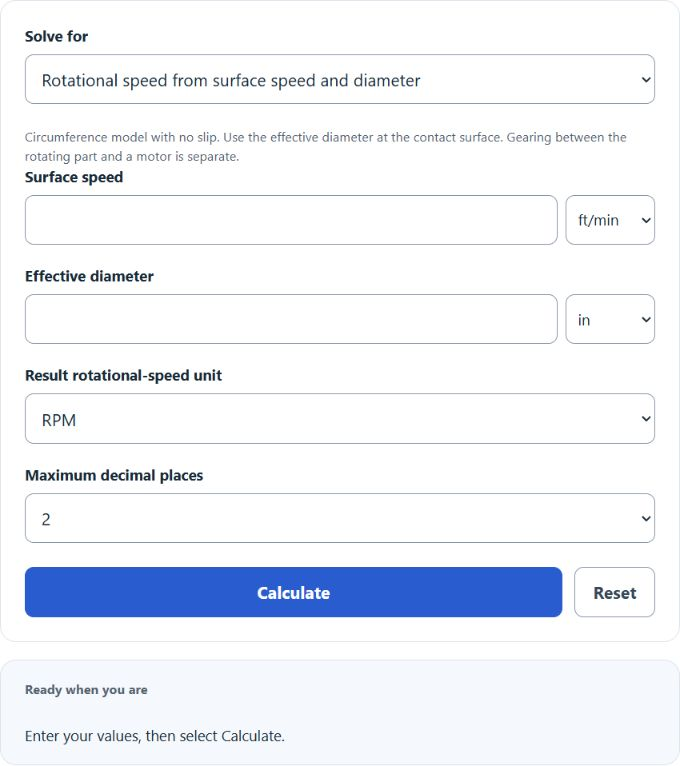
Select the unknown and enter the other two quantities to convert surface speed, rotational speed or effective diameter. Supports imperial and metric length/speed units and RPM or angular-speed units.
| FPM to RPM | RPM to FPM |
|---|---|
| 50 ft/min = 95.493 RPM | 60 RPM = 31.416 ft/min |
| 75 ft/min = 143.239 RPM | 100 RPM = 52.360 ft/min |
| 100 ft/min = 190.986 RPM | 175 RPM = 91.630 ft/min |
| 150 ft/min = 286.479 RPM | 300 RPM = 157.080 ft/min |
| 200 ft/min = 381.972 RPM | 600 RPM = 314.159 ft/min |
| 300 ft/min = 572.958 RPM | 900 RPM = 471.239 ft/min |
| 400 ft/min = 763.944 RPM | 1,200 RPM = 628.319 ft/min |
| 500 ft/min = 954.930 RPM | 1,750 RPM = 916.298 ft/min |
| 750 ft/min = 1,432.394 RPM | 1,800 RPM = 942.478 ft/min |
| 1,000 ft/min = 1,909.859 RPM | 3,600 RPM = 1,884.956 ft/min |
| Formulas (D in inches): FPM = (RPM × π × D) ÷ 12 and RPM = (FPM × 12) ÷ (π × D). This table uses D = 2 in. | |
| FPM to RPM | RPM to FPM |
|---|---|
| 100 ft/min = 95.493 RPM | 50 RPM = 52.360 ft/min |
| 150 ft/min = 143.239 RPM | 100 RPM = 104.720 ft/min |
| 200 ft/min = 190.986 RPM | 200 RPM = 209.440 ft/min |
| 250 ft/min = 238.732 RPM | 300 RPM = 314.159 ft/min |
| 300 ft/min = 286.479 RPM | 500 RPM = 523.599 ft/min |
| 400 ft/min = 381.972 RPM | 750 RPM = 785.398 ft/min |
| 500 ft/min = 477.465 RPM | 1,000 RPM = 1,047.198 ft/min |
| 600 ft/min = 572.958 RPM | 1,750 RPM = 1,832.596 ft/min |
| 750 ft/min = 716.197 RPM | 1,800 RPM = 1,884.956 ft/min |
| 1,000 ft/min = 954.930 RPM | 3,600 RPM = 3,769.911 ft/min |
| Formulas (D in inches): FPM = (RPM × π × D) ÷ 12 and RPM = (FPM × 12) ÷ (π × D). This table uses D = 4 in. | |
- All Unit Converters
- FPM (feet per minute) to CFM (cubic feet per minute) Calculator
- m/min To RPM Calculator
- RPM to Horsepower Calculator
Feet Per Minute To RPM Formula
The following formula is used to calculate RPM (Revolutions Per Minute) from FPM (Feet Per Minute).
Variables:
- RPM is the Revolutions Per Minute
- FPM is the Feet Per Minute
- D is the diameter of the rotating object in inches; π is a constant, approximately equal to 3.14159
To calculate the RPM, multiply the FPM by 12 to convert feet to inches. Then divide this result by the product of π and the diameter of the rotating object. This will give the speed of the rotating object in Revolutions Per Minute.
What is Feet Per Minute To RPM?
Feet Per Minute to RPM (Revolutions Per Minute) is a conversion used to measure the speed or velocity at which a mechanical component is operating. This is commonly used in industries such as manufacturing and engineering. For a conveyor with no slip, belt speed and the effective circumference determine the roller’s RPM. Motor RPM also depends on any gearbox or transmission between motor and roller. Use the effective contact diameter and account separately for slip, belt stretch and gearing. The geometric formula does not establish a safe machine speed. See Sandvik Coromant’s surface-speed formulas.
How to Calculate Feet Per Minute To RPM?
The following steps outline how to calculate the RPM (Revolutions Per Minute) using the Feet Per Minute (FPM) to RPM formula:
- First, determine the FPM (Feet Per Minute) value.
- Next, determine the diameter of the rotating object in inches (D).
- Next, gather the formula from above: RPM = (FPM * 12) / (π * D).
- Finally, calculate the RPM using the formula.
- After inserting the variables and calculating the result, check your answer with a calculator.
Example Problem:
Use the following variables as an example problem to test your knowledge:
FPM (Feet Per Minute) = 60
D (effective diameter in inches) = 6. Then RPM = (60 × 12)/(π × 6) ≈ 38.19719 RPM, or 38.2 RPM at a maximum of two decimal places.