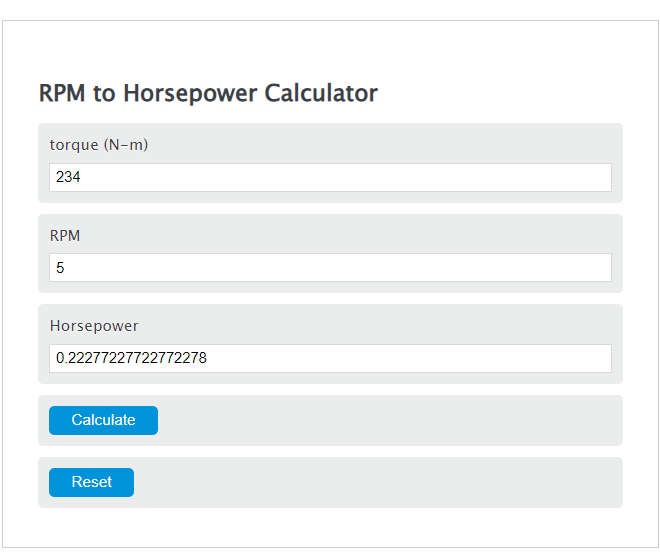
Calculate horsepower, torque, or RPM from any 2 values with lb-ft/N-m, RPM/rad/s, and HP/kW unit conversions to find the missing value easily.
| Torque + RPM to HP | HP + RPM to Torque |
|---|---|
| 100 lb-ft @ 2000 RPM = 38.1 HP | 5 HP @ 1750 RPM = 15.0 lb-ft |
| 150 lb-ft @ 2500 RPM = 71.4 HP | 10 HP @ 1800 RPM = 29.2 lb-ft |
| 200 lb-ft @ 3000 RPM = 114.2 HP | 15 HP @ 3600 RPM = 21.9 lb-ft |
| 250 lb-ft @ 4000 RPM = 190.4 HP | 20 HP @ 3000 RPM = 35.0 lb-ft |
| 300 lb-ft @ 3500 RPM = 199.9 HP | 25 HP @ 1725 RPM = 76.1 lb-ft |
| 300 lb-ft @ 5252 RPM = 300.0 HP | 30 HP @ 540 RPM = 291.8 lb-ft |
| 400 lb-ft @ 4500 RPM = 342.7 HP | 45 HP @ 1000 RPM = 236.3 lb-ft |
| 450 lb-ft @ 5500 RPM = 471.2 HP | 60 HP @ 2000 RPM = 157.6 lb-ft |
| 500 lb-ft @ 6000 RPM = 571.2 HP | 125 HP @ 3600 RPM = 182.4 lb-ft |
| 700 lb-ft @ 2100 RPM = 279.9 HP | 300 HP @ 6000 RPM = 262.6 lb-ft |
| HP = (T × RPM) ÷ 5252 | T = (HP × 5252) ÷ RPM (T in lb-ft) | |
| Torque + RPM to kW | kW + RPM to Torque |
|---|---|
| 100 N·m @ 1500 RPM = 15.7 kW | 1.5 kW @ 1500 RPM = 9.5 N·m |
| 200 N·m @ 2000 RPM = 41.9 kW | 5.5 kW @ 1500 RPM = 35.0 N·m |
| 300 N·m @ 3000 RPM = 94.2 kW | 11 kW @ 1480 RPM = 71.0 N·m |
| 400 N·m @ 4000 RPM = 167.6 kW | 22 kW @ 2950 RPM = 71.2 N·m |
| 500 N·m @ 5000 RPM = 261.8 kW | 45 kW @ 3000 RPM = 143.2 N·m |
| 600 N·m @ 2500 RPM = 157.1 kW | 75 kW @ 3600 RPM = 198.9 N·m |
| kW = (T × RPM) ÷ 9549.3 | T = (kW × 9549.3) ÷ RPM (T in N·m) | |
RPM to Horsepower Formula
Where HP is mechanical horsepower, T is torque in lb-ft, and RPM is rotational speed in revolutions per minute. The equivalent metric form is kW = (T x RPM) / 9549.3, where T is in newton-meters.
Where Does the 5252 Constant Come From?
James Watt defined one horsepower as 33,000 ft-lbf of work per minute in 1782, based on his measurements of brewery draft horses turning a mill wheel. Because torque describes force applied over one revolution (2 pi radians), converting from torque and RPM to power requires dividing by 2 pi. The constant 5252 is simply 33,000 / (2 x pi) = 5252.11, rounded to the nearest whole number. In the metric system, the analogous constant is 9549.3, derived from the fact that 1 kW = 1000 W and power in watts equals torque (N-m) multiplied by angular velocity (rad/s).
The 5252 RPM Crossover Point
On any dyno chart plotting both torque (lb-ft) and horsepower (HP) against RPM, the two curves always intersect at exactly 5252 RPM. When RPM = 5252, the formula HP = T x 5252 / 5252 simplifies to HP = T, so the numerical values are identical. Below 5252 RPM, the torque number is always higher. Above 5252 RPM, horsepower is always larger. This crossover has no physical significance; it is purely an artifact of the unit definitions.
Types of Horsepower
Not all horsepower ratings measure the same thing. The type depends on where in the drivetrain power is measured and which unit system applies.
| Type | Abbr | Definition | Watts |
|---|---|---|---|
| Mechanical | hp | 33,000 ft-lbf/min (Watt’s standard) | 745.70 |
| Metric | PS | 75 kgf-m/s (EU/Japan ratings) | 735.50 |
| Electrical | hp(E) | Exactly 746 W (motor nameplates) | 746.00 |
| Brake | BHP | Crankshaft/flywheel output via dyno | Varies |
| Indicated | IHP | Cylinder pressure power, pre-friction | Varies |
| Shaft | SHP | Propeller shaft (marine/aviation) | Varies |
| Wheel | WHP | At wheels, after drivetrain losses | Varies |
BHP is the most common automotive rating. WHP is typically 10-20% lower due to transmission, differential, and bearing losses. IHP is mainly used in thermodynamic engine cycle analysis.
Typical HP, Torque, and RPM by Application
| Application | HP | Torque | RPM |
|---|---|---|---|
| Push mower | 3-7 | 5-9 lb-ft | 2,800-3,200 |
| NEMA motor | 1-25 | 3-75 lb-ft | 1,725-3,600 |
| 4-cyl sedan | 130-180 | 130-180 lb-ft | 5,500-6,500 pk |
| V8 pickup | 355-420 | 380-460 lb-ft | 4,500-5,600 pk |
| Diesel pickup | 250-500 | 440-1,075 lb-ft | 2,800-3,200 pk |
| EV sedan | 200-670 | 250-700 lb-ft | 0-18,000 |
| 600cc sportbike | 95-120 | 45-50 lb-ft | 12,000-14,500 pk |
| Marine inboard | 200-430 | 350-450 lb-ft | 4,400-5,400 pk |
| Air compressor | 5-200 | 15-600 lb-ft | 1,200-3,600 |
| Class 8 semi | 400-605 | 1,450-2,050 lb-ft | 1,200-1,800 pk |
Electric Motors vs. Combustion Engines
The formula applies identically to both, but their torque curves differ fundamentally. An electric motor produces maximum torque from 0 RPM and maintains it through a base speed, after which torque falls. A combustion engine produces zero torque at 0 RPM, builds gradually to a mid-range peak, then drops before redline. This means a 300 HP electric motor feels quicker at low speeds than a 300 HP gas engine: the electric motor reaches peak power at much lower RPM.
Drivetrain Losses: BHP vs. WHP
Factory HP is almost always BHP at the crankshaft. Wheel power is reduced by transmission, driveshaft, differential, and bearing friction. Typical losses: manual 8-12%, automatic 12-18%, AWD 15-22%. A 400 BHP engine with an automatic typically delivers 340-350 WHP. Chassis dynos (Dynojet, Mustang) measure WHP directly, which is why dyno numbers run lower than factory specs.
Frequently Asked Questions
What is horsepower?
A unit of power equal to 33,000 ft-lbf/min (745.7 W), defined by James Watt in 1782 based on brewery draft horse output.
How does torque differ from horsepower?
Torque is rotational force (lb-ft or N-m) at a given instant. Horsepower factors in how fast the shaft spins (RPM), representing total work rate. A high-torque diesel and low-torque sportbike engine can make the same HP through different T and RPM combinations.
Why do torque and HP cross at 5252 RPM?
At RPM = 5252, the formula HP = T x 5252/5252 = T, so numerical values match. This is a unit artifact, not an engine design feature.
BHP vs. WHP vs. PS?
BHP = crankshaft power. WHP = wheel power (10-20% less). PS = metric HP (735.5 W, about 98.6% of mechanical HP).
Works for electric motors?
Yes. HP = T x RPM / 5252 applies to any rotating shaft. Electric motor “electrical HP” = exactly 746 W, differing from mechanical HP by less than 0.04%.
HP to kW conversion?
HP x 0.7457 = kW. kW x 1.341 = HP. For PS: PS x 0.7355 = kW, kW x 1.3596 = PS.