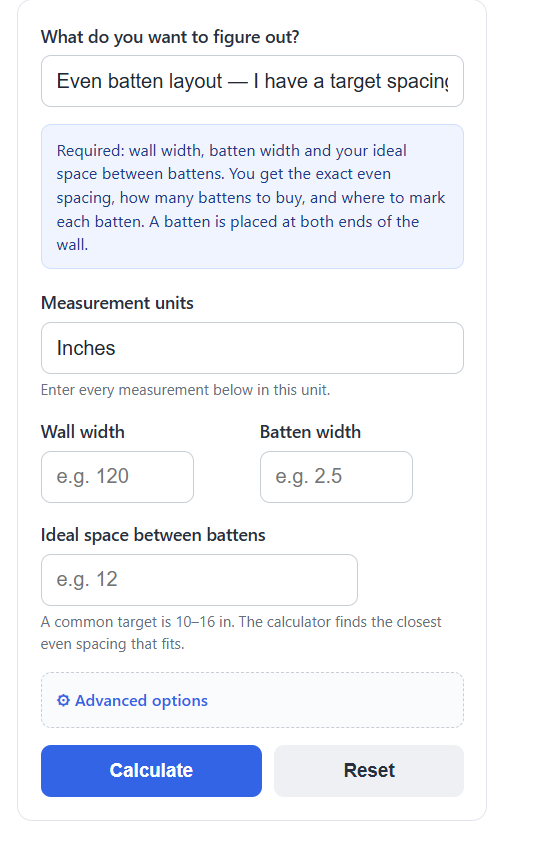
Calculate board and batten spacing, batten count, and the boards and battens needed for your wall or siding project.
- All Construction Calculators
- 2X6 Calculator
- Wainscoting Calculator
- Siding Calculator
- Board Spacing Calculator
Board and Batten Formula
This tool works in two ways. For an even batten layout on an accent wall, it spreads the battens evenly across the wall width with a batten at each end:
On-center = (Wall width - Batten width) / Spaces
 Gap = On-center - Batten width
 Battens = Spaces + 1
For board and batten siding, it estimates how many boards and battens to order and the total linear footage:
Boards = ceil(Wall width / (Board width + Gap))
 Battens = Boards + 1
 Total linear feet = (Boards + Battens) * Height * (1 + Waste)
- Wall width: the full width of the wall or section you are covering.
- Wall height: the vertical run of each board and batten piece (siding mode).
- Batten width: the width of the narrow vertical strip.
- Board width: the width of the wide board behind the battens (siding mode).
- Spaces: the number of gaps between battens, which is always one less than the number of battens.
- On-center: the distance from the center of one batten to the center of the next.
- Gap: the open space you see between two battens.
- Waste: an allowance added to the material total for cuts and offcuts.
If you give the tool a target spacing, it rounds the wall to a whole number of even spaces and reports the exact gap that result produces, so the layout stays symmetrical with a batten at both ends. If you give it a batten count instead, it divides the wall into that many evenly spaced battens. The siding mode counts boards across the wall, adds one batten per seam plus the two ends, then multiplies the piece height by the count and your waste factor to give linear feet to buy.
Common Spacing and Material Widths
Use these ranges as a starting point, then enter your own numbers to lock in an exact, symmetrical layout.
| Project | Typical batten spacing (on-center) |
|---|---|
| Interior accent wall | 12 to 16 in |
| Lower or wainscot section | 10 to 12 in |
| Tall feature wall | 16 to 24 in |
| Exterior siding battens | 12 in over board seams |
| Piece | Common width |
|---|---|
| Batten strip | 2 to 4 in |
| Siding board | 6 to 12 in |
| Expansion gap behind battens | 1/8 to 1/4 in |
Designers often keep the batten width to about one third or one quarter of the visible board for a balanced look.
Example Problems
Even layout from a batten count. Your wall is 60 in wide, your battens are 3 in wide, and you want 5 battens. The spaces equal 5 minus 1, which is 4. On-center is (60 – 3) / 4 = 14.25 in. The gap is 14.25 – 3 = 11.25 in. So you place 5 battens, each 11.25 in apart, with one at each end.
Siding material estimate. A wall is 192 in wide and 108 in tall. Boards are 8 in wide with no gap, battens are 3 in wide, and you allow 10 percent waste. Boards = ceil(192 / 8) = 24. Battens = 24 + 1 = 25. Total linear feet = (24 + 25) pieces at 108 in (9 ft) each, times 1.10, which is about 485 linear feet to order.
Frequently Asked Questions
How far apart should board and batten battens be? Most interior accent walls use 12 to 16 in on-center, while shorter sections often look better at 10 to 12 in. There is no single correct number. Pick a spacing you like, then let the calculator round it to an even layout so both end gaps match.
Why does the gap come out different from the number I entered? A wall rarely divides into a whole number of your exact target spacing. The tool rounds to the nearest whole number of spaces so the battens stay symmetrical, then reports the true gap that layout produces. The result is usually within an inch of your target.
How many battens do I need for a wall? The number of battens is always the number of spaces plus one, because you place a batten at both ends of the wall. For siding, the battens equal the number of boards plus one, since each seam plus the two ends gets a batten.