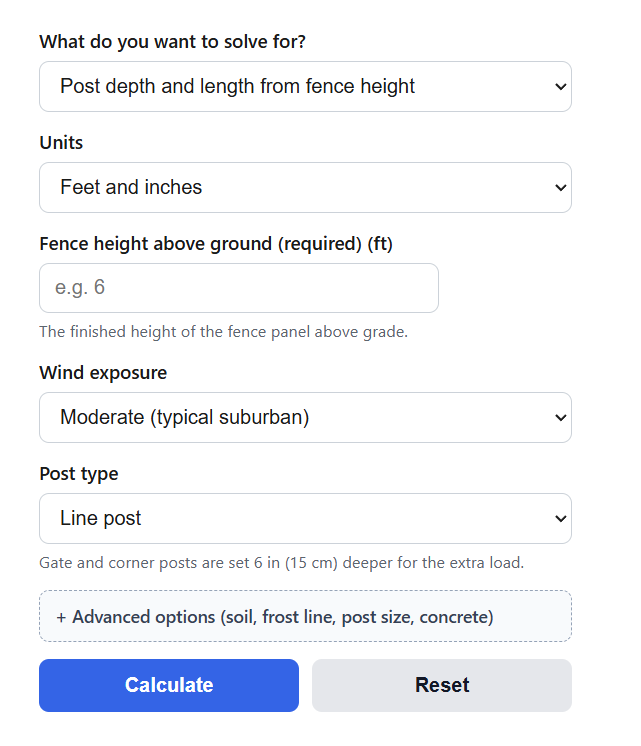
Calculate how deep to set fence posts from fence height, wind, soil, and frost line, plus post length, hole size, and concrete per post.
Fence Post Depth Formula
PD = H * R * S
PL = H + PD
- PD is the post depth, the buried length measured from ground level to the bottom of the post (in)
- H is the fence height above ground (in)
- R is the depth ratio set by wind exposure: 0.333 for sheltered yards, 0.36 for typical suburban sites, 0.40 for open or coastal sites
- S is the soil factor: 1.0 for loam, 1.10 for sand or clay, 0.90 for rocky or compacted ground
- PL is the minimum total post length you need to buy (in)
The calculator applies three overrides to the base formula. Gate and corner posts get 6 inches added to the depth because they carry swinging and bracing loads. The depth is never allowed below a 24-inch minimum regardless of fence height. If you enter a frost line depth, the post bottom is placed 6 inches below the frost line whenever that is deeper than the formula result.
The second solve mode works the formula in reverse. Given the total length L of a post you already own, the achievable fence height is H = L – PD, where PD is found from PD = (L * R * S) / (1 + R * S) and then checked against the same 24-inch and frost line minimums. This tells you the tallest fence a stock 8, 10, or 12 foot post can safely support.
With the advanced options open, the calculator also sizes the hole at 3 times the post width (10 inch minimum), adds 4 inches of hole depth for a gravel drainage base, and estimates concrete per post from the hole volume minus the post volume, with 10 percent waste included.
Post Depth and Post Length by Fence Height
The table below shows the recommended embed depth in average loam soil for a line post at each wind exposure level, plus the standard lumber length that covers the result. Values include the 24-inch minimum.
| Fence height | Low wind | Moderate wind | High wind | Stock post to buy |
|---|---|---|---|---|
| 4 ft | 24 in | 24 in | 24 in | 6 ft |
| 5 ft | 24 in | 24 in | 24 in | 8 ft |
| 6 ft | 24 in | 26 in | 29 in | 8 ft (low wind) or 10 ft |
| 7 ft | 28 in | 31 in | 34 in | 10 ft |
| 8 ft | 32 in | 35 in | 39 in | 12 ft |
In cold climates the frost line can override every value above. Water in the soil freezes and expands, and a post that bottoms out above the frost line gets pushed upward a little more each winter. The table below gives typical frost line ranges by U.S. region. Always confirm the exact figure with your local building department, since it is often written into the fence permit requirements.
| Region | Typical frost line | Post bottom (frost + 6 in) |
|---|---|---|
| Gulf Coast, Florida, Southern California | 0 to 5 in | Height rule governs |
| Southeast, coastal Pacific Northwest | 5 to 10 in | Height rule usually governs |
| Mid-Atlantic, southern Plains | 10 to 18 in | 16 to 24 in |
| Ohio Valley, lower Midwest | 18 to 30 in | 24 to 36 in |
| Northeast, upper Midwest | 30 to 42 in | 36 to 48 in |
| Northern tier (MN, ND, MT, ME) | 42 to 72 in | 48 to 78 in |
Example Problems
Example 1: You are building a 6-foot wood privacy fence on a typical suburban lot with loam soil, using 4×4 line posts. The depth ratio for moderate wind is 0.36, so PD = 72 * 0.36 * 1.0 = 25.9, rounded up to 26 inches. The minimum post length is PL = 72 + 26 = 98 inches, or 8 feet 2 inches, so you would buy 10-foot posts. The hole should be about 11 inches across (3 times the 3.5 inch actual post width) and 30 inches deep including a 4-inch gravel base, which works out to roughly 1.4 cubic feet of concrete, or three 80 lb bags per post.
Example 2: You already have 8-foot posts left over from another project and your yard is sheltered, so the ratio is 0.333. The reverse mode gives PD = (96 * 0.333) / 1.333 = 24 inches, which also meets the 24-inch minimum. The maximum fence height is 96 – 24 = 72 inches, so these posts can support a fence up to 6 feet tall.
FAQ
How deep should posts be for a 6-foot fence?
Plan on 24 to 29 inches depending on wind exposure: 24 inches in a sheltered yard, about 26 inches on a typical suburban lot, and about 29 inches on an open or coastal site. Solid privacy panels catch far more wind than open picket or chain link styles, so treat a solid 6-foot panel in an open area as the high wind case. If your local frost line plus 6 inches is deeper than any of these numbers, dig to that depth instead.
Do fence posts really need to go below the frost line?
In climates where the ground freezes, yes. Frozen soil expands and grips the post or its concrete footing, lifting it slightly each freeze and thaw cycle. Over a few winters this frost heave tilts posts and racks gates out of alignment. Setting the post bottom at least 6 inches below the local frost line puts it in soil that never freezes, so there is nothing beneath it to push it up. In warm regions with a frost line near zero, the one third height rule and the 24-inch minimum govern instead.
Should posts be set in concrete or gravel?
Concrete gives the strongest hold and is the standard choice for any solid panel fence over 4 feet tall and for all gate and corner posts. Compacted gravel is acceptable for shorter, open style fences in well drained soil, and it drains water away from the wood, which slows rot. Either way, place about 4 inches of gravel at the bottom of the hole first so the end grain of the post never sits in standing water, and slope the top of a concrete footing away from the post so runoff sheds off.