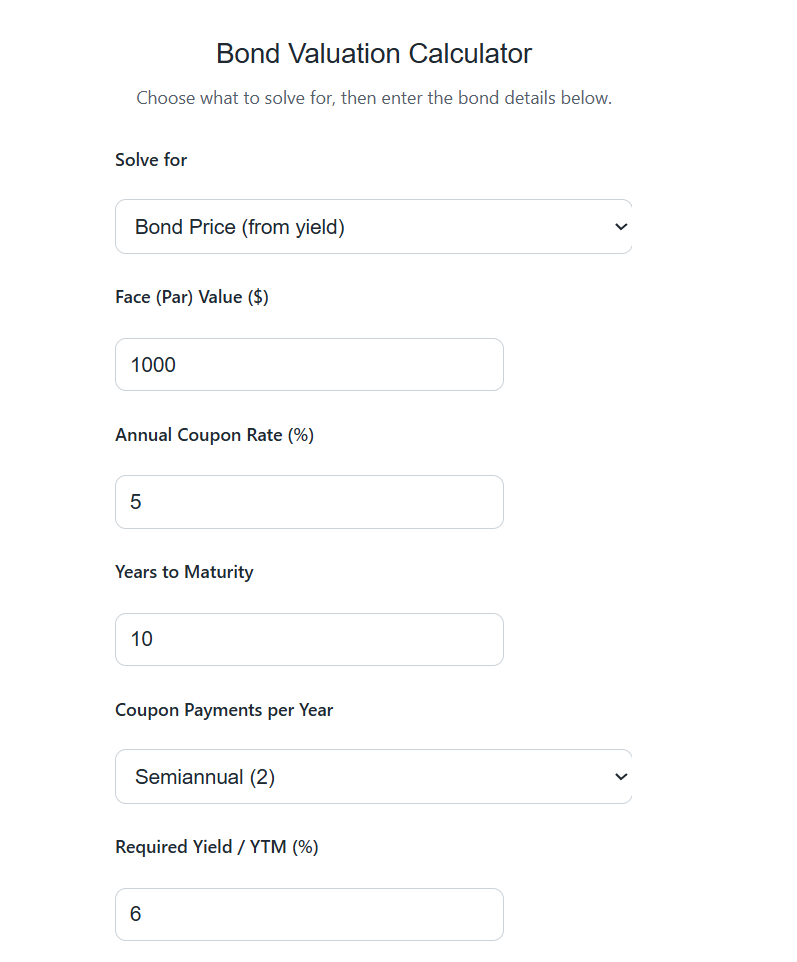
Calculate a bond’s fair price from its coupon, face value, term, and required yield, or solve for the yield to maturity from a current market price.
Bond Valuation Formula
A bond is worth the present value of every cash flow it pays. Those cash flows are the periodic coupon payments plus the face value returned at maturity, each discounted back to today at the required yield. The calculator uses this formula when you solve for price:
P = C * (1 - (1 + r)^-n) / r + F / (1 + r)^n
The coupon paid each period and the periodic discount rate come from the annual figures divided by the number of payments per year:
C = F * (annual coupon rate) / m, r = (annual yield) / m, n = years * m
- P = bond price (present value of all cash flows)
- C = coupon payment per period
- F = face value, also called par value
- r = yield per period (the required return divided by payments per year)
- n = total number of periods until maturity
- m = coupon payments per year (1 for annual, 2 for semiannual, 4 for quarterly, 12 for monthly)
When you solve for price, you supply the required yield and the calculator discounts the cash flows directly. When you solve for yield to maturity, the calculator works in reverse: it searches for the single rate r that makes the present value of the cash flows equal the current market price you entered. There is no closed form for that rate, so it is found by iteration. The current yield shown with each result is simply the annual coupon divided by the price, which ignores any gain or loss at maturity.
How Price Moves With Yield
Price and yield move in opposite directions. When the required yield is below the coupon rate, the bond is worth more than par and trades at a premium. When the required yield is above the coupon rate, the bond trades at a discount.
| Relationship | Price result |
|---|---|
| Yield is below the coupon rate | Premium (price above par) |
| Yield equals the coupon rate | Par (price equals face value) |
| Yield is above the coupon rate | Discount (price below par) |
The table below shows the price of a $1,000 face value bond with a 5% coupon paid semiannually and 10 years to maturity, priced at a range of yields.
| Yield to maturity | Bond price |
|---|---|
| 3% | $1,171.69 |
| 4% | $1,081.76 |
| 5% | $1,000.00 |
| 6% | $925.61 |
| 7% | $857.88 |
Example Problems
Example 1: Solve for price. You are looking at a bond with a $1,000 face value, a 5% annual coupon paid semiannually, and 10 years to maturity. You require a 6% yield. The coupon per period is $1,000 * 0.05 / 2 = $25, the periodic rate is 0.06 / 2 = 0.03, and there are 10 * 2 = 20 periods. Discounting the 20 coupons of $25 plus the $1,000 face value at 3% per period gives a price of $925.61. Because the price is below par, the bond trades at a discount.
Example 2: Solve for yield to maturity. A bond has a $1,000 face value, a 6% annual coupon paid once a year, and 3 years left to maturity. It currently trades at $1,027.23. Setting the present value of the three $60 coupons plus the $1,000 face value equal to $1,027.23 and solving for the rate gives a yield to maturity of 5%. The yield is below the coupon rate, which is why the bond sells at a premium.
Frequently Asked Questions
What is the difference between the coupon rate and the yield to maturity? The coupon rate is fixed when the bond is issued and sets the dollar amount of interest you receive each year. The yield to maturity is the total annual return you actually earn if you buy at the current price and hold to maturity, including every coupon and any difference between the price you paid and the face value. They are equal only when the bond trades exactly at par.
Why does a bond price fall when interest rates rise? A bond pays a fixed coupon. If yields available in the market rise, your fixed coupon is worth less by comparison, so buyers will only pay a lower price that brings the bond up to the new market yield. The reverse happens when rates fall, which pushes prices above par.
What does payments per year change? It sets how often coupons are paid and how the annual figures are split. A semiannual bond pays half the annual coupon twice a year and discounts at half the annual yield over twice as many periods. Most corporate and government bonds pay semiannually, so that is the default here.