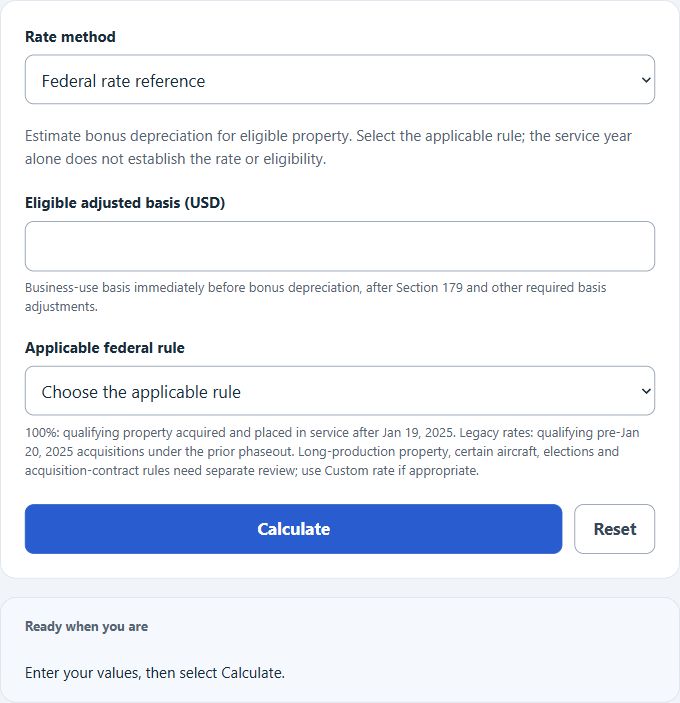
Estimate bonus depreciation from eligible adjusted basis and an applicable federal rule or custom rate. Acquisition timing and eligibility matter; the service year alone does not establish the rate.
- All Business Calculators
- Reverse Depreciation Calculator
- Boat Depreciation Calculator
- Appliance Depreciation Calculator
Bonus Depreciation Formula
The calculator uses eligible adjusted basis immediately before bonus depreciation and the applicable rate to estimate the bonus deduction. Apply business-use, Section 179 and other required basis adjustments first. It also shows the remaining basis that may be recovered through regular MACRS depreciation.
- Bonus Depreciation is the amount deductible in the first year under the bonus depreciation rate.
- Eligible adjusted basis is qualified business-use basis after Section 179 and other required adjustments, immediately before bonus depreciation.
- Bonus Rate is the applicable federal percentage for the selected rule, or the custom rate you enter.
- Remaining Basis is the portion of eligible adjusted basis left after bonus depreciation. This amount may be depreciated under regular MACRS rules.
Federal rate reference: Choose the applicable rule. IRS Notice 2026-11 provides 100% for qualifying property acquired and placed in service after January 19, 2025. Older acquisitions may remain subject to the prior phaseout. Acquisition-contract rules, long-production property, certain aircraft and elections require separate review. The calculator assumes eligibility and does not determine it.
Custom Rate: The calculator uses the percentage you enter instead of a preset federal-rule rate. This is useful for testing scenarios or handling cases where a different rate applies.
Federal Bonus Depreciation Rates by Year
The table below shows the general prior-law rates. For qualifying property acquired and placed in service after January 19, 2025, the new rule generally allows 100%, including in 2026 and later. The 2025–2027 legacy rows apply to eligible older acquisitions; special property and elections may differ. See IRS Notice 2026-11.
| Year placed in service (general legacy rules) | Bonus depreciation rate | Result for a qualified asset |
|---|---|---|
| 2022 | 100% | Full cost may be deductible as bonus depreciation. |
| 2023 | 80% | 80% bonus deduction, 20% remaining basis. |
| 2024 | 60% | 60% bonus deduction, 40% remaining basis. |
| 2025 | 40% | 40% bonus deduction, 60% remaining basis. |
| 2026 | 20% | 20% bonus deduction, 80% remaining basis. |
| 2027 and later | 0% | 0% under the legacy phaseout; qualifying new-law acquisitions may receive 100%. |
Bonus Depreciation Examples
Example 1: Asset placed in service in 2024
Assume qualified equipment has $50,000 of eligible adjusted basis and was placed in service in 2024 under the general rule. The 2024 bonus depreciation rate is 60%.
The bonus depreciation deduction is $30,000. The remaining basis is:
The remaining basis is $20,000.
Example 2: Custom bonus rate
You enter eligible adjusted basis of $75,000 and a custom bonus depreciation rate of 40%.
The bonus depreciation deduction is $30,000, and the remaining basis is $45,000.
Bonus Depreciation FAQ
What does “placed in service” mean for bonus depreciation?
Placed in service generally means the asset is ready and available for use in your business. The purchase date alone is not always enough. Use the placed-in-service timing and the legally applicable acquisition timing to select a rule. Payment date alone does not determine acquisition status.
Is the remaining basis lost?
No. The remaining basis is the part of eligible adjusted basis not deducted through bonus depreciation. It is typically depreciated over time under regular MACRS rules, assuming the asset qualifies for depreciation.
Does every asset qualify for bonus depreciation?
No. Bonus depreciation generally applies to qualified business property with a recovery period of 20 years or less, along with certain other qualifying property. Land, inventory, and personal-use assets generally do not qualify. Tax rules can vary by asset type and situation, so confirm eligibility before relying on the result for a return.