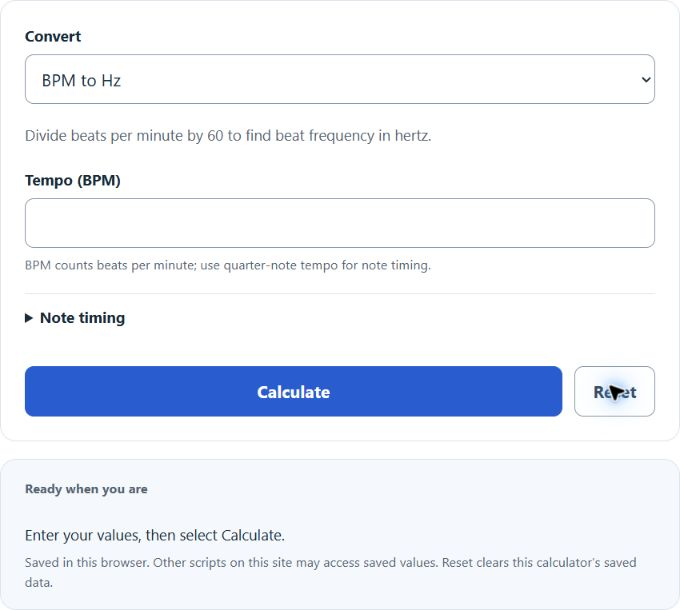
Convert BPM to beat frequency in Hz, or Hz to BPM. Optional note timing gives rhythmic repetition frequency and delay for eight note values.
BPM To Hz Formula
Use Hz = BPM ÷ 60 for rhythmic beat frequency; the inverse is BPM = Hz × 60. NIST defines hertz as reciprocal seconds and one minute as exactly 60 seconds.
Formula source: Columbia U. *openwork* Journal — “Polyrhythmic Cognition and Metric Spaces” (2025)
Variables:
- Hz is the frequency in hertz (cycles per second)
- BPM is the tempo in Beats Per Minute
To calculate the frequency in Hz, divide the tempo in BPM by 60. This is because there are 60 seconds in a minute, so dividing the number of beats per minute by 60 gives the number of beats per second, which is the frequency in Hz.
| BPM | Hertz (Hz) |
|---|---|
| 40 | 0.667 |
| 50 | 0.833 |
| 60 | 1.000 |
| 70 | 1.167 |
| 75 | 1.250 |
| 80 | 1.333 |
| 90 | 1.500 |
| 95 | 1.583 |
| 100 | 1.667 |
| 105 | 1.750 |
| 110 | 1.833 |
| 120 | 2.000 |
| 125 | 2.083 |
| 128 | 2.133 |
| 130 | 2.167 |
| 135 | 2.250 |
| 140 | 2.333 |
| 150 | 2.500 |
| 160 | 2.667 |
| 180 | 3.000 |
| * Rounded to 3 decimals. Formula: Hz = BPM ÷ 60. 1 BPM ≈ 0.016667 Hz; 1 Hz = 60 BPM. | |
What is BPM To Hz?
BPM counts beats per minute; beat frequency counts rhythmic repetitions per second. At 120 BPM, the beat frequency is 2 Hz. This describes a repeating rhythm and does not determine the pitch of an audio waveform. Note timing assumes quarter-note BPM and evenly repeated notes: whole, half, quarter, dotted eighth, eighth, eighth-note triplet, sixteenth and thirty-second notes use frequency multipliers 1/4, 1/2, 1, 4/3, 2, 3, 4 and 8. Divide 1000 by note frequency for delay in milliseconds. At 120 BPM, dotted eighths repeat at 8/3 Hz with a 375 ms delay; zero tempo has no finite delay. See Open Music Theory for rhythmic subdivisions.