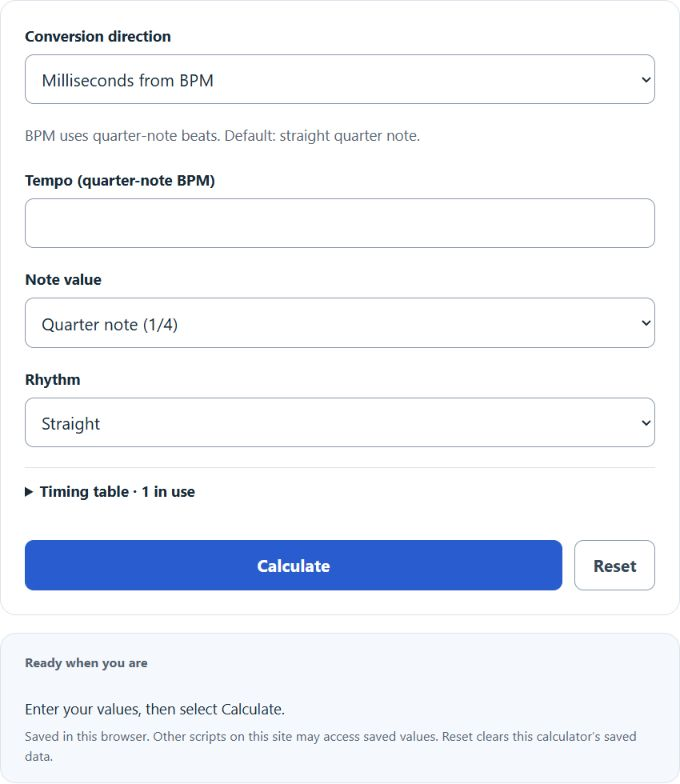
Convert BPM to milliseconds for straight, dotted, and triplet note values, or calculate tempo from a millisecond delay time for precise DAW timing.
- All Unit Converters
- Beat Frequency Calculator
- BPM to FPS Calculator
- BPM to Hz Calculator
- Hz to MS Calculator
- Cycles to MS Calculator
| Calculator Operations | Required Inputs |
|---|---|
| Convert note duration to BPM | Note duration, note value, rhythm |
| Show the full note timing table | BPM; enable the timing table |
| Convert BPM to note duration | BPM, note value, rhythm |
BPM to MS Formula
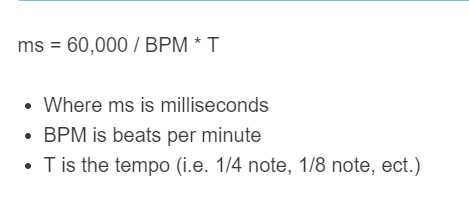
The following formula is used to convert beats per minute to milliseconds.
- Where ms is milliseconds
- BPM is beats per minute
- T is the note multiplier relative to a quarter note, multiplied by the rhythm factor. Whole = 4, half = 2, quarter = 1, eighth = 0.5, sixteenth = 0.25, thirty-second = 0.125, sixty-fourth = 0.0625; straight = 1, dotted = 1.5, triplet = 2/3.
Divide 60,000 by the quarter-note BPM, then multiply by the selected note and rhythm factors. At 120 BPM a straight quarter note is 500 ms; a dotted eighth is 500 × 0.5 × 1.5 = 375 ms. The inverse is BPM = 60,000 × T / note duration in milliseconds.
| BPM | Milliseconds (ms) |
|---|---|
| 40 | 1500.000 |
| 50 | 1200.000 |
| 60 | 1000.000 |
| 65 | 923.077 |
| 70 | 857.143 |
| 72 | 833.333 |
| 75 | 800.000 |
| 80 | 750.000 |
| 85 | 705.882 |
| 90 | 666.667 |
| 96 | 625.000 |
| 100 | 600.000 |
| 105 | 571.429 |
| 110 | 545.455 |
| 112 | 535.714 |
| 120 | 500.000 |
| 125 | 480.000 |
| 128 | 468.750 |
| 130 | 461.538 |
| 140 | 428.571 |
| * Rounded to 3 decimals. Formula: ms = (60000 / BPM) × T. This table uses straight quarter notes, T = 1. | |
BPM to MS Definition
BPM to MS converts a musical tempo to the duration of a selected note. This calculator assumes one beat is a quarter note and the tempo is constant. Other beat-unit conventions must be converted to quarter-note BPM first.
BPM to MS Example
How to convert BPM to MS?
- First, determine the bpm.
Determine the beats per minute.
- Next, choose the note value and rhythm.
Choose, for example, an eighth note with dotted rhythm.
- Finally, calculate the MS.
At 120 BPM, a dotted eighth note is (60,000 / 120) × 0.5 × 1.5 = 375 ms.
FAQ
BPM stands for beats per minute and is typically used in fields of music to describe how quickly the beats to a particular song are moving. For example, 60 beats per minute would be 1 beat every second. BPM is also used in medical fields for measuring heart rate.