Convert percentages, decimals, and basis points, calculate a rate change in bps, or find the monetary impact of basis points on an amount.
- Basis Point to Percentage Calculator
- Percentage Calculator
- Reverse Percentage Calculator
- Percentage to Margin Calculator
- Percent to Ratio Calculator
- Percentage Difference Calculator
- All Business Calculators
Basis Points Formula
A basis point is one one-hundredth of a percentage point. That means 1 basis point equals 0.01%, and 100 basis points equal 1%.
Investor.gov defines one basis point as 0.01 percentage point, or a decimal rate of 0.0001. Convert a decimal rate to bps by multiplying by 10,000; divide bps by 10,000 for a decimal rate. For a fixed base amount, simple impact = amount × bps ÷ 10,000. For example, 25 bps of 100,000 is 250 in the same amount units. This applies the rate once; it does not calculate compounding, payment schedules or bond-price sensitivity.
- bps: basis points
- percent: the percentage value, such as 0.25%
- from rate: the starting rate, entered as a percent
- to rate: the ending rate, entered as a percent
- rate change in bps: the difference between two percentage rates expressed in basis points
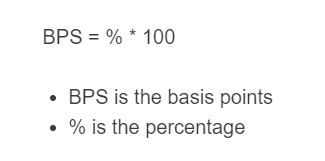
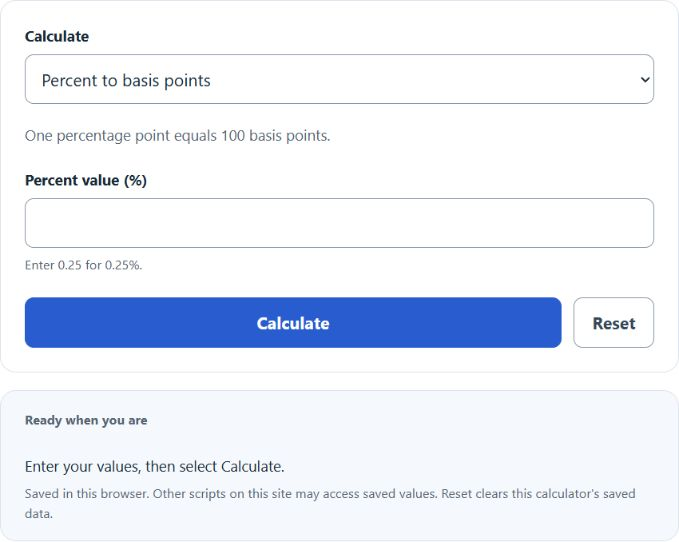
The percent to basis points function multiplies the percent value by 100. For example, 0.25% becomes 25 basis points.
The basis points to percent function divides the basis points value by 100. For example, 50 basis points becomes 0.50%.
The rate change function subtracts the starting rate from the ending rate, then converts that percentage-point difference into basis points. A positive result is an increase, and a negative result is a decrease.
Common Basis Point Conversions
| Basis points | Percent | Decimal |
|---|---|---|
| 1 bps | 0.01% | 0.0001 |
| 5 bps | 0.05% | 0.0005 |
| 10 bps | 0.10% | 0.0010 |
| 25 bps | 0.25% | 0.0025 |
| 50 bps | 0.50% | 0.0050 |
| 75 bps | 0.75% | 0.0075 |
| 100 bps | 1.00% | 0.0100 |
Typical Rate Change Meanings
| Rate change | Basis points | Common wording |
|---|---|---|
| 0.10 percentage points | 10 bps | Ten basis points |
| 0.25 percentage points | 25 bps | Quarter-point move |
| 0.50 percentage points | 50 bps | Half-point move |
| 0.75 percentage points | 75 bps | Three-quarter-point move |
| 1.00 percentage point | 100 bps | One full percentage point |
Example Calculations
Example 1: Convert percent to basis points
You want to convert 0.25% to basis points.
So, 0.25% equals 25 basis points.
Example 2: Find the change between two rates
A rate moves from 5.00% to 5.25%.
The rate increased by 25 basis points, which is a 0.25 percentage-point increase.
FAQs
How many basis points are in 1%?
There are 100 basis points in 1%. Since 1 basis point equals 0.01%, you multiply a percent by 100 to convert it to basis points.
Is a basis point the same as a percentage point?
No. A basis point is smaller than a percentage point. One percentage point equals 100 basis points. For example, a move from 4% to 5% is a 1 percentage-point increase, or 100 basis points.
What does a negative basis point change mean?
A negative basis point change means the rate went down. For example, if a rate falls from 6.00% to 5.75%, the change is -25 basis points.