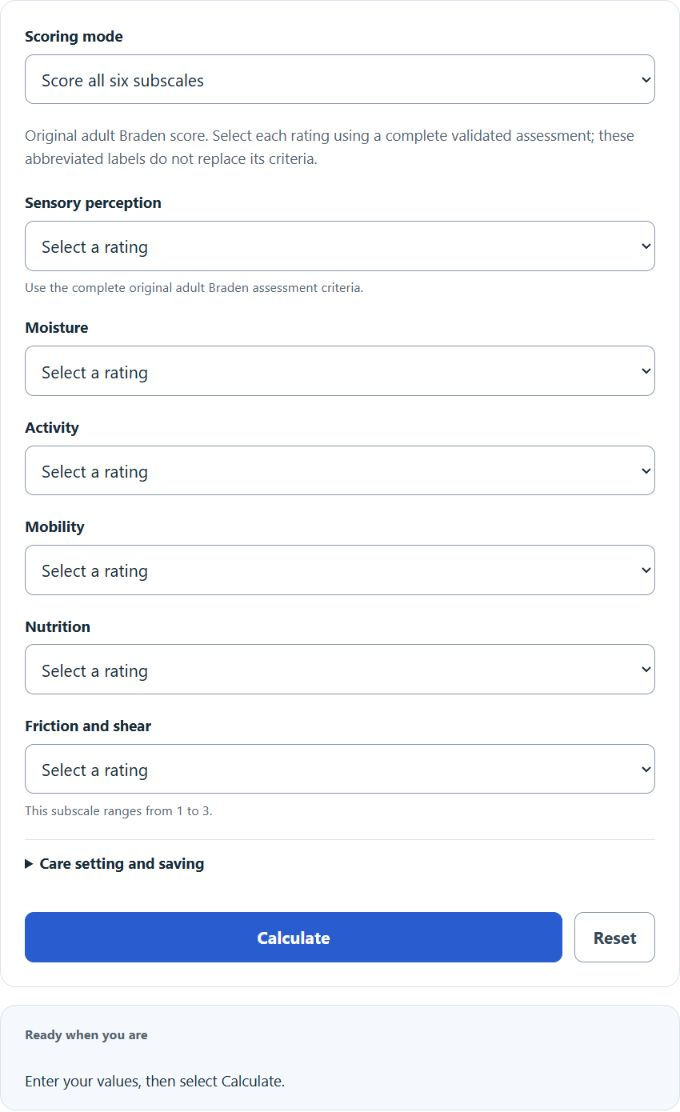
Add the six original adult Braden subscale scores or interpret an existing total. Review conventional screening bands and low subscales with a complete clinical assessment. This tool is not the revised Braden Scale II and its abbreviated labels do not replace the full assessment criteria.
Braden Scale Formula
The Braden Scale total is the sum of six subscale scores. You rate each factor by direct observation of the patient, then add the ratings together:
Braden Score = Sensory + Moisture + Activity + Mobility + Nutrition + Friction/Shear
Variables:
- Sensory perception, rated 1 to 4: the ability to feel and respond to pressure-related discomfort
- Moisture, rated 1 to 4: how often the skin is exposed to moisture
- Activity, rated 1 to 4: the degree of physical activity
- Mobility, rated 1 to 4: the ability to change and control body position
- Nutrition, rated 1 to 4: the usual food intake pattern
- Friction and shear, rated 1 to 3: how much the skin drags against surfaces during moves
The total ranges from 6 to 23. A lower total means higher risk, because low ratings pile up on the factors that expose skin to unrelieved pressure. Five subscales top out at 4 and the friction and shear subscale tops out at 3, which is why the maximum is 23 rather than 24.
The calculator runs in two modes. In “Score all six subscales” you rate each factor and the tool adds them into a total, grades the risk, and flags any subscale scoring 1 or 2 so you can see which factors are driving the score. In “Interpret a known total score” you enter a total from 6 to 23 and the tool returns the matching risk level. The optional care setting gives reassessment context under clinical and local policy; it does not change the score. Scores are saved for up to 24 hours only when you explicitly choose local saving. Other scripts on this site may access saved scores; Reset removes this calculator’s saved data.
Braden Score Risk Levels and Prevention Focus
These are conventional original adult Braden screening bands. AHRQ generally uses a total of 18 or below to indicate risk, with thresholds adapted to the population and local policy. A score above 18 does not rule out individual risk factors or replace skin assessment.
| Total score | Risk level | Prevention focus |
|---|---|---|
| 19 to 23 | Lower risk by total; individual risk remains possible | Review skin findings and individual risk factors; reassess under the care plan |
| 15 to 18 | Mild risk | Start a prevention plan and reposition regularly |
| 13 to 14 | Moderate risk | Review an individualized repositioning plan, support surface, moisture and nutrition |
| 10 to 12 | High risk | Review repositioning, pressure redistribution and heel offloading with the care team |
| 6 to 9 | Very high risk | Prompt comprehensive clinical assessment and individualized prevention |
Low subscales identify issues for clinical review. A score of 1 or 2 is highlighted here as a review aid, not as an automatic treatment rule. The appropriate action depends on the full assessment, support surface, comfort and clinical needs.
| Subscale | What a score of 1 or 2 points to | Topics for individualized clinical review |
|---|---|---|
| Sensory perception | Cannot feel or report pressure | Scheduled repositioning and frequent skin checks |
| Moisture | Skin is often damp | Barrier cream, absorbent pads, prompt cleansing |
| Activity | Bed or chair bound | Support surface, cushion, and an out-of-bed plan |
| Mobility | Cannot shift position without help | Individualized assistance with position changes and pressure offloading |
| Nutrition | Poor food and protein intake | Qualified nutritional assessment and an appropriate nutrition plan |
| Friction and shear | Slides or drags on the sheets | Safe handling and shear reduction, heel protection and clinically appropriate positioning |
Example Problems
Example 1: score all six subscales.
You rate a patient sensory 2, moisture 3, activity 2, mobility 2, nutrition 3, and friction 2. Add them: 2 + 3 + 2 + 2 + 3 + 2 = 14, which falls in the 13 to 14 band, so the result is moderate risk. Four subscales scored 2, so the calculator flags sensory perception, activity, mobility, and friction as the factors to target first with repositioning and a support surface.
Example 2: interpret a known total.
You already scored a patient at 12 during rounds. Switch to “Interpret a known total score” and enter 12. A total of 12 sits in the 10 to 12 band, so the result is high risk. A clinician should review skin findings, individual risk factors and an appropriate prevention plan.
Frequently Asked Questions
What is a good Braden Scale score?
Lower totals indicate greater risk in the original adult Braden scale: 6–9 very high, 10–12 high, 13–14 moderate and 15–18 mild. A total of 19–23 is above the commonly used risk cutoff, but does not guarantee freedom from pressure injury. Review all subscales, skin findings and clinical factors.
How often should you reassess the Braden Scale?
Assess promptly on admission or first contact, then periodically and after condition or treatment changes under clinical and local policy. AHRQ suggests acute-care assessment on admission, then daily or after significant condition change, with more frequent assessment when needed. Current international guidance individualizes reassessment and repositioning rather than imposing a universal turning interval or head-of-bed angle.
Why look at the subscales instead of just the total?
The total tells you the overall level of risk, but two patients with the same total can need very different care. A patient can have a reassuring total and still have one very low subscale, such as constant moisture or poor nutrition, that drives a pressure injury on its own. Studies of critical-care patients have found that certain subscale patterns predict injuries even when the total looks moderate, which is why this calculator flags any subscale scoring 1 or 2 rather than stopping at the sum.
Sources: AHRQ risk assessment; AHRQ individualized care planning; LOINC original Braden score bands; International Guideline risk assessment; individualized repositioning guidance.