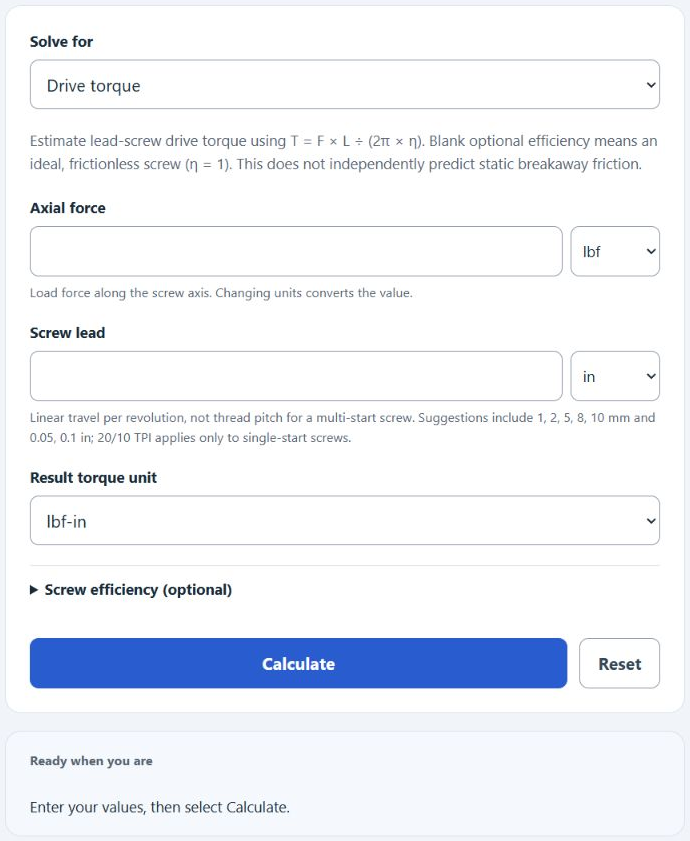
Choose drive torque, axial force, screw lead or efficiency, then enter the displayed values. This lead-screw model estimates rotary-to-linear drive torque; actual static breakaway torque may require additional friction and drag data.
Breakaway Torque Formula
The following example problem outlines the steps and information needed to calculate the Breakaway Torque.
Note: The formula above is the ideal (100% efficient, frictionless) lead screw relationship based on work per revolution, where SL is the screw lead (linear travel per revolution). For a more realistic estimate that accounts for friction and other losses, include an overall efficiency factor η (greater than 0 and at most 1). Blank optional efficiency uses 1. This does not separately account for bearing/nut drag, inertia or static starting friction:
Variables:
- BT is the estimated screw drive torque (lbf-in)
- BF is the axial load force (lbf)
- SL is the screw lead (in)
- η is the overall screw efficiency (unitless, greater than 0 and at most 1)
To calculate a breakaway torque (ideal), multiply the breakaway force by the screw lead, then divide by 2 times pi. To include losses, divide by (2π × η) instead.
How to Calculate Breakaway Torque?
The following steps outline how to calculate the Breakaway Torque.
- First, determine the breakaway force (lbf).
- Next, determine the screw lead (in).
- Next, gather the formula from above = BT = BF * SL / (2*pi).
- Select Drive torque, enter the force and lead, optionally enter a verified screw efficiency, then select Calculate.
- After inserting the variables and calculating the result, check your answer with the calculator above.
Example Problem :
Use the following variables as an example problem to test your knowledge.
breakaway force (lbf) = 300
screw lead (in) = 5
BT = BF * SL / (2*pi) = ?
BT = (300 × 5) / (2π) = 1500 / 6.283185… ≈ 238.7324 lbf-in